Clear Sky Science · en
Interactions of SARS-CoV-2, influenza and respiratory syncytial virus influence epidemic timing and risk
Why virus clashes matter to everyday life
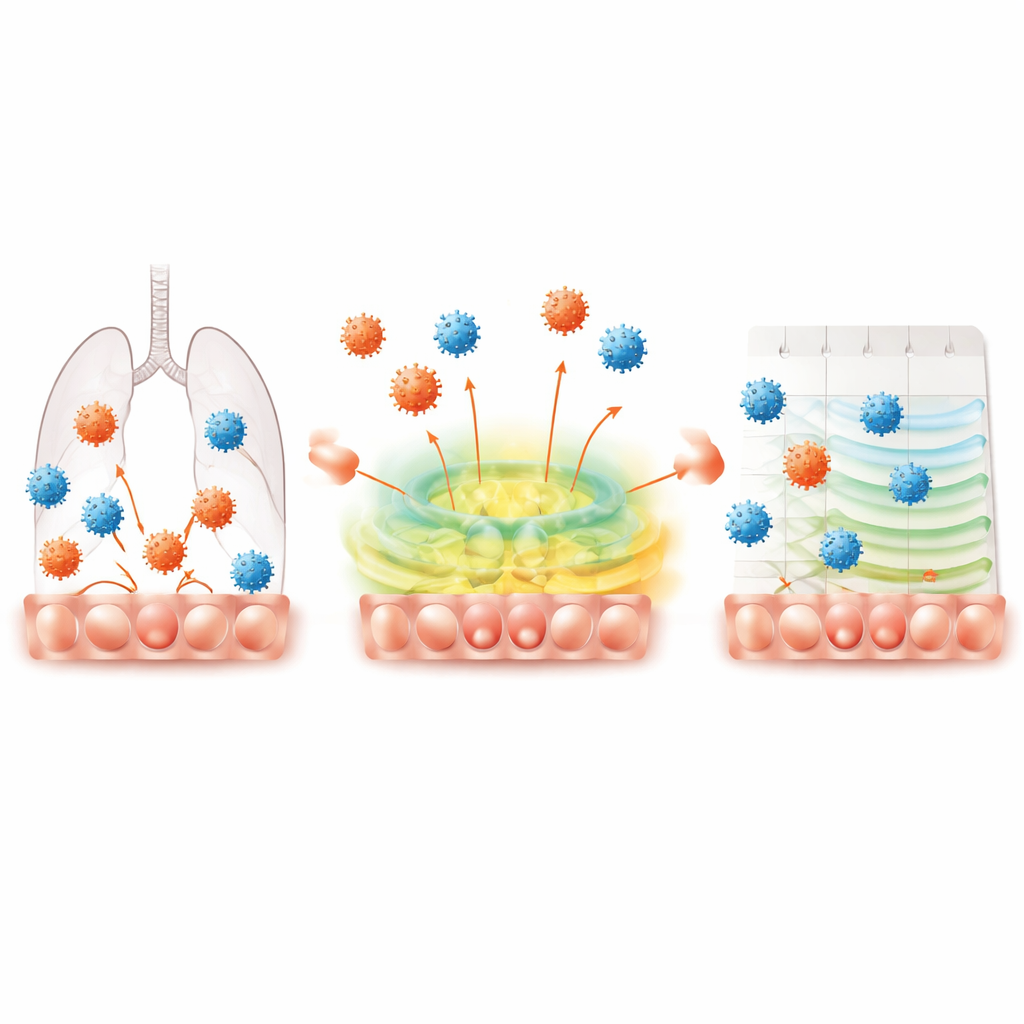
Every winter, headlines warn of a possible “tripledemic” of COVID-19, flu, and other respiratory bugs hitting all at once. This study asks a surprisingly practical question: when these viruses circulate together, do they help or hinder one another? By mining three years of surveillance data from several countries and building detailed computer simulations, the researchers show that waves of influenza A can temporarily blunt the spread of SARS-CoV-2, the virus that causes COVID-19. Understanding this hidden tug‑of‑war could improve how we forecast outbreaks, time vaccination campaigns, and prepare hospitals.
Watching winter waves around the world
The team gathered weekly test data for four major respiratory viruses—SARS-CoV-2, influenza A and B, and respiratory syncytial virus (RSV)—from England, Denmark, Ireland, Portugal, Slovenia, ten regions of the United States, and Beijing. For each place, they tracked the share of lab samples that tested positive, then adjusted the figures so they could be compared despite differences in health systems and testing practices. They also pulled in information on COVID control policies, circulating variants of SARS-CoV-2, weather, and social and economic conditions, all of which can influence how easily infections spread. This broad view allowed them to see not only when each virus surged, but also how the timing of one virus’s ups and downs lined up with another’s.

Finding hidden links between viral surges
To tease out these links, the researchers used a statistical approach that looks at how levels of one virus at a given time are related to the risk of another virus in the weeks that follow. After controlling for season, weather, public health measures, and prior immunity, one pattern clearly stood out. When influenza A activity reached moderate to high levels—roughly the middle range of its usual upswing—the risk of SARS-CoV-2 infections in the following month dropped. The largest dip was seen about five weeks later, when the relative risk of COVID-19 was roughly cut in half compared with times when flu levels were very low. Beyond very high flu activity, this protective effect weakened. For other virus pairs, such as COVID‑19 with RSV, the study did not find convincing evidence of a consistent link, highlighting that not all respiratory viruses interfere with one another in the same way.
Zooming in on the flu–COVID interaction
Statistical patterns alone cannot prove cause and effect, so the team built a mechanistic model—essentially a virtual population in which people can move between states such as “susceptible,” “infected,” “temporarily protected,” and “recovered” for both influenza A and SARS-CoV-2. They calibrated this model with detailed incidence estimates from Beijing between early 2023 and mid‑2024, a period when both viruses were circulating after strict COVID-19 controls were lifted. The best‑fitting model suggested that catching influenza A makes a person much less likely—about 94% less likely—for several weeks to get infected with SARS-CoV-2. This temporary shield lasted a little over a month. In contrast, having COVID-19 slightly increased, or at least did not meaningfully reduce, the chance of catching influenza A, and that effect faded within a few days.
How this tug-of-war shapes epidemic peaks
The researchers then asked what the COVID-19 waves in Beijing might have looked like if influenza A had not dampened SARS-CoV-2 transmission. In simulations where this interaction was removed, COVID-19 surges came earlier and were much larger. A summer 2023 wave peaked about two weeks sooner and more than doubled in size, while a winter 2024 wave arrived roughly six weeks earlier with more than triple the peak infections. These findings suggest that flu circulation can delay and flatten COVID-19 peaks, easing pressure on hospitals. At the same time, a weaker positive association between influenza A and RSV hinted that some viruses might amplify each other instead of competing, although the mechanisms remain uncertain.
What this means for future winters
Overall, the study concludes that influenza A circulation can temporarily reduce the risk of SARS-CoV-2 infection at the population level, most strongly when flu activity is in a middle range and for a window of several weeks. This protection may arise from the body’s broad antiviral defenses after flu infection, from competition between viruses for the same hosts, or from changes in people’s behavior during flu season. Whatever the mix of causes, the message is clear: respiratory viruses do not act alone. Factoring their interactions into outbreak forecasts and vaccination planning could help health officials better time COVID-19 and flu campaigns, anticipate hospital strain, and prepare for seasons when several viruses are likely to collide.
Citation: Liu, Y., Wang, X., Li, M. et al. Interactions of SARS-CoV-2, influenza and respiratory syncytial virus influence epidemic timing and risk. Commun Med 6, 259 (2026). https://doi.org/10.1038/s43856-026-01504-x
Keywords: respiratory viruses, influenza and COVID-19, viral interference, epidemic timing, co-epidemics