Clear Sky Science · en
Enhanced extremes without intensification of South America’s water cycle from 1980 to 2010
Why this matters for people and rivers
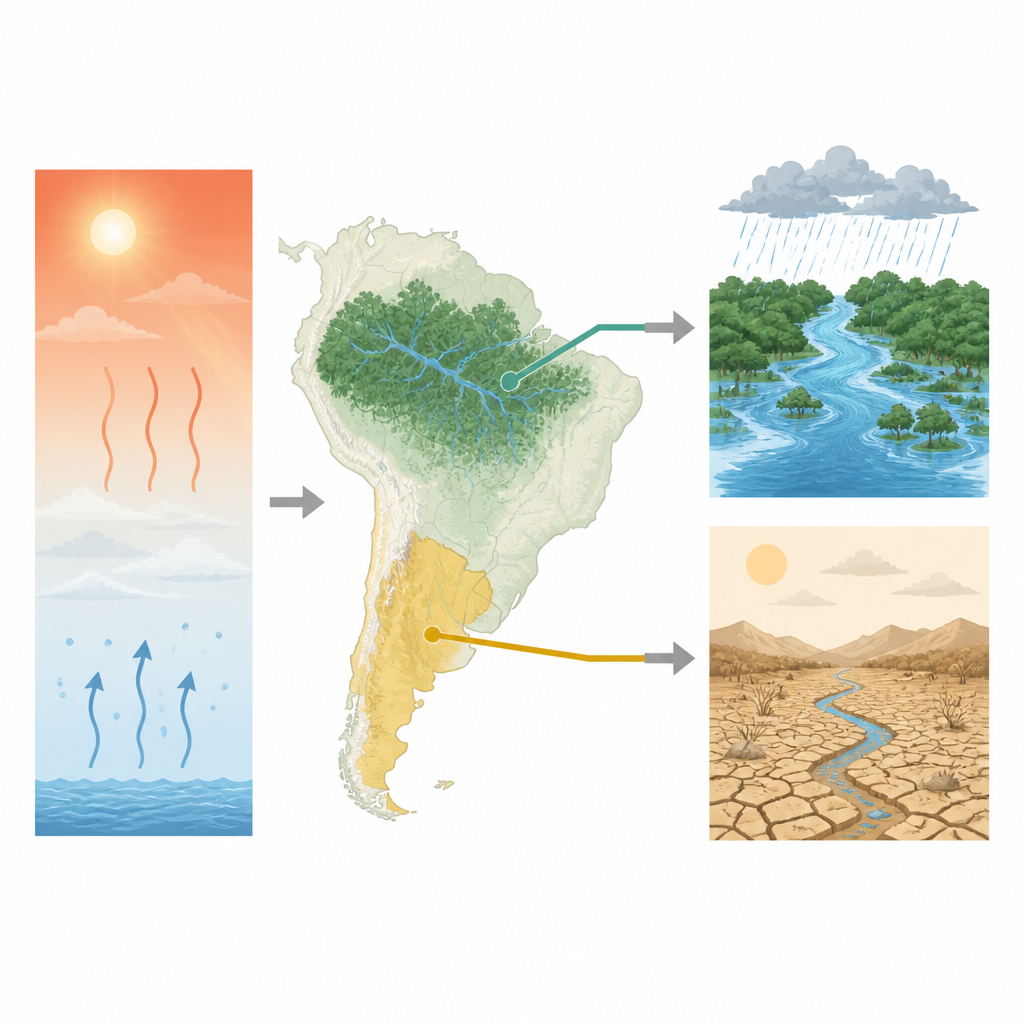
South America holds some of the largest river systems on Earth, including the Amazon and La Plata, which support drinking water, food production, transport and energy for hundreds of millions of people. Many expect that a warmer climate will automatically speed up the water cycle everywhere, with more rain, more evaporation and more river flow. This study tests that idea for South America between 1980 and 2010, using several independent datasets, and finds a more subtle and uneven story: average water flows have not intensified continent-wide, yet floods and droughts have become more extreme in key regions.
Checking many views of the same water story
The researchers combined four major global datasets that describe rainfall, river runoff, evaporation from land and vegetation, and changes in water stored on land. Some are built directly from ground measurements, while others rely on computer models and weather reanalysis. They focused on 95 river catchments spread across South America, including large parts of the Amazon and La Plata basins. By treating each catchment as a natural accounting unit, they checked whether the incoming water from rain could be balanced by the outgoing water through river flow and evaporation, and any change in stored water.
Average water flows are not speeding up
Across the whole continent, all datasets agreed that air temperatures rose between 1980 and 2010. However, for the main water flows on land, most datasets showed no significant trend in average yearly rainfall, river runoff or evaporation. That means the overall land water cycle in South America did not clearly speed up or slow down during these three decades, despite warming. One widely used model dataset, ERA5, did suggest a weakening water cycle and a steady loss of stored water, but this pattern conflicted with the other datasets and with basic water balance checks, indicating that its land water estimates are unreliable in this context.
Hidden shifts in seasons and extremes
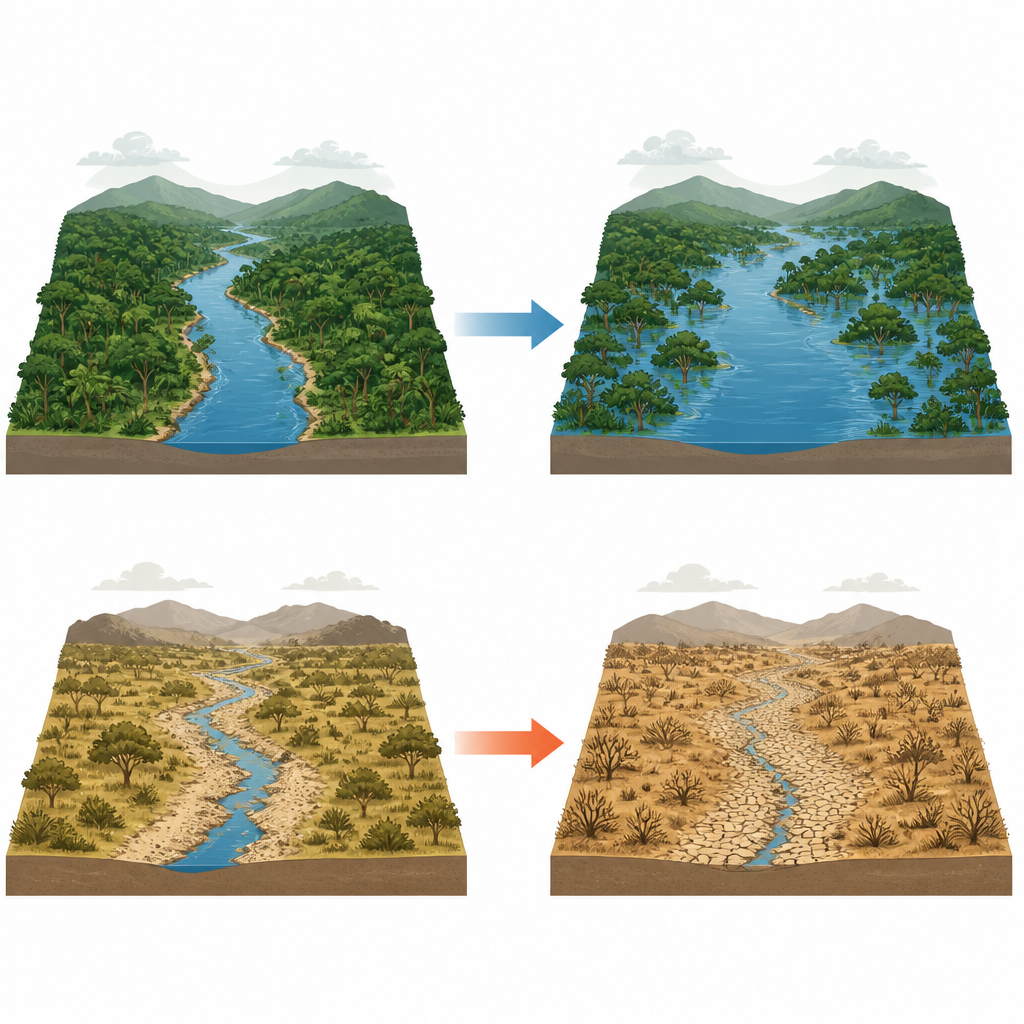
When the authors looked beyond annual averages and zoomed in on seasons and extremes, a different picture emerged. They compared the first half of the period (1980–1994) with the second (1995–2010). In the Amazon Basin, several datasets showed higher wet-season rainfall and river flows, especially in the highest monthly flows. This points to greater flood risk during the rainy season. In the La Plata Basin farther south, the driest-season months saw lower typical river flows and lower extreme low flows, even though average yearly rainfall and evaporation did not change much. This means drought risk increased, with rivers running lower for longer during the dry season.
Local complexity behind simple maps
The study also explored how local river and evaporation changes relate to shifts in rainfall and temperature. Across individual catchments, average runoff and evaporation were strongly tied to how wet the climate was, but changes over time were more loosely connected. Human activities such as deforestation, farming, and water regulation can alter how much rain becomes river flow versus how much returns to the air, and these effects vary from place to place. The findings show that simple, uniform expectations about how rivers should respond to warming can miss this local diversity and the role of people in shaping water flows.
What this means for future water risks
Overall, the work shows that South America’s land water cycle has not uniformly intensified with warming, even as the continent has become hotter. Instead, seasonal patterns and the tails of the distribution have shifted: the Amazon faces stronger wet-season floods, while the La Plata region faces deeper dry-season droughts. For people living in these basins, this means greater exposure to extremes without a clear change in average yearly water supply. The authors argue that future planning and research must rely on multiple datasets, strict water balance checks and better observations, so that water managers can prepare for a world where extremes grow sharper even when averages stay nearly the same.
Citation: Zarei, M., Destouni, G. Enhanced extremes without intensification of South America’s water cycle from 1980 to 2010. Commun Earth Environ 7, 454 (2026). https://doi.org/10.1038/s43247-026-03661-2
Keywords: South America water cycle, Amazon Basin floods, La Plata Basin drought, hydroclimate extremes, climate change impacts