Clear Sky Science · en
Antarctic sea-ice loss shifts the Pacific Decadal Oscillation toward a positive phase
Why shrinking Antarctic sea ice matters far away
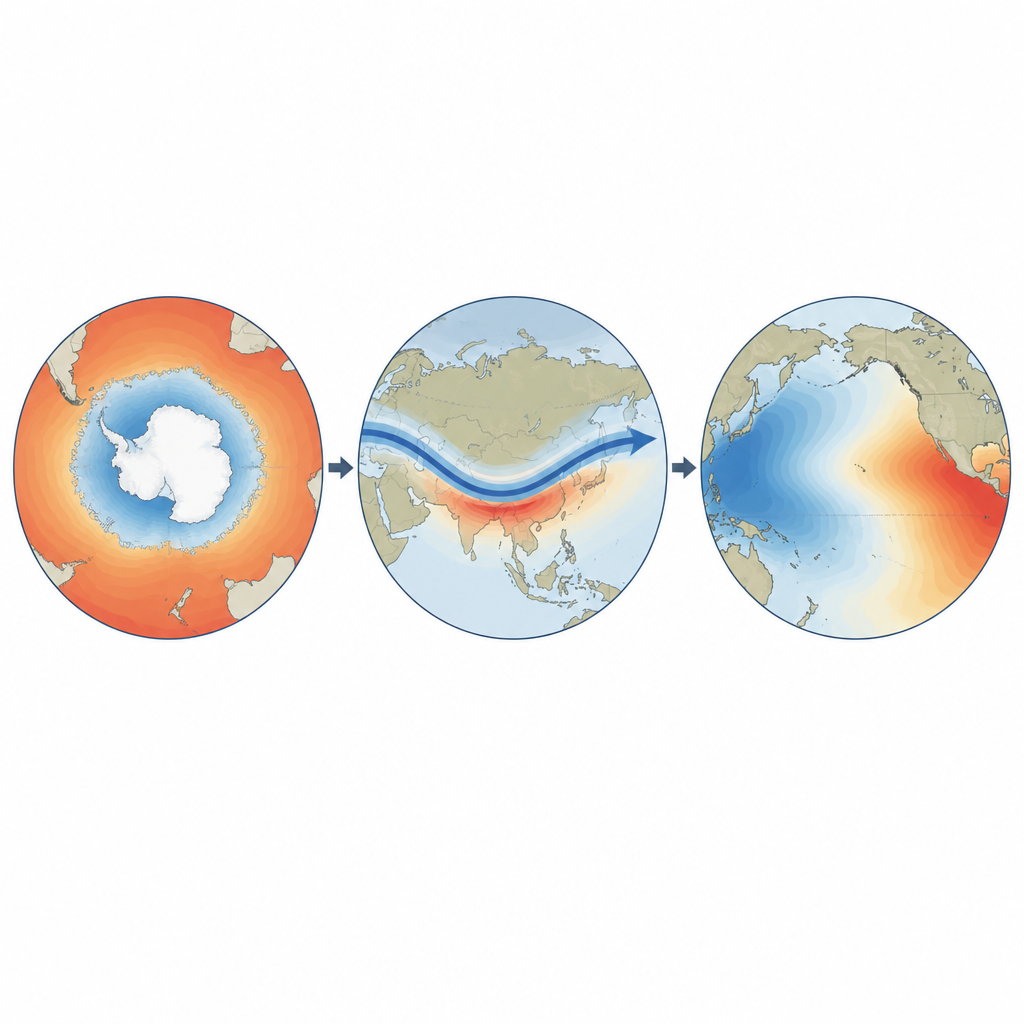
Most people think of Antarctic sea ice as a distant white fringe at the bottom of the globe. This study shows that when that icy ring shrinks, it can help reshape ocean temperatures thousands of miles away in the North Pacific. Those slow shifts, known as the Pacific Decadal Oscillation, are linked to changes in storms, rainfall, and heat waves around the Pacific Rim, meaning what happens near Antarctica can subtly influence weather patterns in places like North America and East Asia over decades.
A slow push toward a warmer Pacific pattern
The researchers used two state of the art climate models and ran paired experiments for 100 years. In one set, the models ran with unaltered sea ice; in the other, the reflective surface of Antarctic sea ice was artificially darkened so it absorbed more sunlight and melted more easily. This approach let the team isolate the specific role of Antarctic sea ice loss, without changing greenhouse gases or other factors. By comparing several runs of each experiment, they could separate the consistent climate response from random year to year fluctuations.
From a warmer Southern Ocean to a tilted climate
When Antarctic sea ice shrank in the experiments, the surrounding Southern Ocean warmed. That extra warmth did not stay local: it spread into the Southern Hemisphere tropics and into the Indian and Atlantic Oceans, creating an imbalance where the Southern Hemisphere became slightly warmer than the Northern Hemisphere across key ocean regions. This cross equatorial temperature contrast altered how heat is carried by winds and rising and sinking air, nudging the entire belt of tropical and subtropical circulation northward in some places and southward in others.
A shifted jet stream links Antarctica to the North Pacific
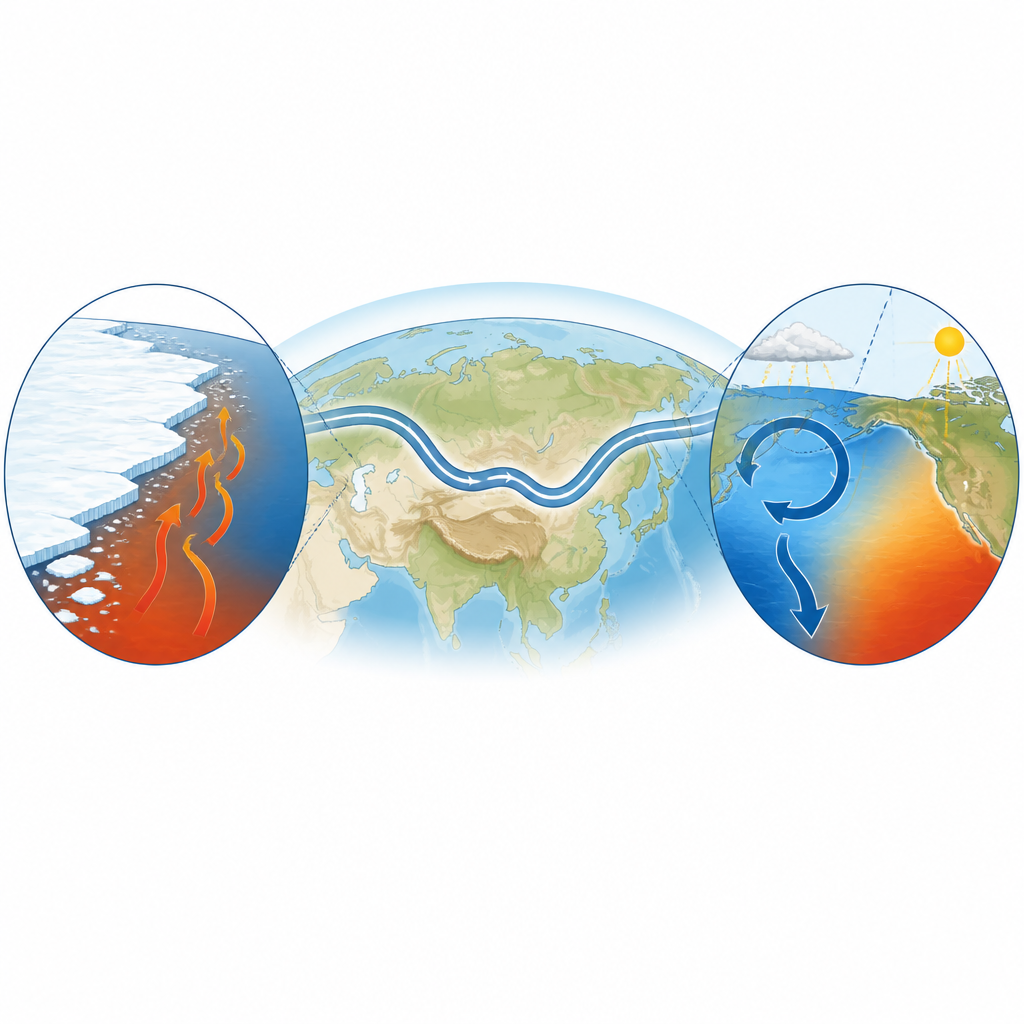
One of the most important changes occurred over Asia. The studies found that the strong west to east high altitude winds, known as the Asian jet, shifted southward and strengthened on its equatorward side. As this jet moved so that it crossed more directly over the high terrain of the Tibetan Plateau, it generated a broad low pressure area and cyclonic winds over the western North Pacific. Those winds pulled colder surface waters southward from higher latitudes and increased cloud cover, cutting down the sunlight that reached the ocean. Together, these processes cooled the western and central North Pacific while allowing the eastern and subpolar Pacific to warm.
A long lasting fingerprint in the Pacific
The resulting pattern of cooler water in the western North Pacific and warmer water in the eastern and northern Pacific closely resembled the positive phase of the Pacific Decadal Oscillation. In one model, this pattern emerged within a few years; in the other, it took almost two decades to fully form, depending on how quickly the cross equatorial temperature contrast and jet shift developed. Even when the long term average state of the tropical Pacific differed among model runs, the North Pacific still tended to settle into this positive PDO like configuration, showing that the extratropical ocean response did not always depend on a particular El Niño or La Niña type background.
What this means for future climate
For a lay audience, the main lesson is that Antarctic sea ice is part of a global web. The study suggests that continued Antarctic sea ice decline can help nudge the Pacific Decadal Oscillation toward its positive phase, a mode of slow ocean change that influences rainfall and storm tracks around the Pacific Basin. The authors do not claim that sea ice loss is the only factor, nor that a rapid switch is guaranteed, but their results highlight Antarctic sea ice as an active player rather than a passive victim. As record low Antarctic sea ice years become more common, this distant connection may become increasingly important for understanding how regional climates evolve over the coming decades.
Citation: Jeong, H., Park, HS., Yeh, SW. et al. Antarctic sea-ice loss shifts the Pacific Decadal Oscillation toward a positive phase. Commun Earth Environ 7, 432 (2026). https://doi.org/10.1038/s43247-026-03489-w
Keywords: Antarctic sea ice, Pacific Decadal Oscillation, Southern Ocean warming, jet stream shift, climate teleconnection