Clear Sky Science · en
Expert elicitation on agricultural enhanced weathering reveals carbon dioxide removal potential and uncertainties in loss pathways
Why Rocks on Farms Matter for the Climate
Slowing climate change will require not only cutting emissions but also pulling large amounts of carbon dioxide out of the air. One emerging idea is to spread certain types of crushed rock on farm fields so that natural chemical reactions lock away carbon for centuries. This paper asks a deceptively simple question: if we deployed this “enhanced weathering” approach widely in agriculture, how much carbon could it really remove, and how sure are we about those numbers?
Turning a Natural Process into a Climate Tool
In nature, rainwater and weak acids slowly dissolve rocks, consuming carbon dioxide and ultimately delivering it to the ocean, where it can be stored for very long times. Enhanced weathering tries to speed this up by grinding rock into fine particles and applying it to soils, especially croplands. The authors focus on six candidate materials: traditional agricultural lime, volcanic basalt, olivine-rich and wollastonite-rich rocks, and two industrial by-products, steel slag and crushed concrete. Each material behaves differently—some dissolve quickly, some more slowly, and some may introduce unwanted metals—so their climate value is not straightforward to compare.
Asking the Experts
Because field data are still sparse and scattered, the researchers used a formal expert elicitation process rather than building yet another model from limited numbers. They carefully screened and recruited 20 scientists working on soils, rivers, oceans, and carbon cycling, excluding anyone with financial ties to commercial enhanced weathering projects. These experts were asked to estimate the global carbon removal potential for each rock type, including emissions from mining, grinding, and transport, as well as side effects like changes in nitrous oxide from soils. They also estimated how efficiently carbon would move from a treated field, through deep soils, rivers, and coasts, into the open ocean where it could remain stored for at least a century.
How Much Carbon Could Be Removed?
The experts’ answers paint a picture of both promise and caution. On a global scale, they judged that agricultural enhanced weathering could likely remove about 0.2 to 0.7 billion tons of carbon dioxide per year, depending on which rock is used—less than many earlier model-based estimates, which often assumed ideal conditions. Importantly, some experts thought certain feedstocks, such as lime, basalt, or olivine, could actually become net sources of greenhouse gases if upstream emissions were high or if downstream losses of carbon back to the air were larger than expected. Basalt and lime emerged as the most promising overall, but the range of estimates was wide and confidence levels only moderate. In short, the technology looks helpful, but not a silver bullet on its own.
Following Carbon from Field to Ocean
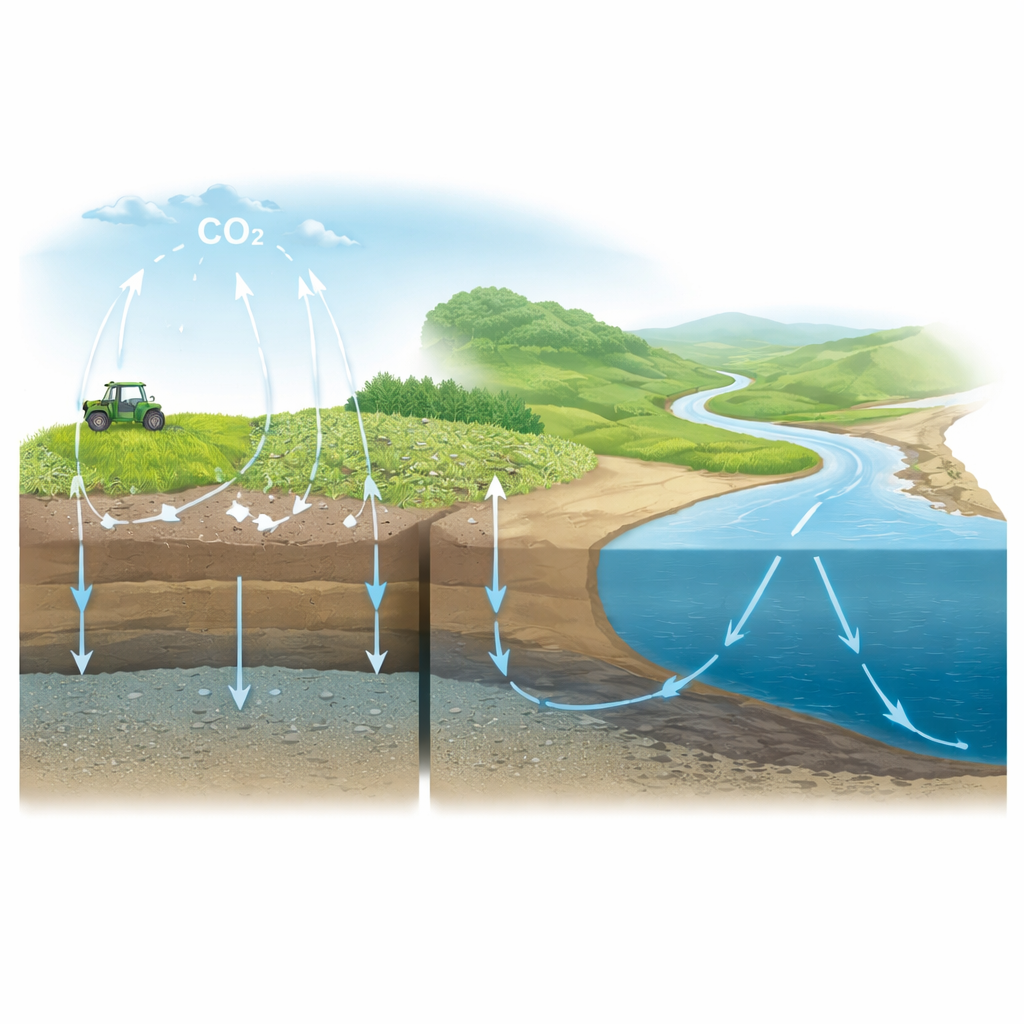
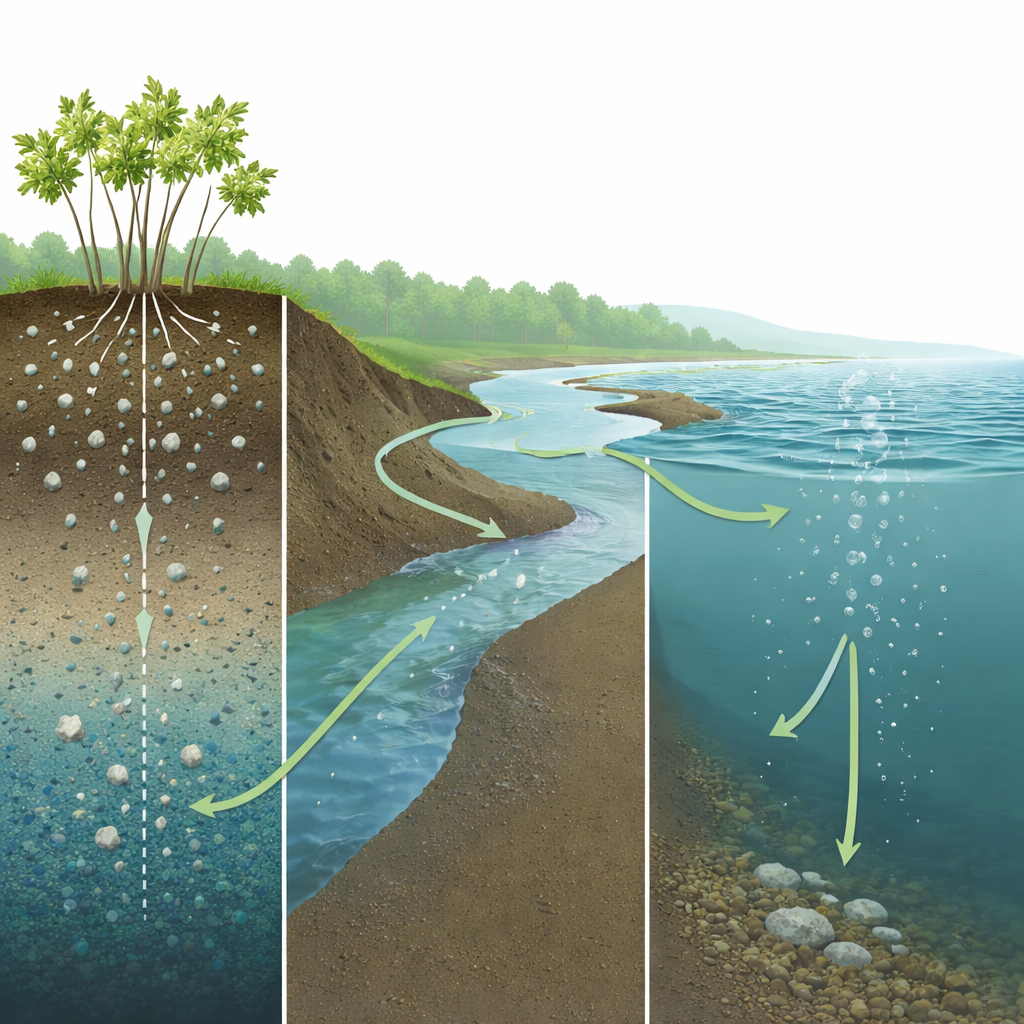
Zooming in on a typical Midwestern U.S. farm with slightly acidic loamy soil, the team asked how much of a hypothetical ten tons of carbon fixed by weathering in the field would ultimately end up as durable storage in the ocean. Across all six materials, experts thought only about one-third of that carbon—roughly 27 to 39 percent—would make it all the way. Losses were expected to be largest in the early stages: in the field itself, where non-ideal chemical reactions or formation of new minerals can release carbon back to the air, and in deeper soils, where slow water movement and secondary mineral formation can trap or re-release carbon. As carbon-bearing water moves into rivers, coasts, and finally the open ocean, the experts’ estimated efficiencies increased, but they also highlighted poorly understood processes like carbon dioxide exchange at the water surface and changing ocean chemistry with depth.
Risks, Uncertainties, and Data Gaps
The study also probed health and environmental risks and the reliability of our measurements. Agricultural lime, already used at large scale, was seen as relatively low risk, while olivine, steel slag, and concrete raised more concern at the field stage because of potential heavy metals or other contaminants. Downstream, perceived risks generally declined. Perhaps most striking, experts estimated that current measurement error for enhanced weathering is roughly as large as the carbon removal signal itself—about 100 percent uncertainty at many stages. They called out deep soils, rivers, estuaries, and nearshore oceans as the biggest blind spots, and emphasized the need for long-term field trials and better tracking of how dissolved materials move from farms all the way to the deep ocean.
What This Means for Climate Solutions
For a non-specialist, the takeaway is that spreading crushed rock on fields is neither magic nor mirage. The expert panel believes agricultural enhanced weathering probably does remove carbon overall, and could contribute meaningfully alongside other strategies, while also offering farm benefits like higher soil pH and potentially better yields. But only a fraction of the theoretical carbon removal is likely to be realized in practice, and the exact fraction is still very uncertain. To use this method responsibly—especially if it is tied to carbon credits—we need more real-world measurements from field to ocean, clear rules for counting both gains and losses, and careful attention to side effects on soils, water, and health. Enhanced weathering belongs in the climate toolkit, the authors conclude, but only if society invests in closing the knowledge gaps that currently surround it.
Citation: Buma, B., Dietzen, C., Gordon, D.R. et al. Expert elicitation on agricultural enhanced weathering reveals carbon dioxide removal potential and uncertainties in loss pathways. Commun Earth Environ 7, 376 (2026). https://doi.org/10.1038/s43247-026-03375-5
Keywords: enhanced weathering, agricultural soils, carbon dioxide removal, rock amendments, climate mitigation