Clear Sky Science · en
South American fire activity in spring is linked to Antarctic sea ice variability
Why polar ice matters for distant wildfires
When we think about South American wildfires, we usually picture local heat, drought, and human activity. This study reveals a surprising extra player: the sea ice fringing Antarctica, thousands of kilometers away. The researchers show that year-to-year changes in Antarctic sea ice, especially near the Antarctic Peninsula, can help set the stage for dangerous fire weather over east‑central South America during spring. This hidden polar connection adds an unexpected twist to how we understand and anticipate wildfire risk in a warming world. 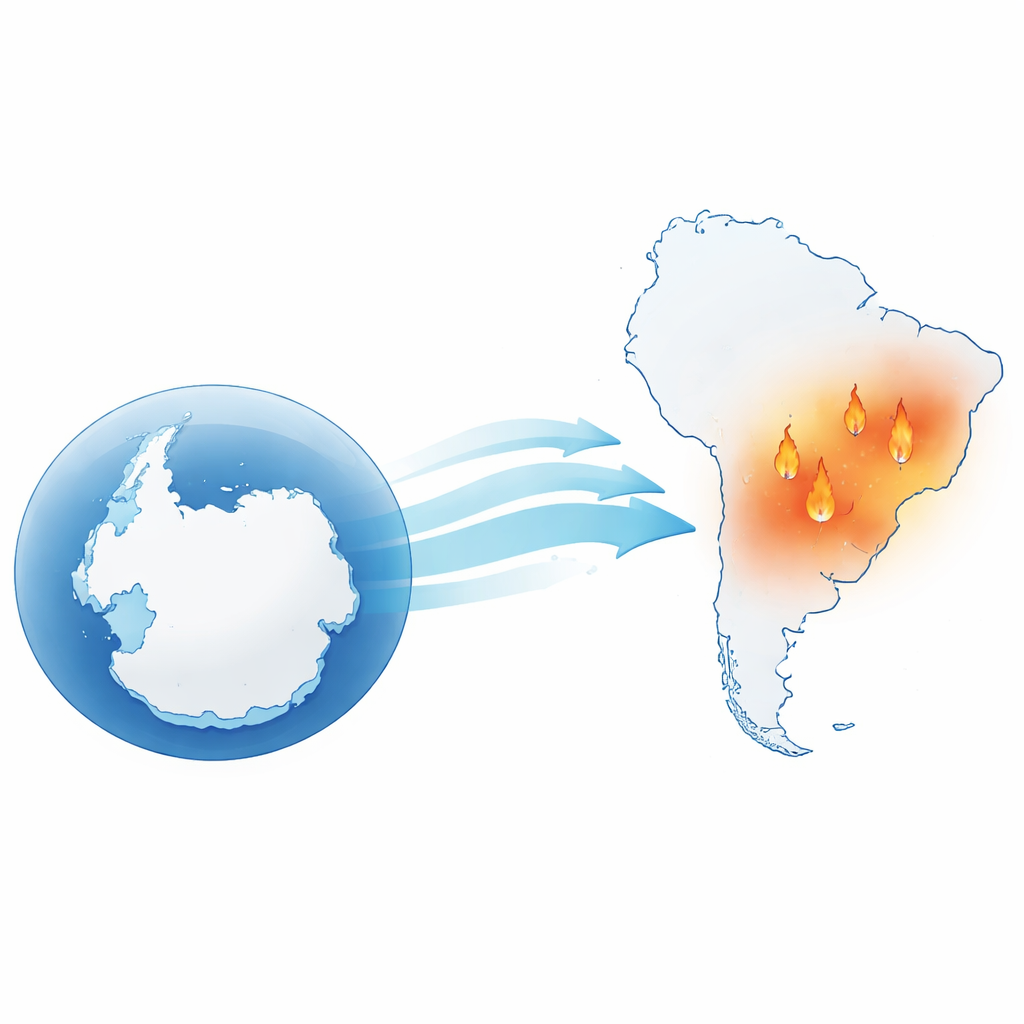
Fire hotspots and a changing climate
South America has become one of the world’s most worrisome wildfire hotspots. Recent crises in the Amazon and the Pantanal have underscored how warming and drying trends are making forests and savannas more flammable. The team examined several indicators of fire activity: indexes that describe how hot, dry, and windy the weather is for burning, satellite maps of burned area, and estimates of the carbon released by fires. All of these show that east‑central South America, including parts of Brazil’s savannas and surrounding regions, consistently experiences intense and highly seasonal fire activity, peaking from late winter into spring.
A distant signal from Antarctic sea ice
To look for remote influences on this fire hotspot, the authors compared satellite records of Antarctic sea ice with South American fire indicators over several decades. Using statistical methods that find linked patterns in two different datasets, they discovered a strong connection in September, the height of the fire season. In years when sea ice is more extensive near the Antarctic Peninsula, fire‑favorable weather—hotter, drier, and windier conditions—tends to intensify over east‑central South America. This relationship shows up consistently across different fire measures and remains robust even after removing long‑term warming trends and known tropical climate influences such as El Niño.
How polar ice reshapes the air above South America
The key question is how extra sea ice near Antarctica can affect weather thousands of kilometers away. The study finds that when sea ice expands around the Antarctic Peninsula, it changes how heat moves between the ocean and the atmosphere, sharpening the temperature contrast between ice‑covered and open water. This sharper contrast fuels more energetic storms along the belt of low‑pressure systems circling the Southern Hemisphere. These storm changes, in turn, nudge the large‑scale wind patterns so that a broad region of high pressure settles over east‑central South America. Under this high‑pressure cap, air tends to sink, clouds thin, sunshine increases, and the surface warms while humidity and rainfall drop—precisely the combination that dries out vegetation and helps fires ignite and spread.
Testing the link with computer experiments
To move beyond statistical links and test cause and effect, the researchers used a state‑of‑the‑art atmospheric computer model. In one set of simulations, the model atmosphere was given typical ocean conditions. In another, they added realistic sea‑ice changes near the Antarctic Peninsula, based on the observed pattern linked to fires. The model responded by producing a stronger high‑pressure system over east‑central South America, with warmer, drier, and windier weather similar to what is seen in the real world. When the scientists computed the same fire‑weather index used operationally in Europe, they found it increased over the South American fire hotspot in the sea‑ice‑perturbed runs, supporting a physical link from Antarctic ice to fire‑favorable weather. 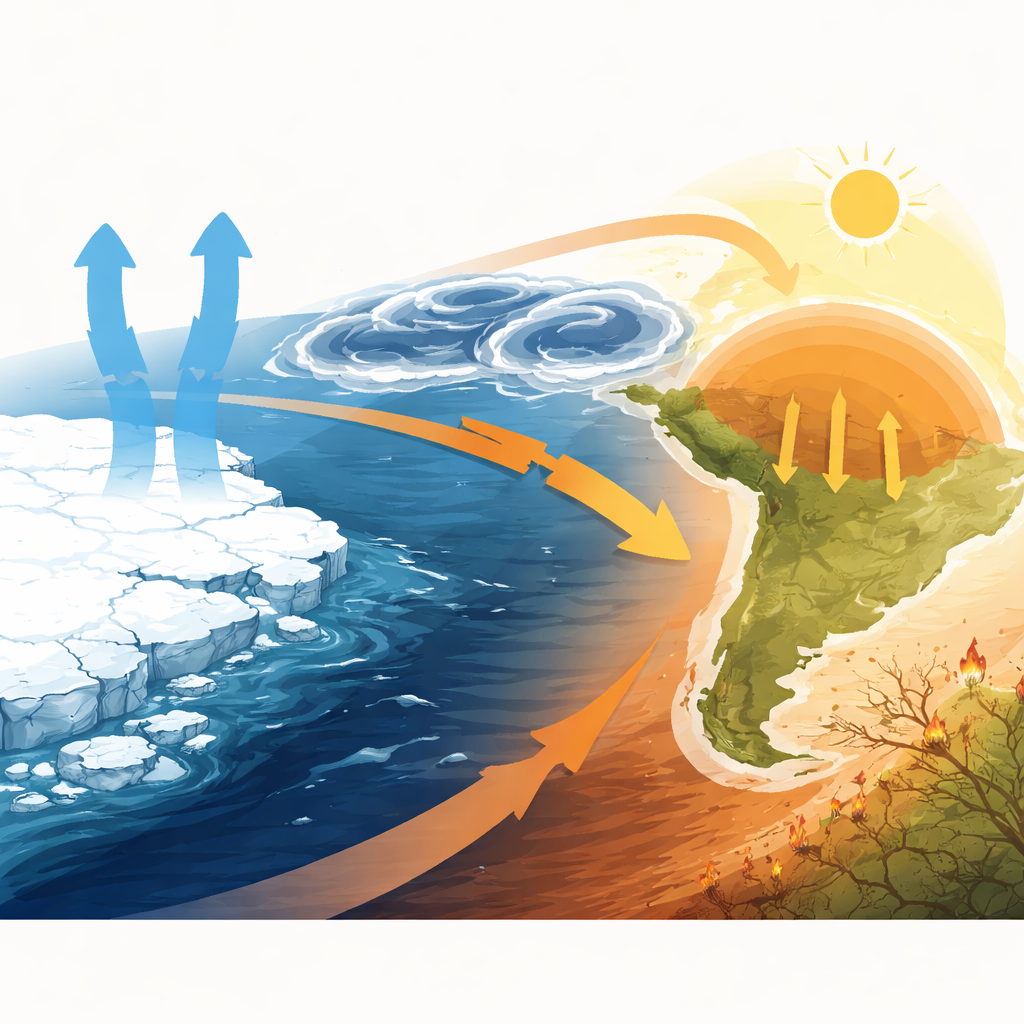
What this means for future fire risk
The authors conclude that Antarctic sea ice, particularly around the Antarctic Peninsula, can act as a remote but important lever on South American fire weather from year to year. This polar influence does not replace better‑known drivers such as shifts in tropical rainfall, nor does it account for human activities like deforestation and land management, which strongly shape where and when fires actually occur. Instead, it adds another layer of complexity to the climate backdrop against which fires play out. As greenhouse warming continues to alter both sea‑ice cover and storm tracks, the strength and character of this polar‑to‑tropics connection may change, making it both a challenge and an opportunity for improving seasonal forecasts of wildfire risk.
Citation: Hou, H., Zhang, L., Cai, W. et al. South American fire activity in spring is linked to Antarctic sea ice variability. Commun Earth Environ 7, 356 (2026). https://doi.org/10.1038/s43247-026-03369-3
Keywords: Antarctic sea ice, South American wildfires, fire weather, climate teleconnection, atmospheric circulation