Clear Sky Science · en
Deoxygenation in the equatorial Panthalassan Ocean predated the end-Triassic mass extinction
When Ancient Seas Ran Low on Breathable Water
Long before dinosaurs disappeared, life in the oceans faced its own crisis. This study looks at how parts of a vast ancient ocean slowly lost oxygen well before a major mass extinction at the end of the Triassic Period. By decoding subtle chemical clues locked in rocks from Alaska, the authors show that marine life may have been living under growing stress for millions of years before the final extinction spike.
A Giant Ocean and a Hidden Danger Zone
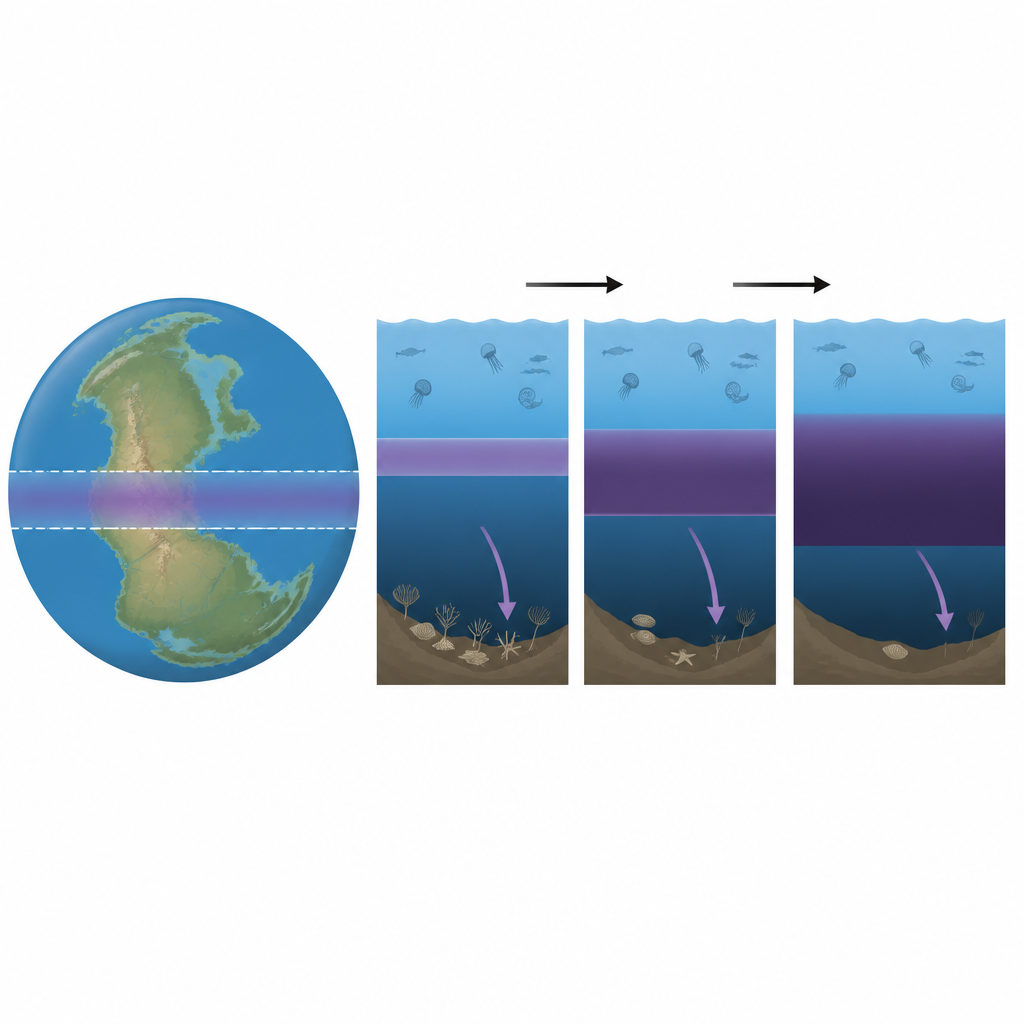
About 200 million years ago, most of Earth’s water formed one huge ocean called Panthalassa. In what is now Alaska, deep water sediments quietly piled up far from land. These layers captured the chemistry of the seawater above them, acting like a tape recorder of ancient conditions. The team studied rocks from a site called Grotto Creek, which preserves sediments from late in the Triassic into the early Jurassic, bracketing the end-Triassic mass extinction that wiped out around 60 percent of marine invertebrate genera.
Reading the Ocean’s Past from Iron and Nitrogen
To find out how much oxygen the water once held, the scientists measured two types of chemical “fingerprints” in the rocks. One is based on different forms of iron that build up differently under oxygen-rich versus oxygen-poor conditions near the seafloor. The other looks at the ratio of heavy to light nitrogen in the tiny bits of ancient organic matter preserved in the sediments. That nitrogen record reflects how nitrogen moved through the food web and how much of it was destroyed in low-oxygen zones within the water column.
A Slow Creep Toward Suffocating Seas
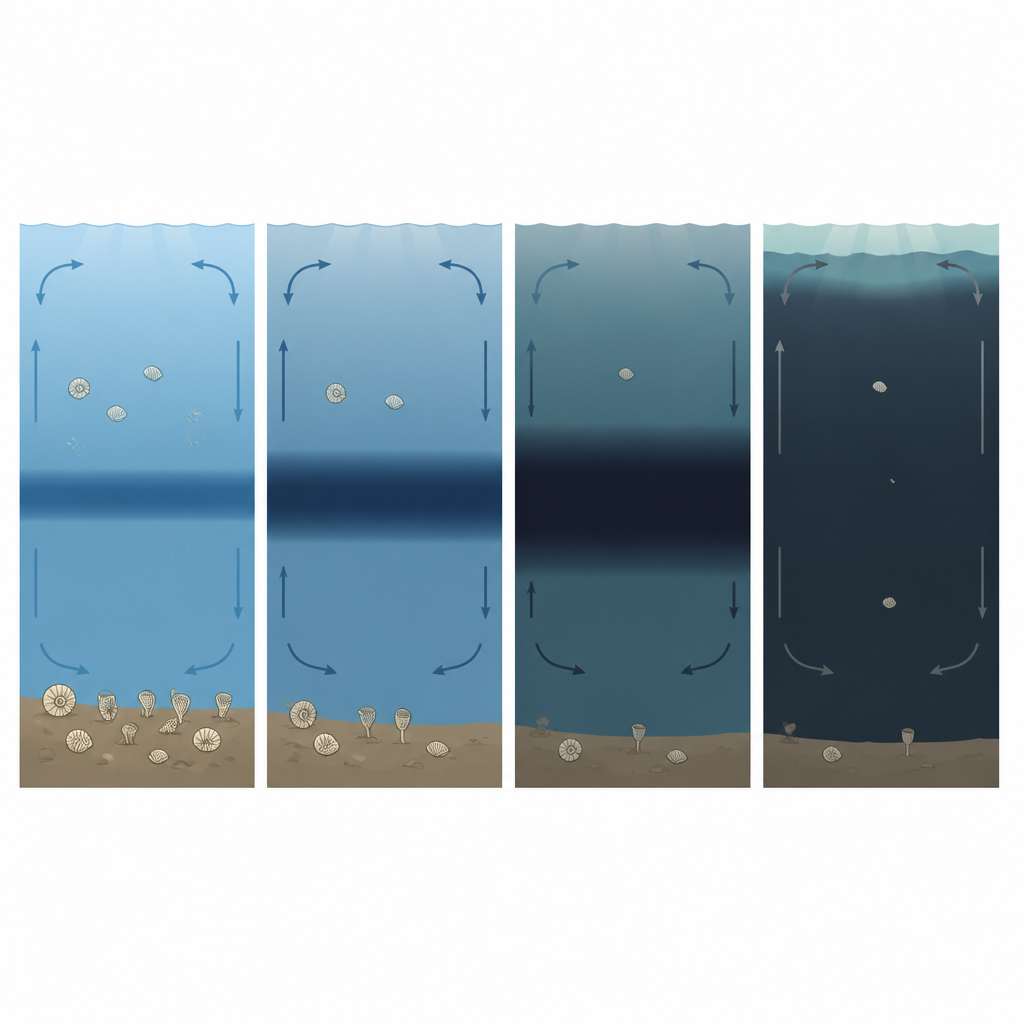
The iron data show that deep waters at this site were largely starved of oxygen throughout the entire interval, with periods when toxic, sulfur-rich conditions became more common, especially during and just after the extinction itself. The nitrogen record reveals how the trouble spread upward. In the earlier part of the record, surface waters were rich in nitrate, a key nutrient, and the water column above the seafloor was better ventilated. Later, the nitrogen values shift in a way that signals increasing loss of nitrate by processes that thrive where oxygen is scarce. This points to the growth and upward spread of an oxygen-poor “minimum zone” in mid-depth waters starting roughly eight million years before the mass extinction.
From Stress to Shortage and Brief Recovery
As time went on, this expanding low-oxygen layer appears to have eaten away at the local nitrate supply. The chemistry suggests that plankton at the surface began to rely more on recycled or newly fixed nitrogen, a hallmark of nutrient-poor, stressed conditions. At the same time, the deep water remained largely anoxic and at times became more sulfide-rich, conditions that are especially hostile to seafloor animals. These changes line up with independent evidence of falling biodiversity and disturbed global carbon cycling near the same time, implying that marine ecosystems were already degraded before the final extinction pulse. After the extinction, the record shows a short-lived shift toward more oxygen and more available nitrate, hinting at a brief episode of environmental recovery before low-oxygen conditions returned.
Why This Ancient Story Matters Today
In simple terms, this study shows that parts of Earth’s largest ancient ocean began to lose oxygen many millions of years before a famous mass extinction, creating long-lasting stress for marine life. Rather than a single sudden catastrophe, the end-Triassic event appears to cap a drawn-out period of worsening conditions, including expanding oxygen-poor zones and repeated chemical upheavals. Understanding how slowly shifting oceans set the stage for a rapid die-off offers a cautionary tale as modern seas warm and lose oxygen, helping researchers better anticipate how today’s gradual changes could tip into more severe ecological crises.
Citation: McCabe, K.E., Marroquín, S.M., Caruthers, A.H. et al. Deoxygenation in the equatorial Panthalassan Ocean predated the end-Triassic mass extinction. Commun Earth Environ 7, 460 (2026). https://doi.org/10.1038/s43247-026-03362-w
Keywords: ocean deoxygenation, end-Triassic extinction, oxygen minimum zone, paleoceanography, marine biodiversity