Clear Sky Science · en
Photovoltaic power response to El Niño–Southern Oscillation
Why Sunshine Isn’t as Steady as It Seems
Solar panels are spreading across the globe at a breathtaking pace, promising cleaner electricity and lower carbon emissions. But sunlight itself is not guaranteed. This study explores how a powerful natural climate rhythm in the Pacific Ocean, known as El Niño–Southern Oscillation, can dim or brighten the skies over major solar regions for months at a time. As societies increasingly depend on solar power, understanding these swings in sunshine becomes crucial for keeping the lights on and emissions down.
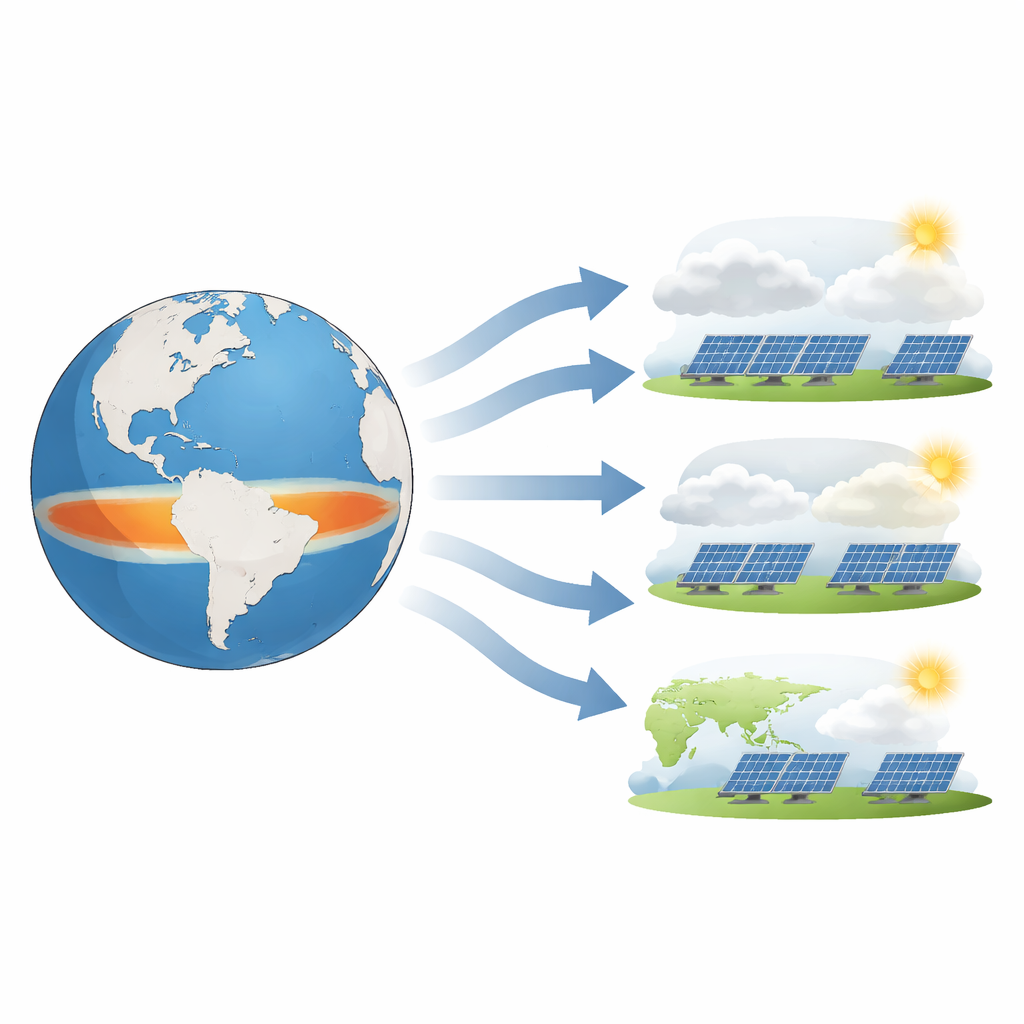
A Global Climate Pulse That Shapes Our Weather
Every few years, the tropical Pacific Ocean shifts between warmer and cooler phases called El Niño and La Niña. These shifts rearrange winds, clouds, and rainfall patterns around the world, altering not only temperatures and storms but also how much sunlight reaches the ground. The authors combined more than four decades of detailed atmospheric and ocean data to follow how these events change key factors for solar power: incoming sunlight, air temperature, and wind speed. They then translated these changes into a measure of how hard typical solar panels could work in the real world, a quantity they call photovoltaic potential.
Where El Niño Steals and Adds Sunlight
The analysis shows clear global fingerprints of El Niño and La Niña on solar resources. During El Niño, warmer waters in the central and eastern Pacific disrupt normal air circulation, often increasing cloud cover over regions like California, the southern Atacama Desert and central Chile, the Chaco Basin in South America, the Middle East, and East China. More clouds mean less surface sunlight, and the study finds that in these areas, solar potential can fall by several percent for an entire season or even a full year. By contrast, places such as parts of the Amazon Basin, southern Africa, eastern Australia, and Southeast Asia often become sunnier during El Niño, gaining solar potential despite also experiencing hotter air that slightly lowers panel efficiency.
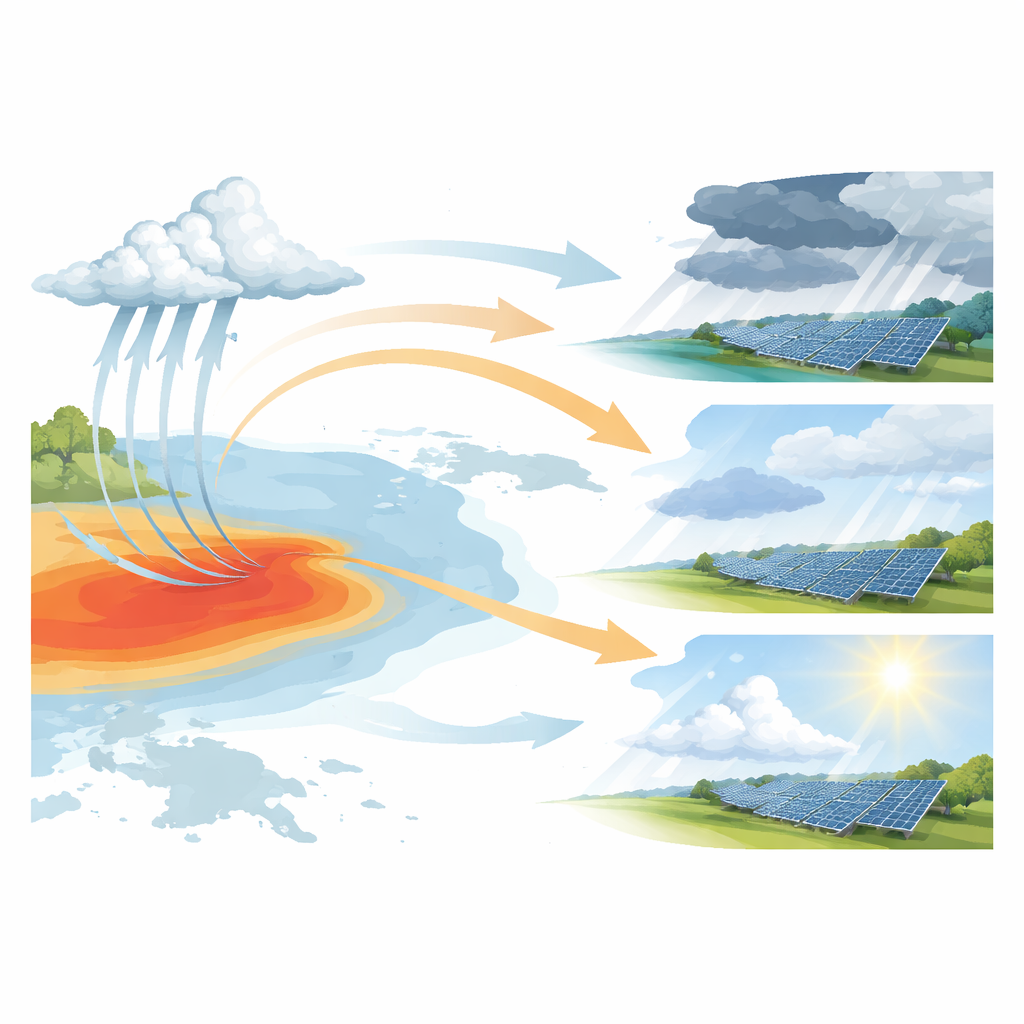
Super El Niño Events and Solar Energy Droughts
The most intense El Niño episodes, known as Super El Niños, are rare but particularly disruptive. Only three have occurred since the early 1980s, yet they leave a strong imprint in the data. During these events, the study finds that year-long solar potential dropped by up to about 10% in solar-sensitive hotspots such as East China and the Chaco Basin, and by several percent in California, central Chile, and the southern Atacama Desert. The authors frame these prolonged reductions as “solar energy droughts”: extended periods when sunlight available for power generation falls well below what is typical for that time of year. In many of these regions, solar farms are now dense and growing fast, so the same level of climate impact will translate into much larger swings in actual electricity production in the future.
From Missing Sunlight to Extra Carbon Emissions
To grasp the real-world consequences, the researchers looked ahead to a future where solar power is far more widespread and grid emissions are lower. Using projections of how much solar electricity regions like East China, California, Chile, and Argentina are likely to produce by the 2030s, along with expected declines in their power-sector carbon intensity, they estimated how a future Super El Niño could ripple through energy systems. Their simulations suggest that a single such event could cut solar output by several percent over a year in these key regions. Because backup power will still partly rely on fossil fuels, the resulting shortfall in solar electricity could temporarily raise global carbon dioxide emissions by tens of millions of tons, with East China contributing the largest share.
Planning for a Bumpy Solar Future
The study concludes that natural climate swings like El Niño and La Niña will increasingly shape the reliability and climate benefits of solar-heavy power grids. As Super El Niños are expected to become more frequent this century, planners cannot assume that sunshine will be stable from year to year. Instead, they argue, energy systems must be designed with these long-lived swings in mind—by spreading solar installations over wider areas, investing in energy storage, diversifying low-carbon backup sources, and using climate forecasts to anticipate when “solar droughts” are likely. For a world leaning ever more on the Sun, the message is clear: building a resilient clean energy future means learning to live with the rhythms of a restless ocean.
Citation: Feron, S., Cordero, R.R., Damiani, A. et al. Photovoltaic power response to El Niño–Southern Oscillation. Commun Earth Environ 7, 325 (2026). https://doi.org/10.1038/s43247-026-03343-z
Keywords: solar power, El Niño, climate variability, energy security, carbon emissions