Clear Sky Science · en
Advancing protein engineering via organic chemistry
Rewriting Nature’s Building Blocks
Proteins are the tiny machines that run our cells, from fighting infections to carrying messages and drugs. Yet nature only builds them from a limited toolkit of 20 standard amino acids and a handful of natural tweaks. This article explains how modern organic chemistry lets scientists go beyond nature’s rules: they can now build, reshape, and upgrade proteins atom by atom to make tougher medicines, smarter diagnostics, and precision tools for studying disease.
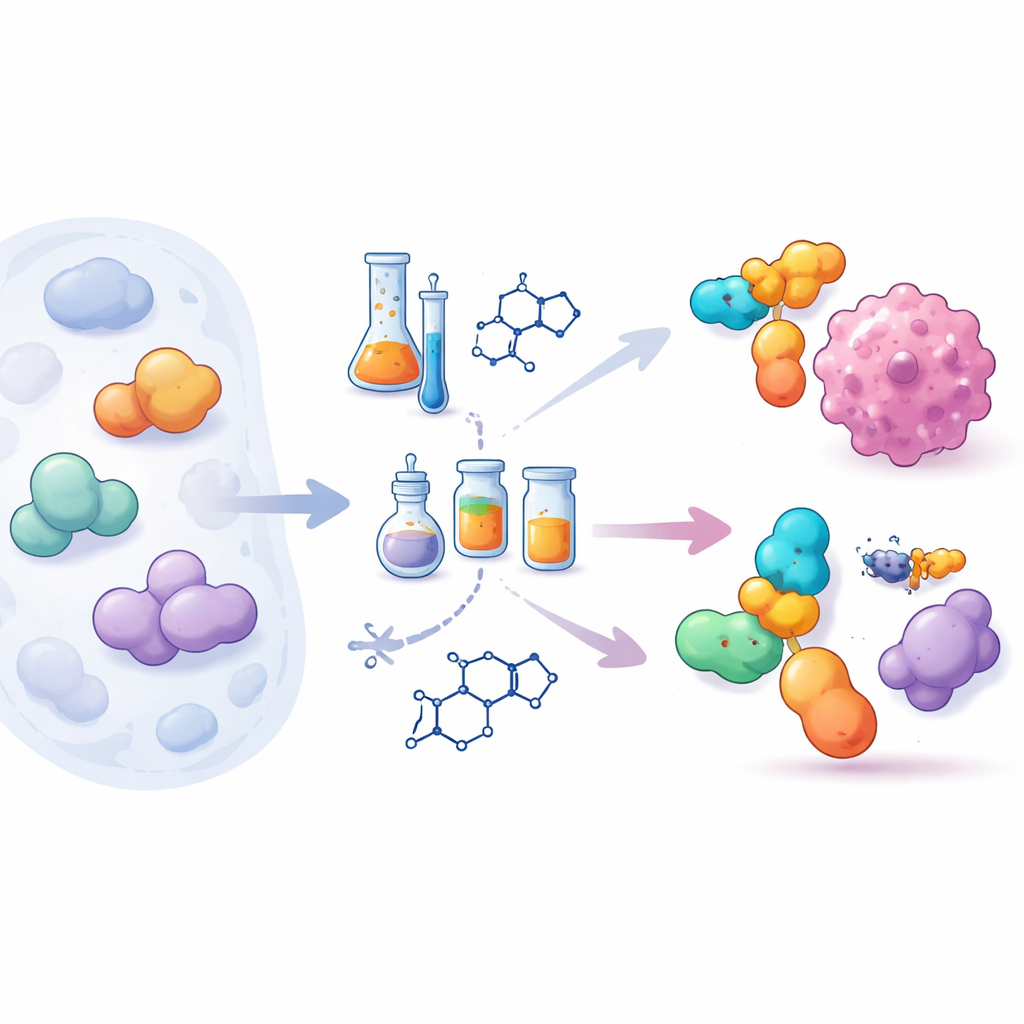
How Chemists Upgrade Natural Proteins
The review begins by describing how natural proteins are already highly regulated by small chemical tags, called post-translational modifications, that can switch their activity on or off. Inspired by this, chemists now deliberately alter protein side chains, sequences, and even their backbone to fine-tune shape and stability. Powerful methods such as solid-phase peptide synthesis and chemoselective “click-like” ligation let researchers stitch together long protein chains piece by piece, then add precise changes at chosen positions. These strategies turn proteins into customizable platforms whose behavior can be programmed rather than merely observed.
Locking Proteins into Tougher, Smarter Shapes
A major theme is using chemical “staples” and crosslinks to lock proteins into shapes that work better in harsh conditions, such as inside tumors or industrial reactors. For example, researchers reinforced fragile transcription factors—proteins that bind DNA and control which genes turn on—by installing hydrocarbon staples and aromatic cross-bridges between key helices. These stabilized mimics can slip into cells, latch onto cancer-linked DNA sites, and block the action of hard-to-drug targets like the Myc oncogene. Similar crosslinking strategies have made enzymes more heat-resistant and active, and strengthened the immune messenger interleukin-2 so it lasts longer in the body without losing its beneficial effects.
Designing Proteins with New Sequences and Mirror Images
The authors also highlight how entirely new protein sequences can be crafted to expose hidden binding pockets or flip the usual selectivity of reactions. Automated flow synthesis allows rapid production of macrocyclic proteins with locked conformations that favor binding to specific drug-like molecules. Chemists can swap in non-natural amino acids to probe which interactions matter most for catalysis or recognition. Pushing this further, they build “mirror-image” proteins made of D-amino acids—the chemical opposite of those in nature. These mirror proteins resist natural enzymes that normally chew up drugs and can be evolved, using mirror-image display technologies, into potent, non-immunogenic blockers of growth factors and inflammatory signals.
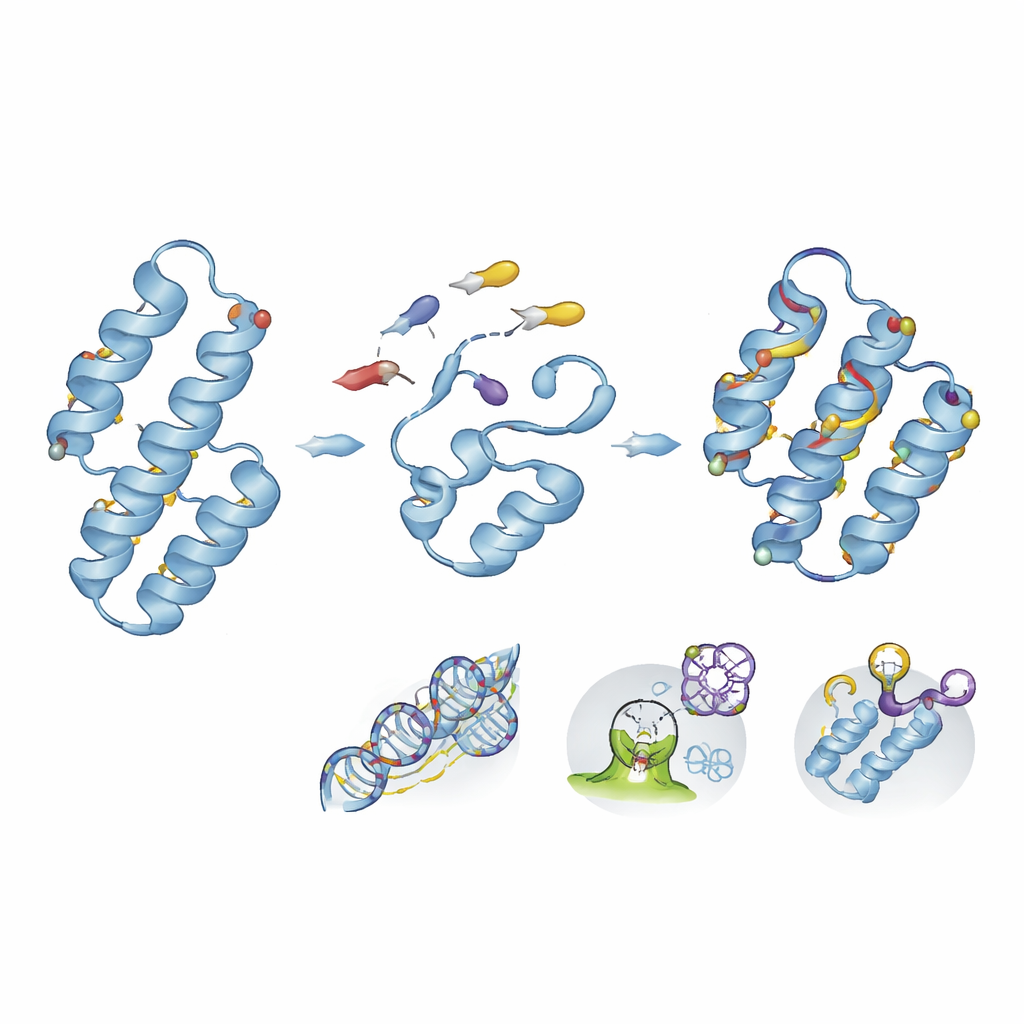
Building Proteins from Scratch to Capture Drugs and Toxins
Beyond modifying what nature provides, de novo protein design lets scientists create brand-new folds that never existed in biology. Using computational blueprints and high-throughput screening, teams have built small helical bundles that nestle toxic drugs such as the blood thinner apixaban inside specialized pockets, pulling them out of circulation in animal models. The same design principles can be combined with backbone cyclization or mirror-image chemistry to yield highly stable, long-lasting binders. Other custom miniproteins have been tailored to recognize cancer or inflammation-related targets with nanomolar affinity while shrugging off degradation in blood and tissues.
From Chemical Tricks to Future Medicines
In closing, the article argues that the marriage of organic chemistry, structural biology, and computation is turning proteins into fully engineerable materials. By altering side chains, sequences, and backbones in a controlled way, researchers can now craft proteins that are more stable, more selective, and better able to enter cells than many natural counterparts. Remaining challenges include scaling up complex syntheses, expanding the types of chemical junctions that can be used to join fragments, and reliably folding large, heavily modified proteins. Nonetheless, the trajectory is clear: chemically engineered proteins are poised to become a new class of medicines and molecular tools, capable of tackling previously “undruggable” targets and enabling therapies with greater precision and fewer side effects.
Citation: Nithun, R.V., Singh, M., Baransi, A. et al. Advancing protein engineering via organic chemistry. Commun Chem 9, 161 (2026). https://doi.org/10.1038/s42004-026-02033-3
Keywords: chemical protein engineering, synthetic proteins, protein therapeutics, de novo protein design, mirror-image proteins