Clear Sky Science · en
Addressing Vitamin B12 deficiency through aeroponic fortification of a salad crop (Pisum sativum)
Why salad could solve a hidden nutrient gap
Many people are cutting back on meat and dairy for health, ethical, or environmental reasons. But there is a catch: plants do not naturally make Vitamin B12, a nutrient vital for healthy blood and nerves. This study explores a simple idea with big implications—can we grow everyday salad greens so that a small handful delivers a full day’s worth of Vitamin B12, without pills or animal products?
The problem with B12 and modern diets
Vitamin B12 is an oddity among vitamins: only certain bacteria can make it, and it does not occur in ordinary plant foods. In wealthy countries, many people remain mildly deficient, which can quietly damage nerves and blood over time. Supplements and fortified foods such as breakfast cereals help, but pills are often taken on an empty stomach, when the body’s own B12-absorbing machinery works less efficiently. As interest in plant-based diets grows worldwide, finding new, convenient ways to build B12 into everyday foods becomes increasingly important.
Turning pea shoots into a natural-like B12 source
The researchers focused on pea shoots, a popular salad ingredient that grows quickly and is already produced at scale in indoor vertical farms. Instead of trying to engineer plants to make B12—a daunting task, since the vitamin requires about thirty bacterial enzymes—they used a shortcut: adding a stable, human-active form of B12 (cyanocobalamin) to the nutrient mist in an aeroponic growing system. In aeroponics, plant roots dangle in air and are regularly sprayed with a fine nutrient mist, which maximizes contact between roots and solution. By enriching this mist with B12 for just two days, they found that the shoots absorbed and stored the vitamin, particularly in their leaves. At commonly used doses, about 15 grams of pea shoots—roughly a small salad portion—contained at least the recommended daily intake of B12, far outperforming earlier methods that simply soaked seeds in B12 solution. 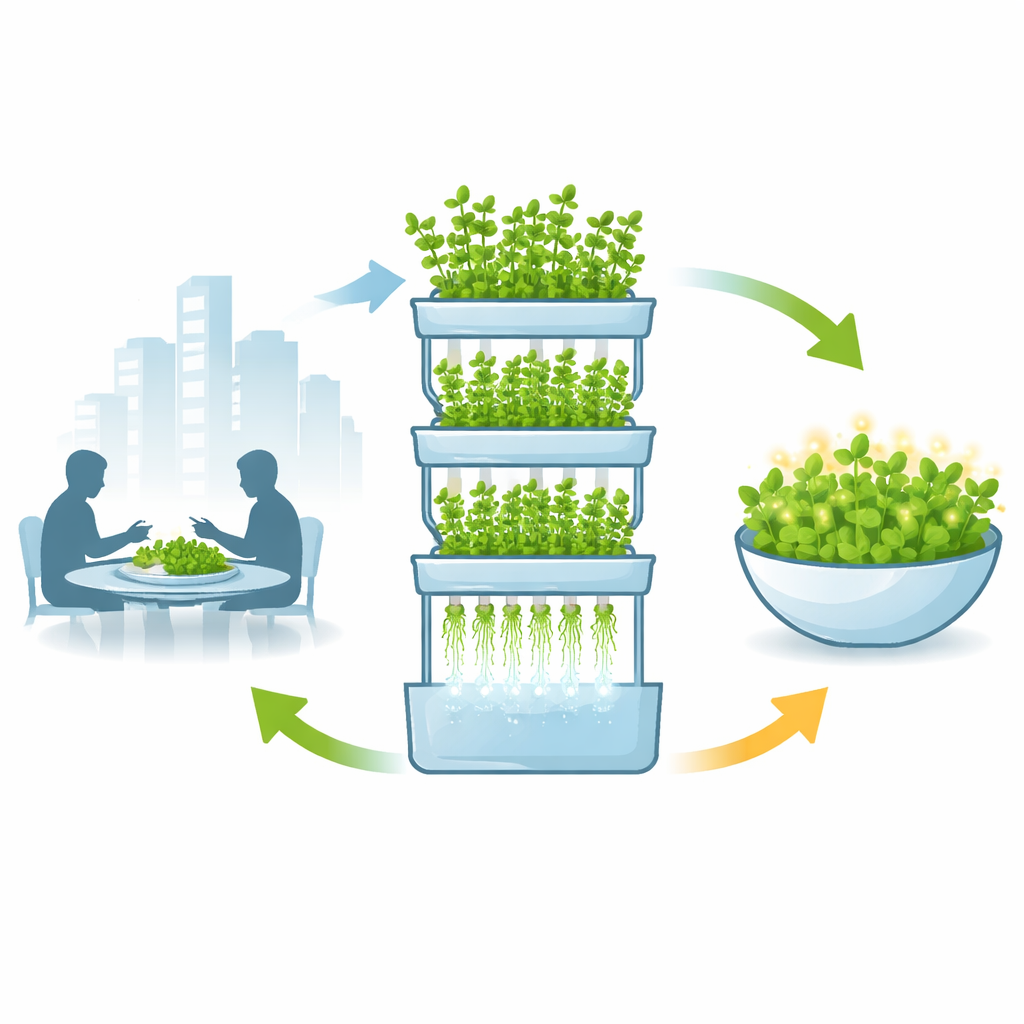
Flexible for growers and friendly to shelf life
For farmers, a fortification method must fit around real-world schedules and equipment. The team showed that they could add B12 during several different stages of pea shoot development and still reliably reach the target level in a 15‑gram serving, giving growers flexibility in when they dose the system. They also tested whether loading plants with B12 would shorten shelf life, since yellowing and loss of freshness can quickly make salad unsellable. Pea shoots fortified with B12 and then stored in chilled, dark conditions for nearly a month behaved much like untreated ones: chlorophyll gradually declined, tissues aged, and leaves yellowed at a similar pace. Importantly, the amount of active B12 in the leaves stayed steady for at least four weeks of cold-chain storage.
Proof that the vitamin is actually usable by the body
It is not enough for B12 to sit inside the plant; it must be released during digestion so it can be absorbed. To test this, the researchers used a laboratory system that imitates the mouth, stomach, and small intestine. They mashed or lysed fortified pea shoots to mimic chewing, then exposed them to simulated digestive fluids. In both cases, the B12 stored in the tissue was gradually released, with the largest pulse emerging in the intestinal phase where absorption normally occurs in humans. A typical 15‑gram serving of pea shoots grown with higher B12 dosing released well over the adult daily requirement during this simulated digestion, and even lower dosing reliably met the recommended amount.
Costs and prospects for scaling up
Because Vitamin B12 is relatively expensive, the team ran an economic analysis to check whether this method could work commercially. They estimated the extra cost of adding B12 to the aeroponic nutrient solution, the energy used by the misting devices, and the labor needed to dose the system, under realistic price ranges for food-grade and pharmaceutical-grade B12. Even without reusing the nutrient solution, they found that fortifying enough pea shoots to give one person a full daily B12 dose would add only a few pence to each 15‑gram portion. If farms recycle the enriched nutrient solution across multiple growing cycles—a common practice in hydroponic-style systems—the added cost could drop to less than one penny per serving, while still delivering sufficient B12. 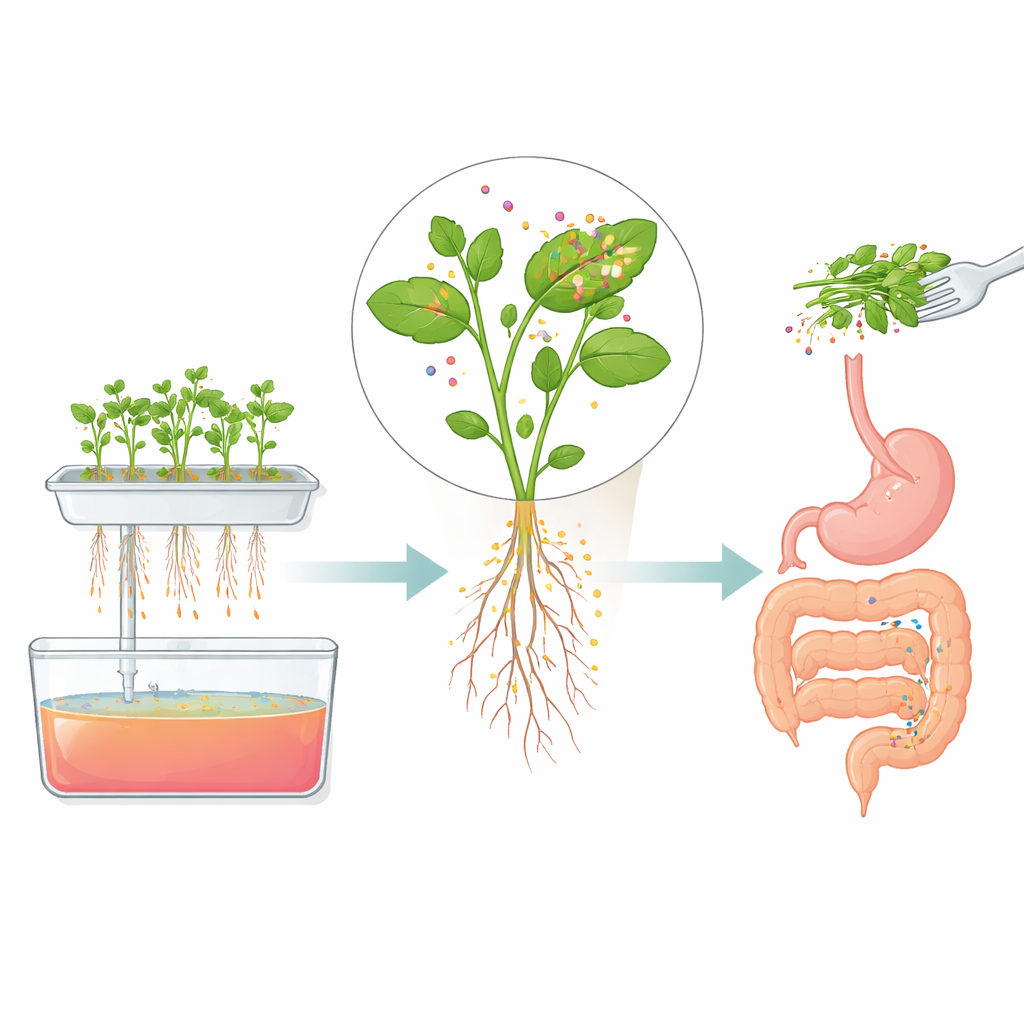
A new way to eat your vitamins
Overall, this study shows that a small serving of aeroponically grown pea shoots can be turned into a reliable, shelf-stable, and affordable source of Vitamin B12. The fortified leaves retain their vitamin content during cold storage, do not spoil faster than ordinary shoots, and release nutritionally meaningful amounts of B12 during digestion. Because the method works in an existing commercial indoor-farming setup, it offers a practical route to salads that quietly supply a vital nutrient—helping people who eat little or no animal products, or who struggle with deficiency, to meet their B12 needs simply by enjoying a bag of greens.
Citation: Eldridge, B.M., Javvadi, S.G., Perez-Moral, N. et al. Addressing Vitamin B12 deficiency through aeroponic fortification of a salad crop (Pisum sativum). Commun Biol 9, 544 (2026). https://doi.org/10.1038/s42003-026-09764-y
Keywords: vitamin B12, aeroponic farming, pea shoots, salad fortification, plant-based nutrition