Clear Sky Science · en
A multi-way SMILES-based hypergraph inference network for metabolic model reconstruction
Why Filling in Metabolic Blind Spots Matters
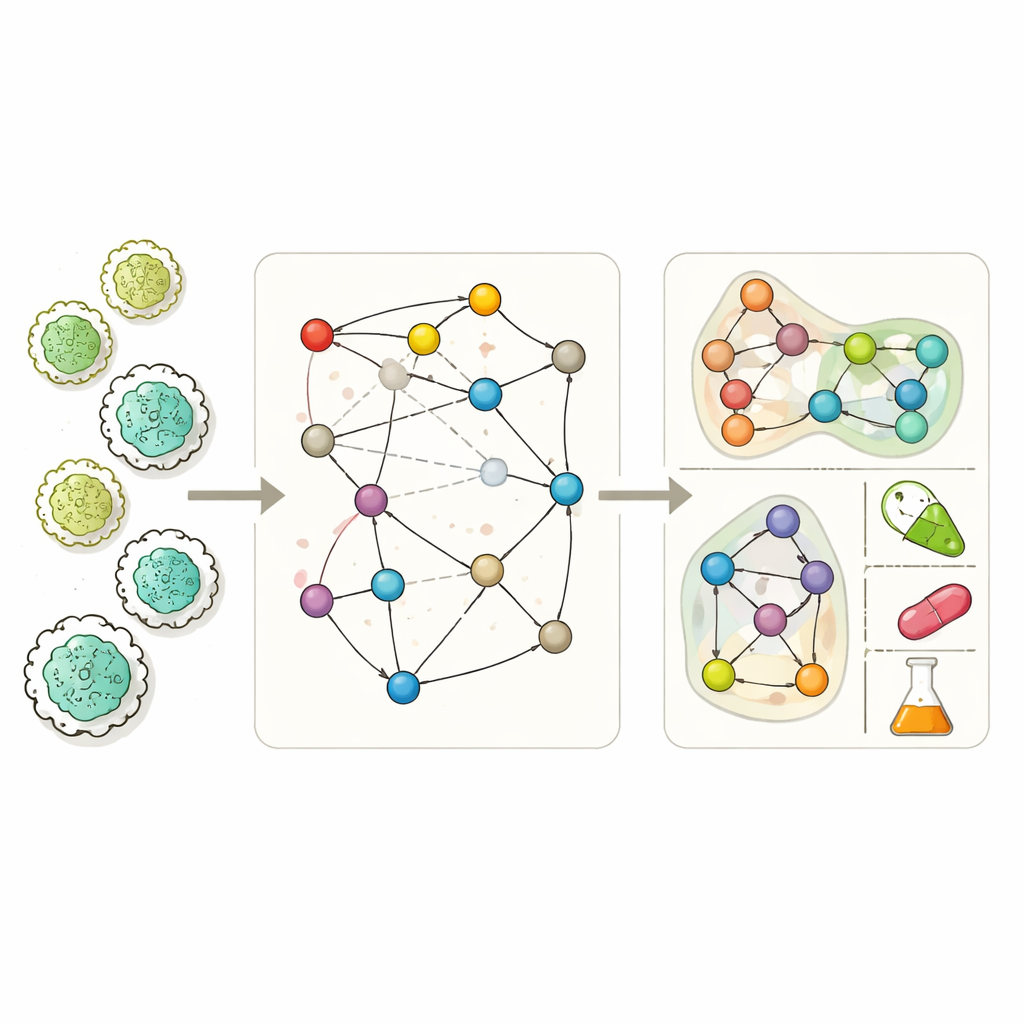
Every living cell hums with thousands of tiny chemical reactions that keep it alive, growing, and adapting. Scientists build large-scale “maps” of these reactions to design better microbes for making fuels, study how our gut bacteria affect health, and even search for new drug targets. But many of these maps are full of missing pieces: reactions that almost certainly happen in cells but are absent from our models. This paper introduces MuSHIN, a new artificial intelligence system that helps fill in those blind spots, making our maps of metabolism sharper, more reliable, and far more useful.
Building Better Maps of Cellular Chemistry
Modern genome-scale metabolic models aim to list nearly every chemical reaction that an organism can carry out. With them, researchers can simulate how a microbe grows in different environments, what by-products it secretes, and which genes are essential for survival. Yet these models are often incomplete. Gaps in biochemical knowledge, errors in genome annotation, and limited experiments leave holes in the networks, so simulated cells sometimes fail to grow, cannot produce known fermentation products, or mis-predict which genes are vital. Existing “gap-filling” tools try to plug these holes, but many either depend heavily on condition-specific experimental data or simplify the network so much that they miss the complex, many-molecule interactions that real reactions involve.
From Simple Links to Rich Hyper-Connections
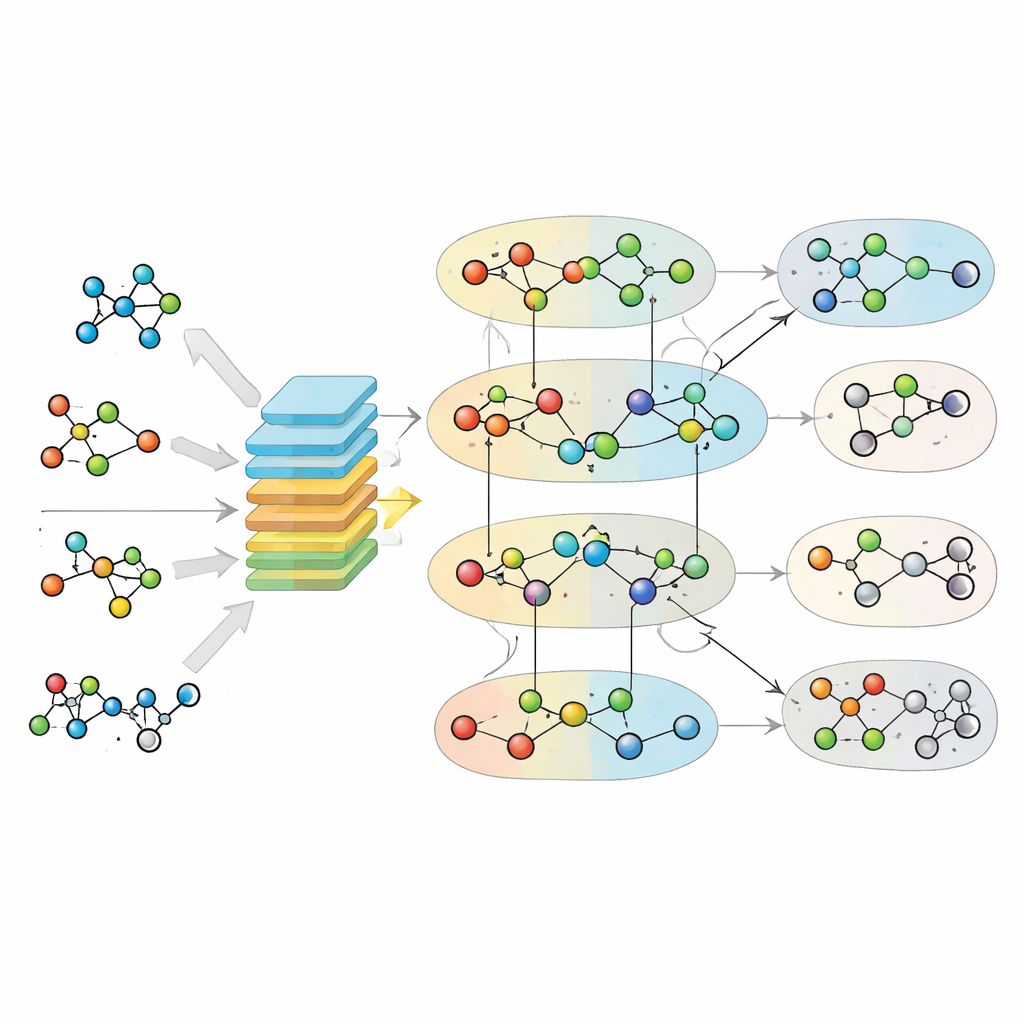
MuSHIN tackles this problem by representing metabolism in a more faithful way. Instead of treating each reaction as a simple pairwise link between two metabolites, it uses a hypergraph, where a single connection can tie together any number of molecules at once. This mirrors real biochemistry, in which one reaction often transforms several substrates into several products simultaneously. MuSHIN then enriches this structure with chemical “meaning.” It converts each metabolite and reaction, described as SMILES strings (a text encoding of molecular structure), into high-dimensional numerical fingerprints using two transformer-based chemistry models called ChemBERTa and RXNFP. These fingerprints allow the system to reason not just about who connects to whom in the network, but also about what the molecules and reactions look like chemically.
How the Learning Engine Works
Once the hypergraph and chemical fingerprints are in place, MuSHIN learns to distinguish real reactions from fake ones. The authors build training sets by taking known reactions from high-quality metabolic models and then creating “negative” examples by subtly scrambling the participants in each reaction, preserving overall balance but making the chemistry implausible. MuSHIN uses a dual attention mechanism to pass information back and forth between metabolite nodes and reaction hyperedges, repeatedly refining its internal representation of both. This attention process helps the model focus on the most informative parts of the network and the most telling chemical features. In the final step, MuSHIN scores each reaction, outputting how likely it is to be valid and therefore a good candidate for filling a gap.
Putting MuSHIN to the Test
The researchers rigorously tested MuSHIN on 926 metabolic models from two major databases, systematically removing known reactions and asking the model to recover them. Across a range of quality measures, MuSHIN consistently outperformed several leading hypergraph and deep-learning methods, in some cases boosting performance by about 17 percentage points. Remarkably, it remained accurate even when as many as 80% of the reactions were stripped away, showing resilience in extremely incomplete networks. In another set of experiments, the team applied MuSHIN to 24 draft models of anaerobic bacteria involved in fermentation. By adding only the top 100 reactions that MuSHIN ranked for each organism, they dramatically improved the ability of these models to predict which fermentation products—such as ethanol, lactic acid, or formic acid—are actually observed in experiments, whereas competing methods needed many more added reactions to achieve modest gains.
Uncovering Hidden Gateways in Metabolism
A closer look at the reactions MuSHIN proposes reveals why its predictions are so valuable. Nearly half of its suggested additions turn out to be transport and exchange reactions—steps that move molecules across cell membranes or into and out of the modeled system. These reactions are notoriously underrepresented yet often control whether a pathway can carry any flux at all. By correctly restoring such boundary steps, MuSHIN reopens blocked metabolic routes and recovers missing fermentation products across multiple species. The model also resolves more intricate gaps, such as restoring succinate production in a gut bacterium by adding coordinated transporters that complete a branch of the central energy-generating cycle.
What This Means for Biology and Medicine
For non-specialists, the key message is that MuSHIN makes our virtual cells behave more like real ones. By blending a richer network representation with chemistry-savvy AI, it can spot missing reactions that other methods overlook, especially in poorly studied microbes. This improved accuracy could speed up the design of industrial strains for producing fuels and chemicals, sharpen models of the human gut microbiome, and support more precise simulations of disease metabolism and treatment responses. As future extensions incorporate genes, regulation, and even new reactions never seen before, tools like MuSHIN may become central to turning genomic data into reliable, predictive blueprints of living systems.
Citation: Zhao, Y., Chen, Y., Yu, Y. et al. A multi-way SMILES-based hypergraph inference network for metabolic model reconstruction. Commun Biol 9, 531 (2026). https://doi.org/10.1038/s42003-026-09761-1
Keywords: genome-scale metabolic models, metabolic network reconstruction, hypergraph neural networks, deep learning in systems biology, microbial fermentation