Clear Sky Science · en
Lagged influence of spring southern annular mode on late-summer Antarctic fast ice variability
Why the quiet ice at Earth’s bottom matters
Along the edge of Antarctica lies a belt of “fast ice” – sea ice that is locked in place against the coast and ice shelves. It may look static and unremarkable, but this anchored ice helps steady fragile ice shelves, shapes ocean currents that reach the deep sea, and supports wildlife such as emperor penguins. This study asks a deceptively simple question with global implications: how do shifts in a major wind pattern around Antarctica months earlier help determine how much of this protective fast ice survives into late summer?
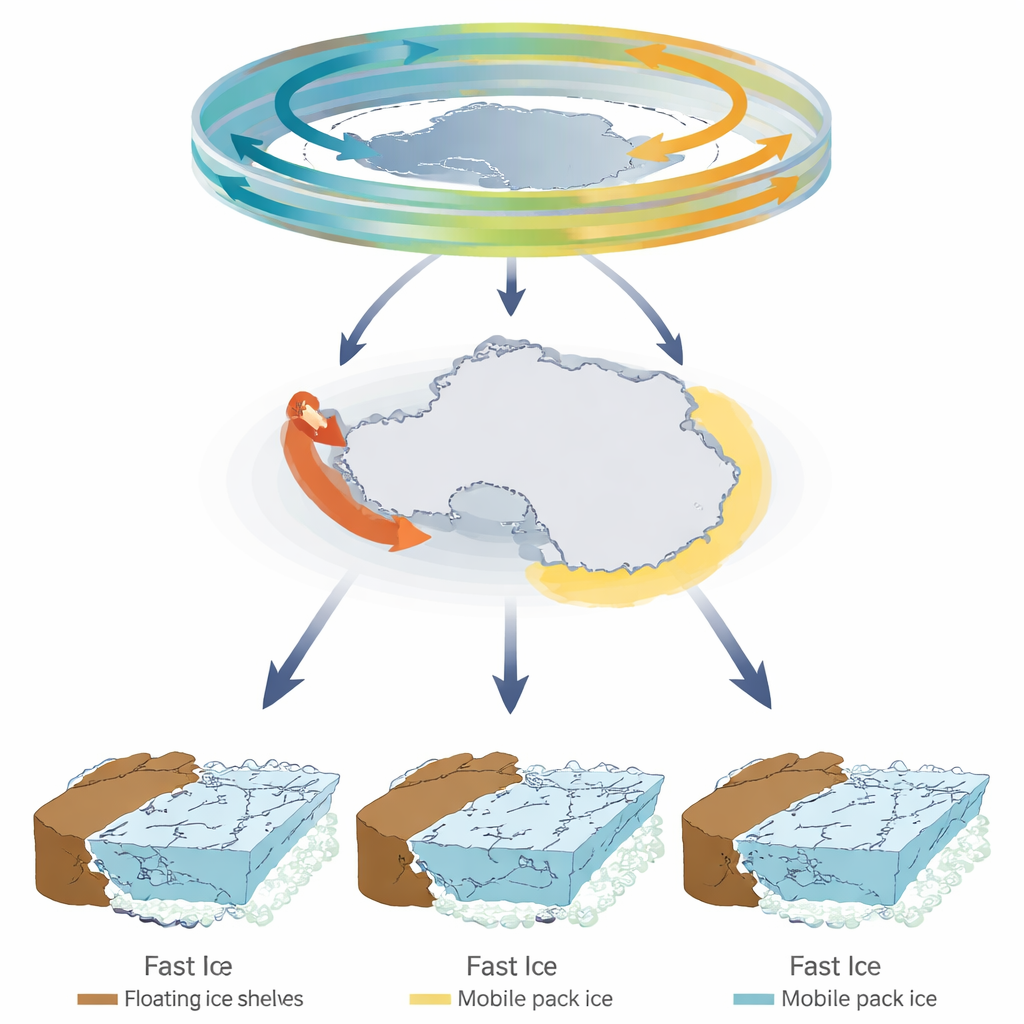
A southern wind ring with a long memory
The research focuses on the Southern Annular Mode, a dominant pattern of winds and air pressure that forms a ring around Antarctica. When this pattern is in a “positive” phase, the belt of strong westerly winds tightens and shifts toward the pole. Using more than two decades of satellite-based maps of Antarctic fast ice, combined with atmospheric and ocean records, the authors tracked how the state of this wind pattern in early spring (September) relates to the amount of fast ice present the following March, when fast ice typically reaches its yearly minimum.
Linking spring skies to late-summer ice loss
The team found a strong and delayed connection: years with a strongly positive Southern Annular Mode in September tend to have noticeably less fast ice around Antarctica the next March. This link is not spread evenly around the continent. Three regions – Dronning Maud Land in the Atlantic sector, the Amundsen Sea in West Antarctica, and the Australian sector in East Antarctica – account for most of the connection. In these areas, changes in the springtime wind belt alter how floating sea ice drifts and melts, setting the stage for how much anchored fast ice survives months later.
How drifting ice and ocean waves chip away at coastal ice
In Dronning Maud Land and the Amundsen Sea, the mechanism is largely mechanical. During positive Southern Annular Mode springs, near-surface winds push surrounding pack ice northward, away from the coast. This export of sea ice reduces the protective buffer in front of the fast ice. With more open water exposed, the ocean absorbs extra sunlight, further warming the surface and melting remaining sea ice. As summer progresses, larger ocean waves – or swell – can now penetrate closer to the coast. The study shows that in years with stronger springtime northward ice drift, summertime coastal ice is reduced, waves grow higher, and the extent of fast ice recorded in March shrinks accordingly.
A different story along Australia’s Antarctic front
The Australian sector behaves differently. Here, the coastline is studded with long glacier tongues and rocky headlands that shape bays where fast ice can accumulate. In this region, the authors found little direct link between the Southern Annular Mode and simple loss of coastal sea ice. Instead, the key lies in how ice drifts along the coast. Under positive phases of the wind pattern, stronger eastward winds oppose the usual westward flow of pack ice driven by the Antarctic Coastal Current. This change in direction reduces the delivery of ice into the bays where fast ice forms, leading to less fast ice in spring and, because spring conditions echo forward in time, less fast ice remaining the following March.
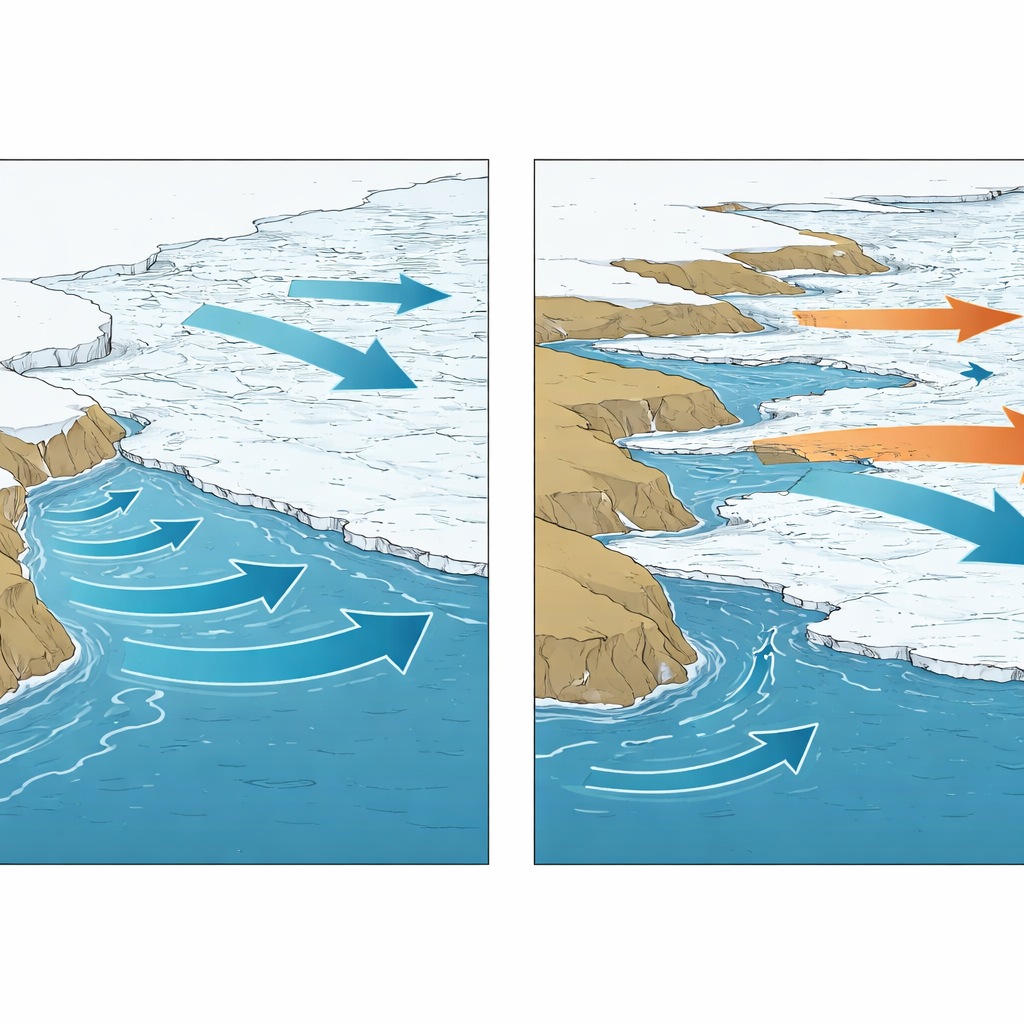
What this means for a changing climate
Together, these findings reveal that a ring-shaped atmospheric pattern circling the Southern Ocean can precondition the Antarctic coastline for fast ice loss months in advance, but through different pathways in different regions. In some areas, the loss of a protective ice fringe exposes fast ice and ice shelves to damaging waves; in others, shifts in alongshore ice traffic starve coastal embayments of the raw material needed to build fast ice. Because the Southern Annular Mode itself is influenced by human-driven climate change, understanding these links is vital. Changes in this wind pattern could ripple through the Antarctic system, altering the stability of ice shelves and the formation of dense waters that help power the global ocean conveyor. Although current records of fast ice are relatively short, this work provides an important early map of how the atmosphere’s shifting ring can quietly reshape the frozen edge of Antarctica.
Citation: Heo, ES., Jin, E.K. Lagged influence of spring southern annular mode on late-summer Antarctic fast ice variability. npj Clim Atmos Sci 9, 81 (2026). https://doi.org/10.1038/s41612-025-01205-7
Keywords: Antarctic sea ice, fast ice, Southern Annular Mode, climate variability, ocean circulation