Clear Sky Science · en
Music is a distinct perceptual category with subjective grounds
Why we care what counts as music
From birdsong to car alarms, our ears are flooded with sounds. Yet most of us instantly know whether something “counts” as music. This study asks a simple question with big implications: do ordinary listeners actually treat music as a special kind of sound, and if so, what guides that judgment?
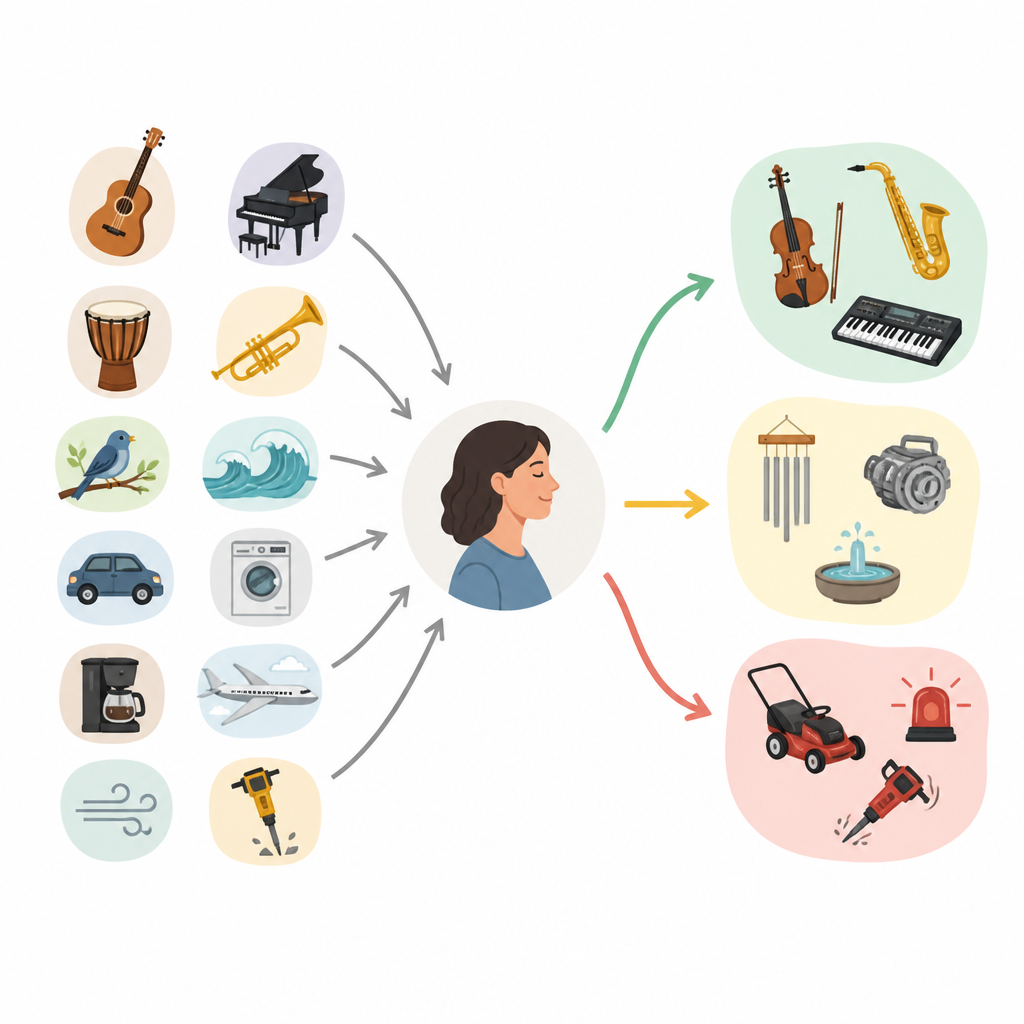
Listening to many kinds of sounds
The researchers recruited 735 adults living in Western countries to take part in online listening tests. Participants heard brief clips drawn from a wide range of sources: instruments, environmental sounds, machines, experimental pieces, and musical traditions from many parts of the world. Vocalizations such as speech and singing were deliberately left out, to focus on less obvious cases. After each clip, people indicated whether they thought it was music or not, sometimes also rating how confident they felt.
Stable judgments across different situations
Across several experiments, the team gently changed the listening situation. In one version, participants judged from their own point of view or tried to guess what “most people” would say. In another, they heard shorter or longer excerpts of the same sounds. A third experiment repeated clips either right away or after a delay, to see if people would change their minds. All these changes produced only small shifts in responses. Most sounds were either reliably classed as music or as not music, and listeners rarely reversed their decisions when hearing the same clip again. This suggests that, at least for Western listeners, music functions as a stable mental category rather than a flimsy opinion.
Three groups of sounds in the middle
When a new group of listeners rated each clip on a sliding scale from “not music” to “music,” the results formed three clusters. One set of sounds was almost always treated as music, another set as clearly not music, and a third group landed in an in-between zone. This ambiguous cluster included experimental pieces, unfamiliar Indigenous traditions, metallic sounds like bells and chimes, and drum performances that echo the patterns of speech. Interestingly, within the “music” cluster, pieces from non-Western cultures were rated just as musical as more familiar Western styles. In other words, once a sound fell inside the mental category of music, its cultural origin mattered little to these listeners.
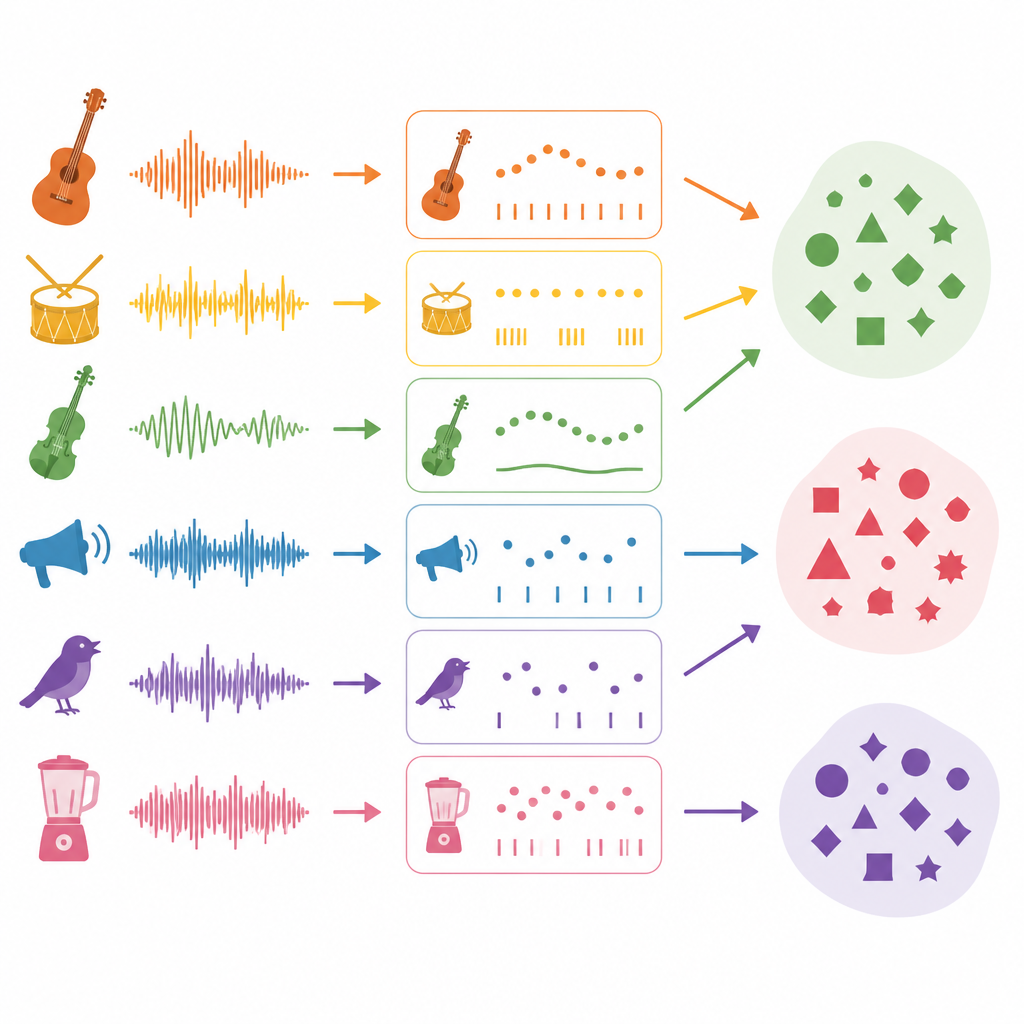
How our minds tell music from other sounds
To uncover what drives these judgments, the authors compared two kinds of information about each clip. One set captured low-level acoustic features, such as aspects of pitch and loudness, extracted by computer algorithms. The other came from listeners’ ratings of higher-level qualities: whether they heard a melody, a steady rhythm, recognizable instruments, repetition, or the sense that the sound was produced on purpose. When the researchers modeled how well each type of information predicted cluster membership, perceptual judgments came out far ahead. In the space defined by acoustic features, music, non-music, and ambiguous clips overlapped heavily. In the space defined by perceived features, the three groups separated cleanly, with ambiguous sounds sitting between the clear cases.
Music as a shared but flexible idea
The findings point to music as a shared concept built on interpretation rather than on any fixed recipe of sound measurements. Listeners seem to rely most on the sense that someone intentionally shaped the sound, that it involves instruments, and that it carries melody and rhythm. Sounds lacking some of these cues fall into an uncertain region where people disagree. The study suggests that music is not defined by strict physical rules but by a community’s way of hearing: stable enough that many people agree most of the time, yet open enough to include new and unfamiliar styles as our listening habits change.
Citation: Larrouy-Maestri, P., Aydin, T.A. & Wald-Fuhrmann, M. Music is a distinct perceptual category with subjective grounds. Sci Rep 16, 16414 (2026). https://doi.org/10.1038/s41598-026-54414-2
Keywords: music perception, sound categorization, perceptual cues, cross-cultural music, music cognition