Clear Sky Science · en
Mangrove growth and biomass dynamics along the mud-dominated coast of French Guiana
Why these coastal forests matter
Mangrove forests do more than shelter crabs and birds. They buffer coasts from waves, trap carbon in their wood and soils, and help build land in places where the sea is full of drifting mud. Along the Atlantic shore of French Guiana, these forests grow on a moving carpet of Amazon river mud that is constantly building new coastline in some places while stripping it away in others. This study asks a simple but important question for anyone interested in coastal protection and blue carbon: can we tell how much wood, and therefore carbon, these mangroves hold just by knowing how old each forest patch is?
Coasts shaped by moving mud
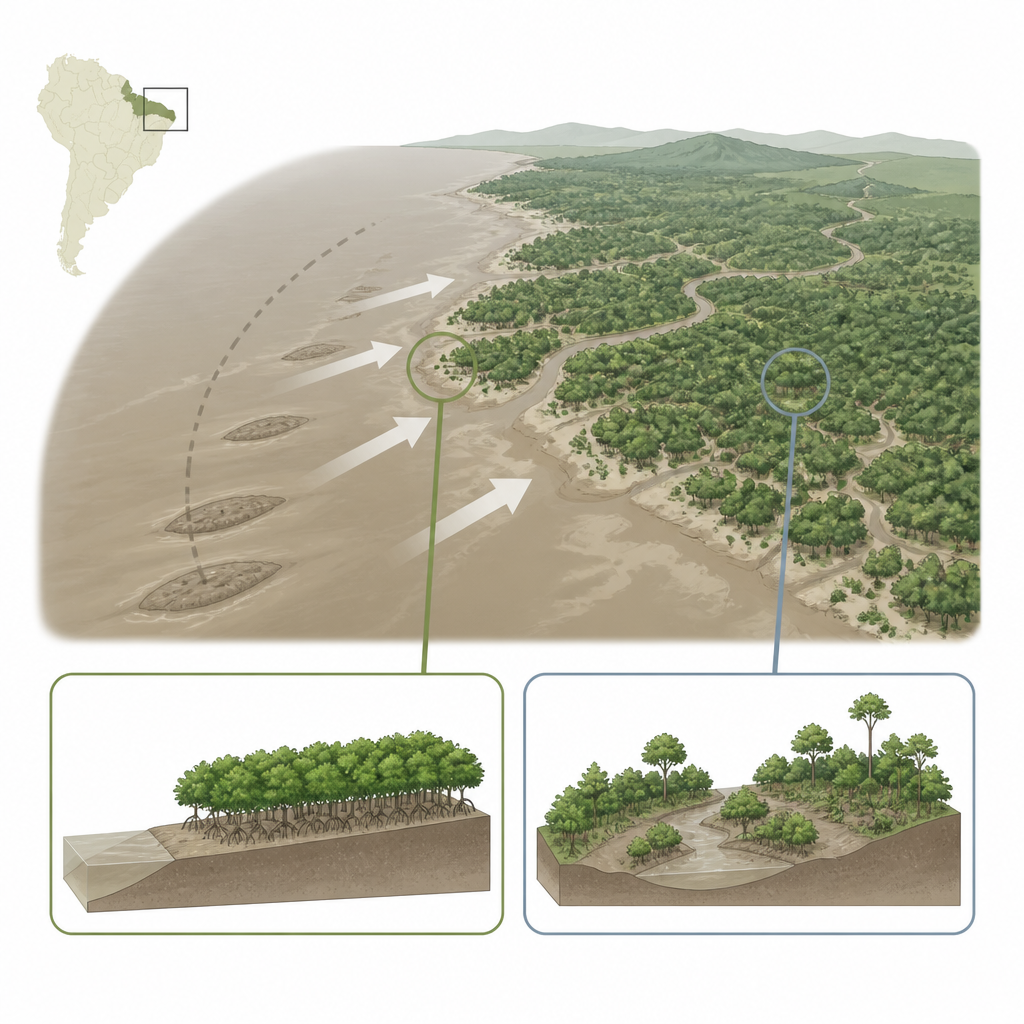
The shoreline of French Guiana is dominated by long, shore-hugging banks of fine mud carried from the Amazon. These mudbanks drift along the coast, causing alternating phases of build up and erosion. When a fresh bank arrives, it raises the seabed, calms the waves and creates new ground that mangrove seedlings can colonize. Decades later, the same area may be attacked by waves again, cutting into the forest and washing trees away. The result is a patchwork of mangrove stands of different ages and sizes, with young pioneer growth standing next to mature forests and eroding edges. This restless setting makes it hard to follow individual trees through time, so the researchers instead compared many stands of different ages to reconstruct typical growth paths.
Two kinds of mangrove neighborhoods
Not all mangroves along this coast live under the same rules. One key species, Avicennia germinans, usually forms tall, fairly even aged stands on the seaward side, directly on top of new mudbanks. Another group, Rhizophora species, more often occupies creeks and estuaries farther inland, where tides, salinity and water levels vary over short distances. The team measured tree trunk thickness at chest height and calculated aboveground biomass, a measure of the mass of wood and leaves per hectare, in 69 forest plots. They then used historical aerial photos and satellite images from 1940 onward to determine when each stand first developed a closed canopy, giving an age since establishment.
Testing how forests grow over time
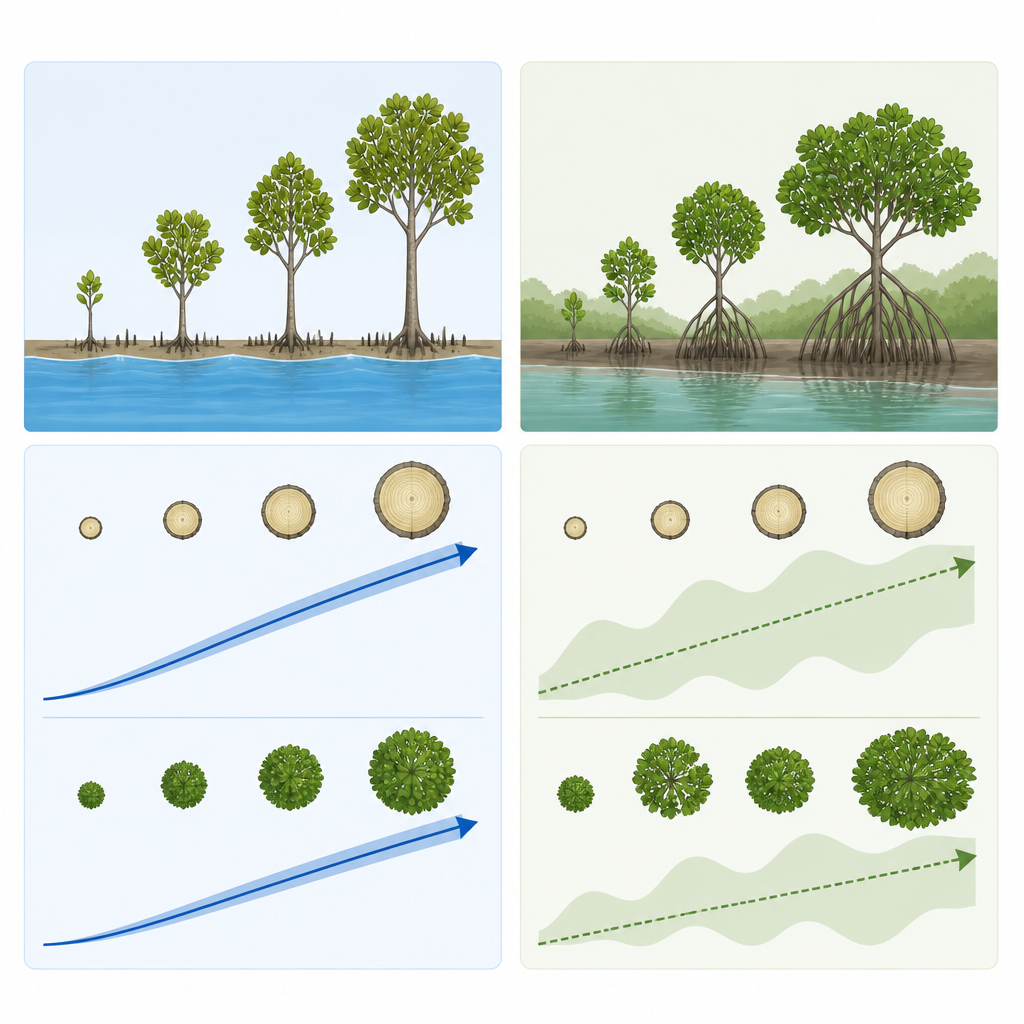
To see how well age predicts forest structure, the scientists fitted four common growth curves that relate stand age to average trunk diameter and biomass. These curves represent different shapes of growth over time, from steadily rising patterns to those that level off as the forest matures. For coastal Avicennia stands, age explained most of the variation in average trunk thickness: older stands consistently had thicker trees, and all four curves described this pattern similarly well. Biomass also tended to rise with age in these stands, but with much more scatter, likely due to differences in how many trees share a plot, how they compete for space, and past small scale disturbances.
When age is not enough
For Rhizophora dominated stands in estuaries and interior zones, age was a much weaker guide. Trunk thickness and biomass varied widely among stands of similar age, and none of the growth curves could explain more than a modest fraction of this spread. Local conditions such as flooding frequency, salt levels, nutrient supply and the complex multi stemmed form of Rhizophora trees all appear to break the simple link between stand age and forest mass. In both mangrove types, age did a better job of predicting average trunk size than total biomass, because biomass also depends on how many trees grow in a stand and how their sizes are distributed.
What this means for blue carbon
The authors conclude that stand age is a useful first clue to forest structure for coastal Avicennia mangroves in French Guiana, especially when managers need broad estimates of tree size across large areas. However, age alone is too crude for reliable biomass and carbon stock estimates, particularly in the more varied Rhizophora forests of estuaries and river mouths. To understand how much carbon these mangroves store, and how they will respond to future shifts in sea level, mud supply and storms, models must combine stand age with information on canopy height, tree density and the local physical setting. In short, knowing how old a mangrove forest is helps, but it is only part of the story in such a dynamic coastal world.
Citation: Agyekum, M.K., Protazio, J.M.B., Staquet, A. et al. Mangrove growth and biomass dynamics along the mud-dominated coast of French Guiana. Sci Rep 16, 15869 (2026). https://doi.org/10.1038/s41598-026-53756-1
Keywords: mangroves, biomass, French Guiana, mudbanks, blue carbon