Clear Sky Science · en
Seismic imagery from volcanoes on the Azores Plateau implies that explosive deep-water eruptions are more common than previously thought
Hidden blasts in the deep ocean
Most people picture volcanic explosions as fiery mountains towering above the sea, but many eruptions actually happen far below the waves. This study looks at two submarine volcanoes on the Azores Plateau in the Atlantic Ocean and finds that powerful deep-water explosions, once thought to be rare, may be surprisingly common and largely invisible from the seafloor landscape alone.
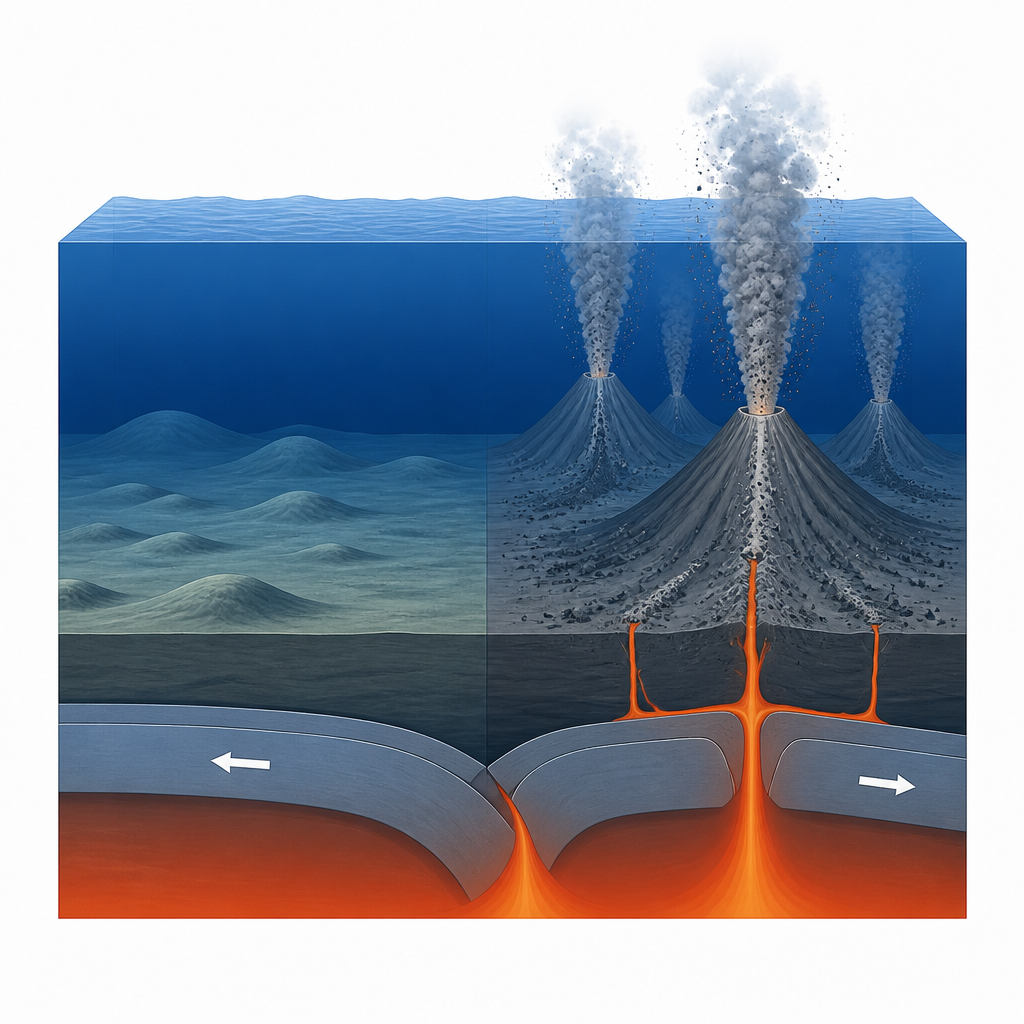
Volcanoes buried under the waves
The Azores Plateau is a broad underwater high created by unusually hot and chemically rich rock rising from deep within Earth. Scattered across this plateau are more than a million submarine volcanoes worldwide, many at depths of several kilometers. Because they are hard to reach, scientists usually infer their behavior from seafloor maps and sparse rock samples. Until now, the prevailing view held that the crushing pressure of deep water keeps even gas-rich magmas mostly quiet, oozing out lava gently rather than exploding.
Listening to the seafloor with sound
To test this view, the researchers used high-resolution seismic reflection data and detailed seafloor maps from two deep-water volcanoes more than 2 kilometers below the surface. Seismic imaging works a bit like medical ultrasound for the seabed: sound waves travel into the seafloor and bounce back from different layers, revealing their internal structure. By tracing patterns of strong and weak reflections, and comparing them with cores and drill holes from other volcanic regions, the team could distinguish between solid lava flows and loose, fragmented debris left by explosive eruptions.
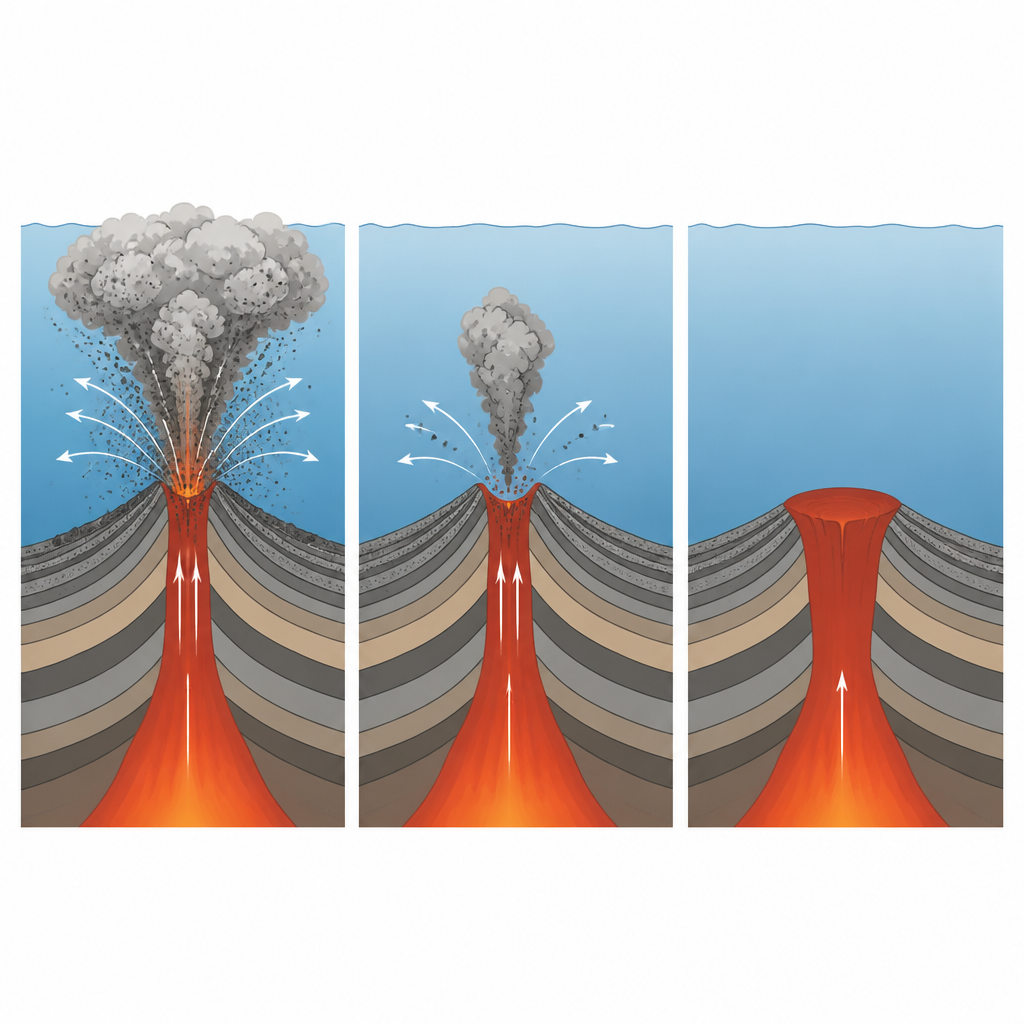
Reading the life story of a hidden volcano
Beneath the two volcanoes, the imagery shows a thick sheet of ancient lava that once spread across a huge area of the plateau at great depth. Above this, finely layered mud settled on the seafloor over millions of years. Within this quiet cover, the scientists identified subtle funnel-like structures and disturbed zones that point to rising magma and possible hydrothermal activity. On top of these, they found mound-shaped volcanic cones made mostly of stratified, broken rock fragments rather than smooth coherent lava, along with crater-like depressions at their summits that are now buried.
From fierce blasts to gentle lava flows
The internal layering of the cones reveals a sequence of events. The lower flanks consist of highly fragmented volcanic debris that matches known signatures of explosive eruptions observed elsewhere. The presence of buried craters suggests that eruptions began violently, blasting magma into ash and gravel that settled downslope. Later, as the magma lost gas or its composition changed, activity became less explosive. Coarser material and even lava then filled the craters and capped the volcanoes, smoothing their tops. This quiet ending helps explain why modern seafloor maps often show simple cones without obvious explosion craters, even where the eruption history was anything but gentle.
Why deep blasts matter for climate and oceans
The findings challenge the assumption that high water pressure almost always suppresses explosive activity in the deep ocean. The study shows that eruptions at depths greater than 2 kilometers can still be strongly explosive, possibly driven by high levels of carbon dioxide in the magma or intense interactions between hot lava and cold seawater. Because explosive eruptions release gas and ash more efficiently than slow lava flows, they may contribute more to the ocean and atmosphere than previously thought. The authors conclude that seismic imaging is essential to uncover these hidden events, and that explosive deep-water eruptions may be much more frequent worldwide than seafloor shapes alone would suggest.
Citation: Hübscher, C., Friedrich, A., Preine, J. et al. Seismic imagery from volcanoes on the Azores Plateau implies that explosive deep-water eruptions are more common than previously thought. Sci Rep 16, 15066 (2026). https://doi.org/10.1038/s41598-026-53050-0
Keywords: submarine volcanism, deep-water eruptions, Azores Plateau, seismic imaging, volcanic ash