Clear Sky Science · en
Six-degree-of-freedom knee motion during treadmill walking in mechanically and kinematically aligned TKA
Why knee replacement alignment matters
Total knee replacement helps many people walk with less pain, yet up to one in five patients still feel their new joint is not quite right. Surgeons now debate whether placing the artificial joint in a standard straight position for everyone or tailoring it to each person’s natural leg shape gives better results. This study followed people on a treadmill before and after knee replacement to see how these two approaches affect the way the knee actually moves during walking.
Two ways to line up a new knee
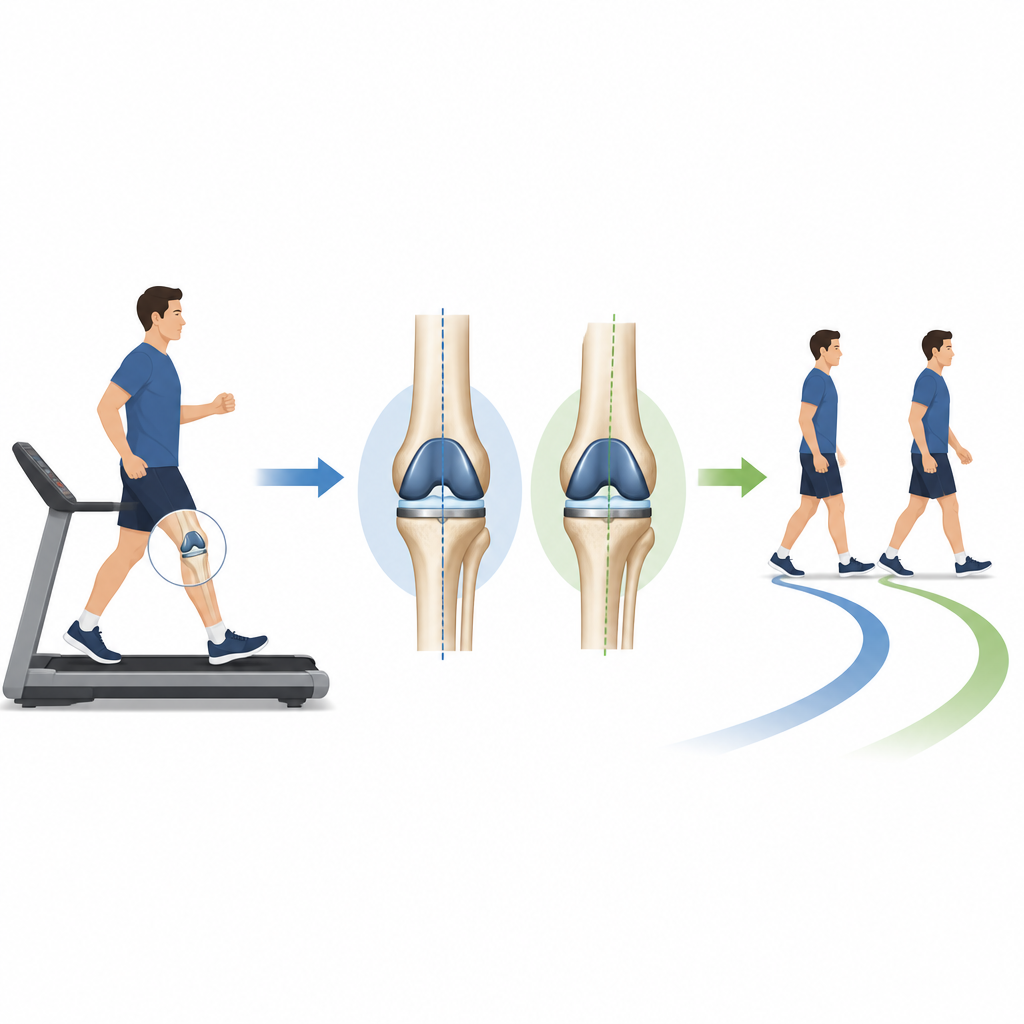
In traditional surgery, the new knee is positioned so that the leg is as straight as possible from hip to ankle. In the newer, more tailored approach, the surgeon tries to copy the patient’s own pre-arthritis leg shape, which may be slightly bow-legged. The team randomly assigned almost 100 people needing knee replacement to receive one of these two methods and used the same type of implant in all patients. They then compared them with a group of volunteers who had no arthritis. Everyone walked on a treadmill on level ground and on a downhill slope at their fastest comfortable speed, both one day before surgery and again one year later.
Watching the knee move in six directions
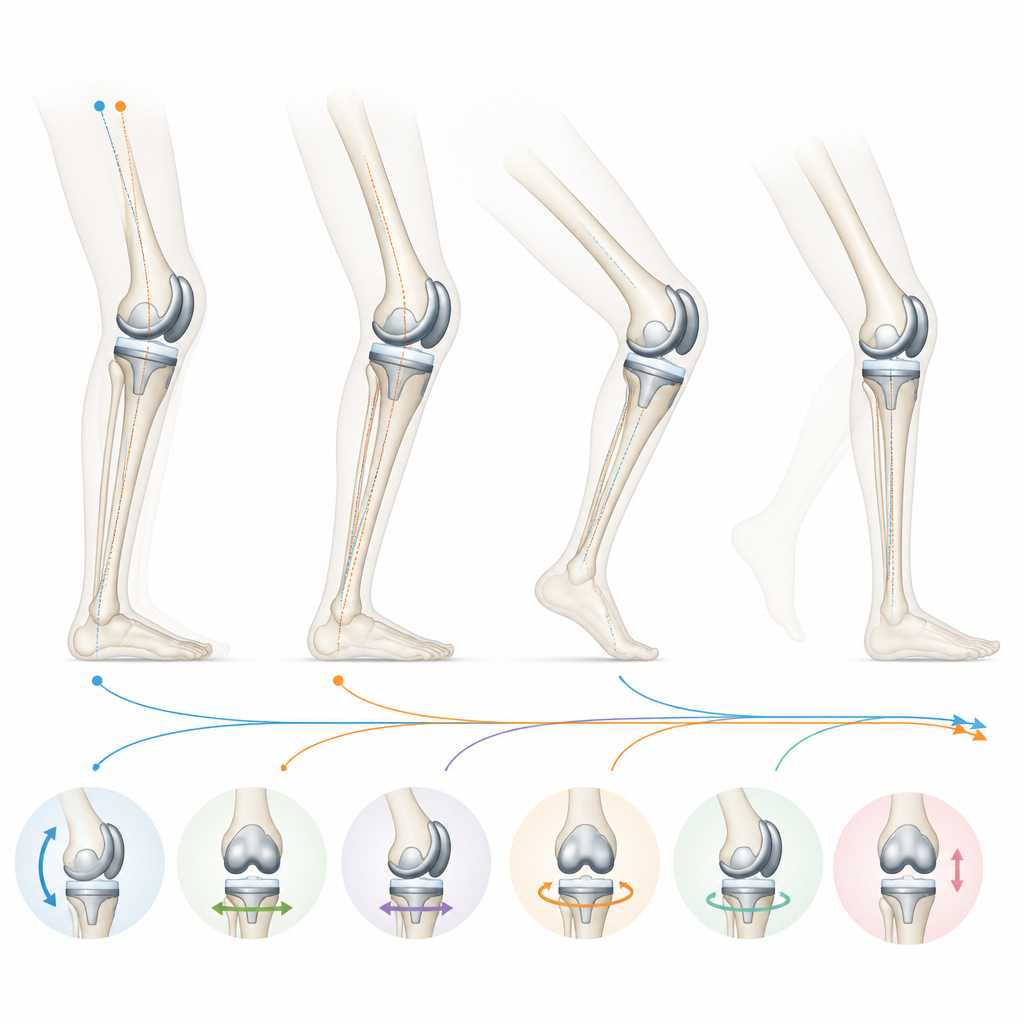
Instead of looking only at how far the knee bends and straightens, the researchers tracked its motion in all six directions: bending, tilting side to side, turning in and out, and sliding and separating of the joint surfaces. They used reflective markers and high-speed cameras to reconstruct the motion of the thigh and shin bones very precisely. From these data they calculated a range-of-motion score that summarized how much the knee moved during walking before surgery. They also asked patients how “natural” their joint felt one year later, using a questionnaire that measures how often people notice their artificial knee in everyday life.
How tailored and standard knees compared
One year after surgery, the overall walking patterns of the two surgical groups were surprisingly similar. For most directions of movement, there were no meaningful differences between the standard and tailored alignment during either level or downhill walking. Both groups still showed some differences from healthy volunteers, such as slightly reduced ability to fully straighten the knee and less separation of the joint surfaces. However, when the researchers focused on patients who started with clearly bow-legged knees, an interesting pattern emerged. In this subgroup, those who received the tailored alignment walked more like the healthy volunteers and reached walking speeds closer to normal.
Matching technique to the individual
The way the knee moved did not fully explain how patients felt about their new joint, but satisfaction scores did differ between groups. On average, people whose replacement was tailored to their own leg shape reported that they noticed their joint less in daily life. The team also found that patients who could move their knee more freely before surgery tended to do better with the tailored method. In contrast, women with stiffer knees before surgery appeared to benefit slightly more from the standard straight alignment. These findings hint that factors such as pre-surgery flexibility, sex, and initial leg shape all influence which alignment strategy works best.
What this means for future knee surgery
For the average patient, both alignment methods led to similar knee motion during walking one year after surgery, but people with bow-legged alignment and good pre-surgery movement seemed to gain more from a tailored approach. Rather than searching for a single “best” way to position every artificial knee, this study suggests surgeons may achieve better outcomes by matching the alignment method to the individual’s leg shape and movement profile. Over time, such patient-specific choices could help more people feel that their new knee truly belongs to their own body.
Citation: Einfeldt, AK., Tücking, L., Savov, P. et al. Six-degree-of-freedom knee motion during treadmill walking in mechanically and kinematically aligned TKA. Sci Rep 16, 15109 (2026). https://doi.org/10.1038/s41598-026-52076-8
Keywords: total knee arthroplasty, gait analysis, kinematic alignment, mechanical alignment, patient-specific surgery