Clear Sky Science · en
Applying explainable artificial intelligence to interpret supervised ensemble learning models for robust credit card fraud detection
Why smarter fraud checks matter to you
Every time you tap your card or shop online, invisible systems decide in a split second whether the payment is safe. If they are too strict, your card is declined at the grocery store. If they are too lax, a criminal can drain your account. This study looks at how to build fraud detectors that are not only accurate but can also explain their decisions, giving banks tools that are both effective and trustworthy.

From simple rules to learning from data
Older fraud systems mainly relied on fixed rules, such as blocking any purchase over a certain amount or in a distant country. Criminals quickly learned to work around those limits. The authors instead explore supervised machine learning, where models are trained on past transactions labeled as genuine or fraudulent. They compare four popular approaches that span from simple linear formulas to more flexible tree based ensembles able to capture subtle patterns in spending behavior.
Testing across many types of card use
To make sure their findings are not tied to one special dataset, the researchers evaluate the four models on three very different collections of card payments. One is a well known European dataset with only a tiny fraction of fraud cases. Another includes richer details such as location, merchant information, and customer data. A third, much larger synthetic set from industry contains tens of millions of transactions. Across all of them, ensemble methods such as Random Forest, XGBoost, and LightGBM usually spot suspicious behavior far better than the simpler baseline model.
Opening the black box of model decisions
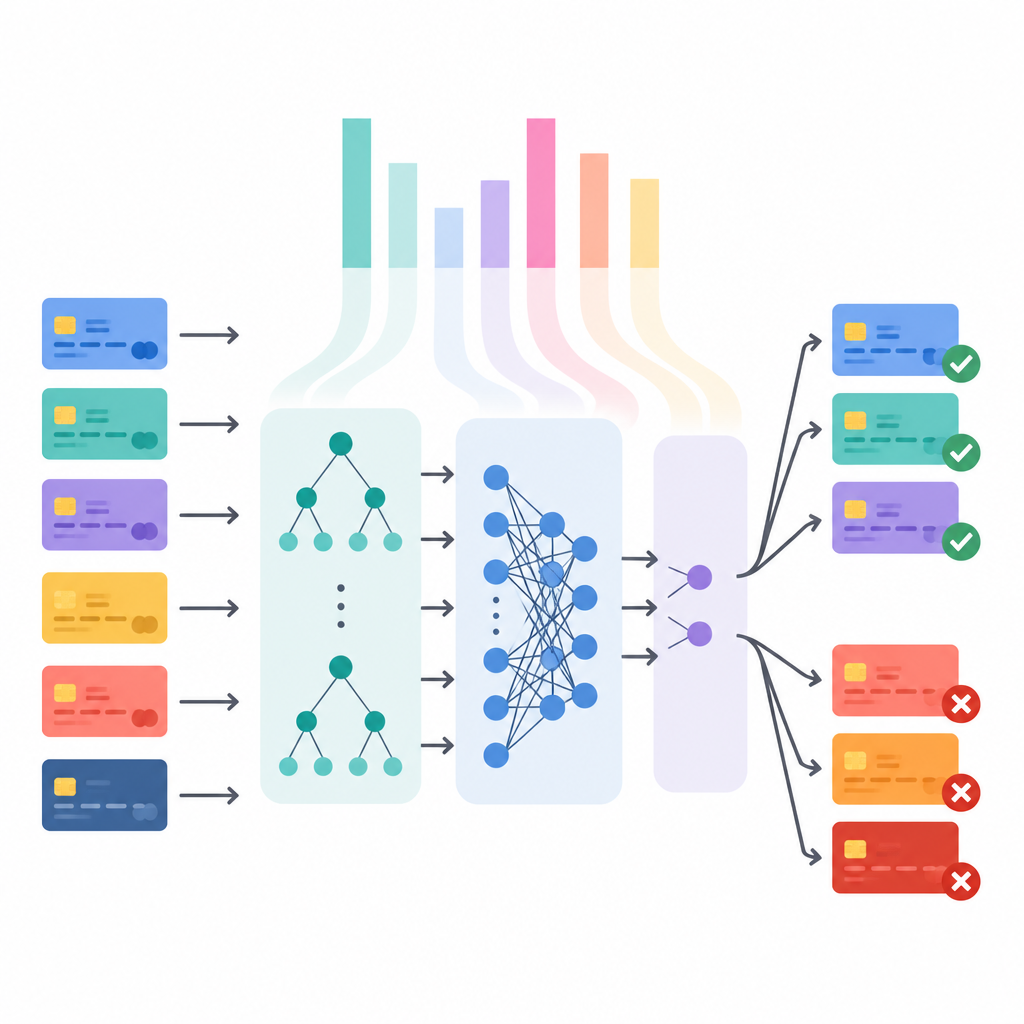
High accuracy alone is not enough for banks or regulators, who increasingly demand to know why a given transaction was blocked. The study therefore links prediction quality to clarity using a method called SHAP, which assigns each input feature a contribution toward the final decision. For whole datasets, these explanations reveal which clues tend to signal fraud, such as particular merchant categories, unusual timing of purchases, or patterns of small test charges followed by larger ones. For single payments, they show how specific details pushed the model toward “fraud” or “legit,” giving analysts a clear starting point for review.
Balancing missed fraud and false alarms
Because fraudulent purchases are so rare, it is easy for a model to appear accurate simply by calling almost everything safe. The authors dig into this imbalance by looking at precision, recall, and related scores, paying special attention to the fraud class itself. They find that some models, like logistic regression, can catch many frauds but at the price of huge numbers of false alerts, while others, such as XGBoost, offer a better compromise between catching bad transactions and leaving genuine customers undisturbed. They also show how shifting the decision threshold lets banks tune this trade off to match their own risk appetite and the financial cost of mistakes.
Bringing explainable fraud tools into the real world
Finally, the paper outlines how such systems could be deployed in practice. The authors suggest a two step setup in which a fast, recall focused model first flags suspect payments, and a more precise model with built in explanations then ranks and justifies those alerts for human investigators. They discuss technical needs like low response times, scalable cloud services, and monitoring for changing fraud tactics, as well as legal requirements that customers receive understandable reasons when automated systems affect them.
What this means for everyday cardholders
In simple terms, the study shows that modern machine learning can make fraud checks both sharper and more transparent. Tree based ensemble models, especially XGBoost and LightGBM, tend to give the best mix of detection power and understandable reasoning across several realistic datasets. By pairing these models with explanation tools and careful tuning of error costs, banks can design fraud systems that better protect your money while reducing frustrating false declines and meeting strict regulatory standards.
Citation: Awad, S.S., Hamza, A.A., Sobh, M.A. et al. Applying explainable artificial intelligence to interpret supervised ensemble learning models for robust credit card fraud detection. Sci Rep 16, 15220 (2026). https://doi.org/10.1038/s41598-026-49939-5
Keywords: credit card fraud, explainable AI, machine learning, ensemble models, financial security