Clear Sky Science · en
Enhanced 3D imaging accuracy using curved sensors: a simulation-based approach
Sharper digital vision for everyday 3D scanning
From facial recognition on phones to factory robots checking the size of a car part, many systems now rely on cameras that can measure the three-dimensional shape of real-world objects. Yet the cameras inside most 3D scanners still borrow a century-old idea: a flat electronic sensor placed behind a lens. This paper explores a deceptively simple twist—bending that sensor into a gentle curve—and shows, through detailed computer simulations, that it can make 3D measurements noticeably sharper and more reliable without adding expensive, bulky optics.
Why flat eyes struggle to see clearly
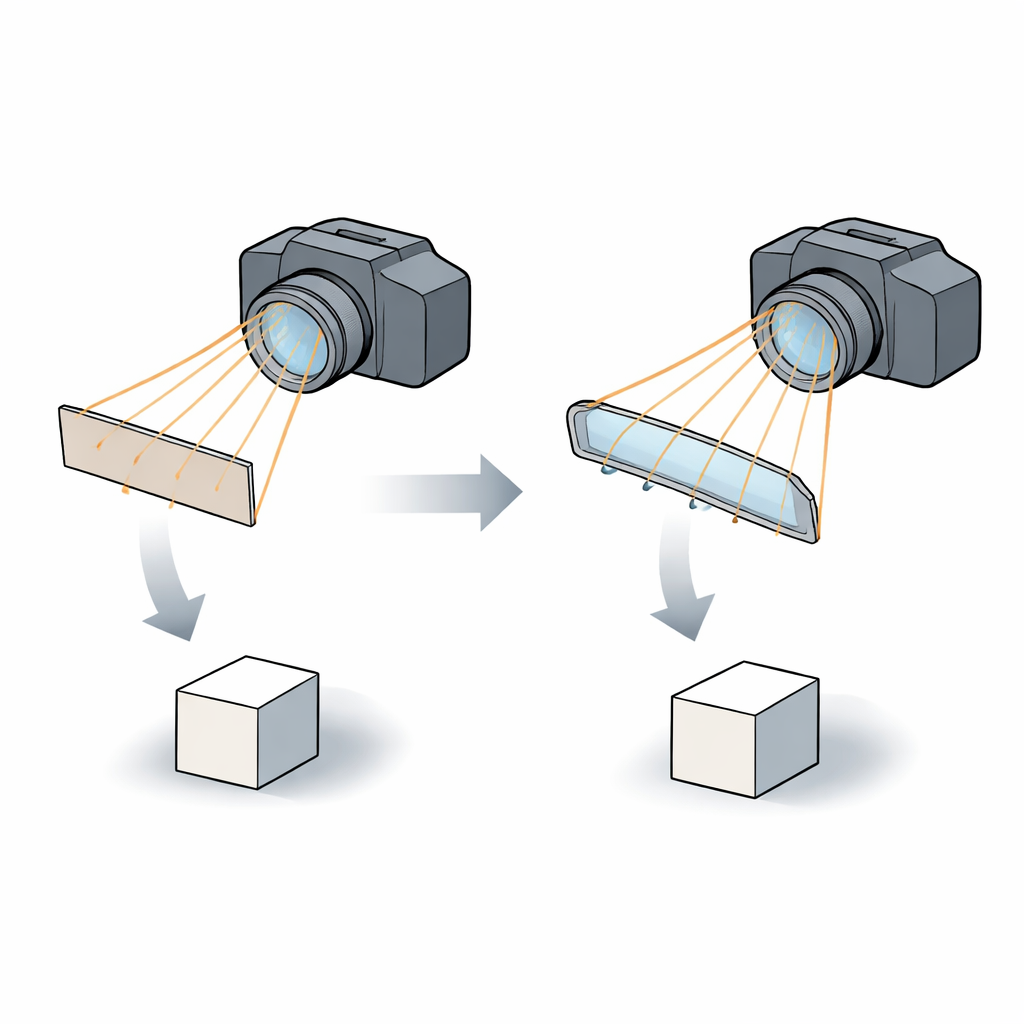
In a typical camera or 3D scanner, light reflected from an object passes through a lens and lands on a flat sensor tiled with millions of tiny pixels. The problem is that lenses naturally bring light to focus on a curved surface, not a flat one. At the center of the image this mismatch is small, so details look sharp. Toward the edges, however, the focus drifts, causing blur and subtle shape distortions that are especially damaging when the goal is to measure distances or dimensions with high precision. Engineers can fight this by stacking multiple lenses to force the light onto a flat sensor, but that makes the system more complex, heavier, and costlier.
Borrowing a trick from living eyes
Human and animal eyes solve the problem differently: the light-sensitive retina is curved, closely matching the way the lens focuses light. Inspired by this, the authors simulated camera systems in which the flat electronic sensor is replaced by a curved one shaped to follow the natural focal surface of the lens. They examined both a simple three-lens setup and a more complex multi-lens design similar to those found in commercial cameras. In each case, they compared how well flat and curved sensors handled common image imperfections such as blurring, stretching, and streaking of details away from the image center.
Turning a curved picture into usable numbers
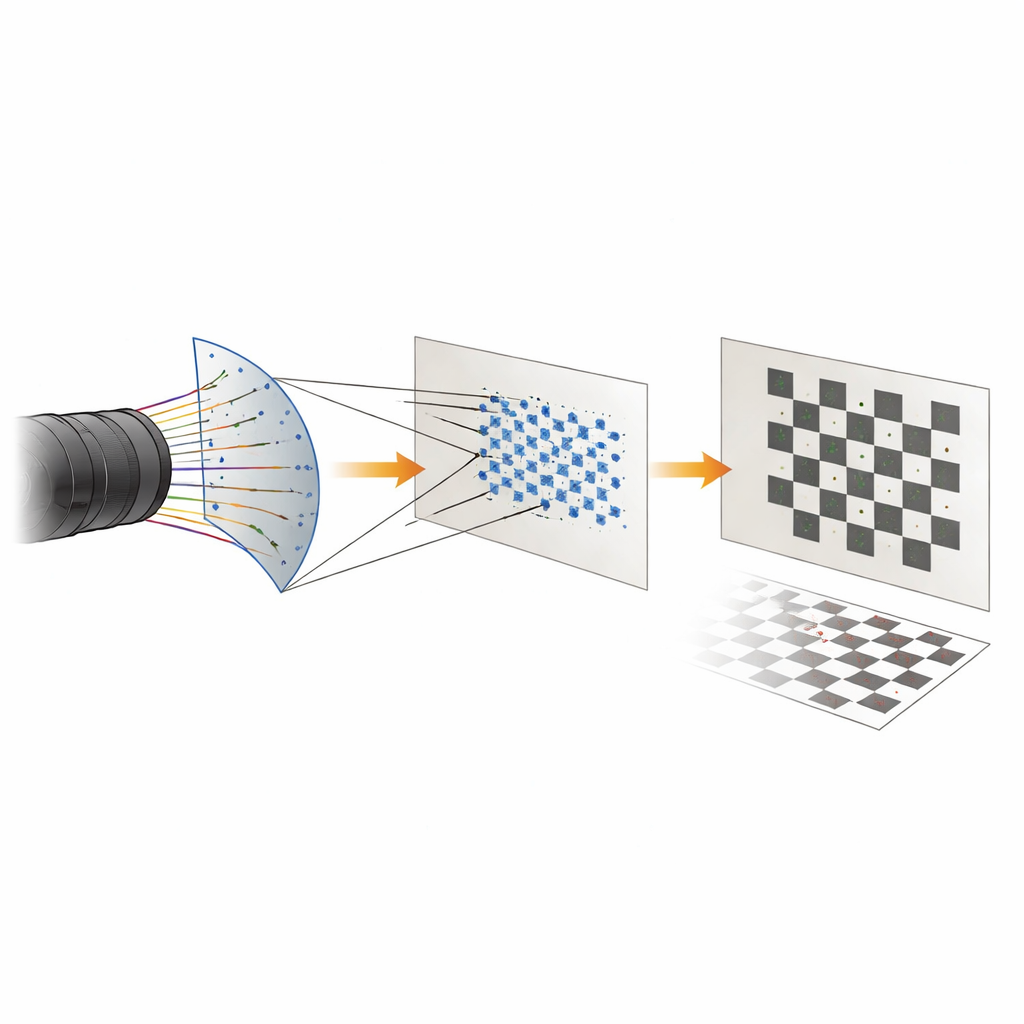
Curving the sensor introduces a new challenge: most software tools used to convert camera images into precise 3D measurements assume the sensor is flat. To address this, the researchers devised a mathematical shortcut. They treat the curved sensor like a thin slice of a sphere and work out how every point on that surface would project back onto an imaginary flat plane. Once those points are “unwrapped” in this way, standard camera-calibration methods—originally designed for flat sensors—can be reused without major changes. This spherical mapping allows the team to estimate how accurately the curved-sensor system could recover real-world sizes and positions.
Putting curved and flat sensors to the test
Using a combination of specialized optical-design software and a virtual calibration tool, the authors generated realistic images of a checkerboard pattern, similar to those used in camera factories. They then ran the same measurement procedure on both flat and curved sensors. For the flat sensor, the average distance errors in reconstructing the pattern’s geometry were about 1.41 percent. With the curved sensor, those errors dropped to 0.78 percent—a reduction of roughly 45 percent. The improvement held up across different lens designs, focal lengths, and sensor curvatures, suggesting that the benefit comes mainly from the sensor shape rather than from fine-tuning the optics.
What this means for future cameras
To a non-specialist, the main message is straightforward: if we bend the camera’s “film” to fit the way lenses really focus light, we can get crisper edges and more trustworthy 3D measurements without resorting to complex glass assemblies. Although the study is based on simulation rather than physical prototypes, it indicates that curved sensors could make future 3D scanners, inspection systems, and perhaps even consumer cameras both more accurate and potentially cheaper. As manufacturing methods for curved electronic detectors mature, this sensor-first approach could help close the gap between man-made cameras and the finely tuned vision systems found in nature.
Citation: Emam, S.M., Daliri, H., Foorginejad, A. et al. Enhanced 3D imaging accuracy using curved sensors: a simulation-based approach. Sci Rep 16, 13004 (2026). https://doi.org/10.1038/s41598-026-48047-8
Keywords: 3D imaging, curved image sensor, camera calibration, optical aberration, machine vision