Clear Sky Science · en
Evaluation of the antiparasitic efficacy of praziquantel against Prohemistomum vivax (Cyathocotylidae) metacercariae in naturally infected African catfish (Clarias gariepinus)
Why sick farmed fish matter to us
African catfish is an important source of affordable protein in Egypt and across much of Africa. Yet many farmed fish are quietly weakened by tiny parasitic worms that lodge as cysts inside their muscles and organs. These hidden infections can stunt growth, kill fish, and cost farmers money. This study tests whether a widely used human medicine, praziquantel, can safely clear one of the most damaging parasites from catfish and explores how the drug might work inside the parasite’s cells.
A hidden worm in a key food fish
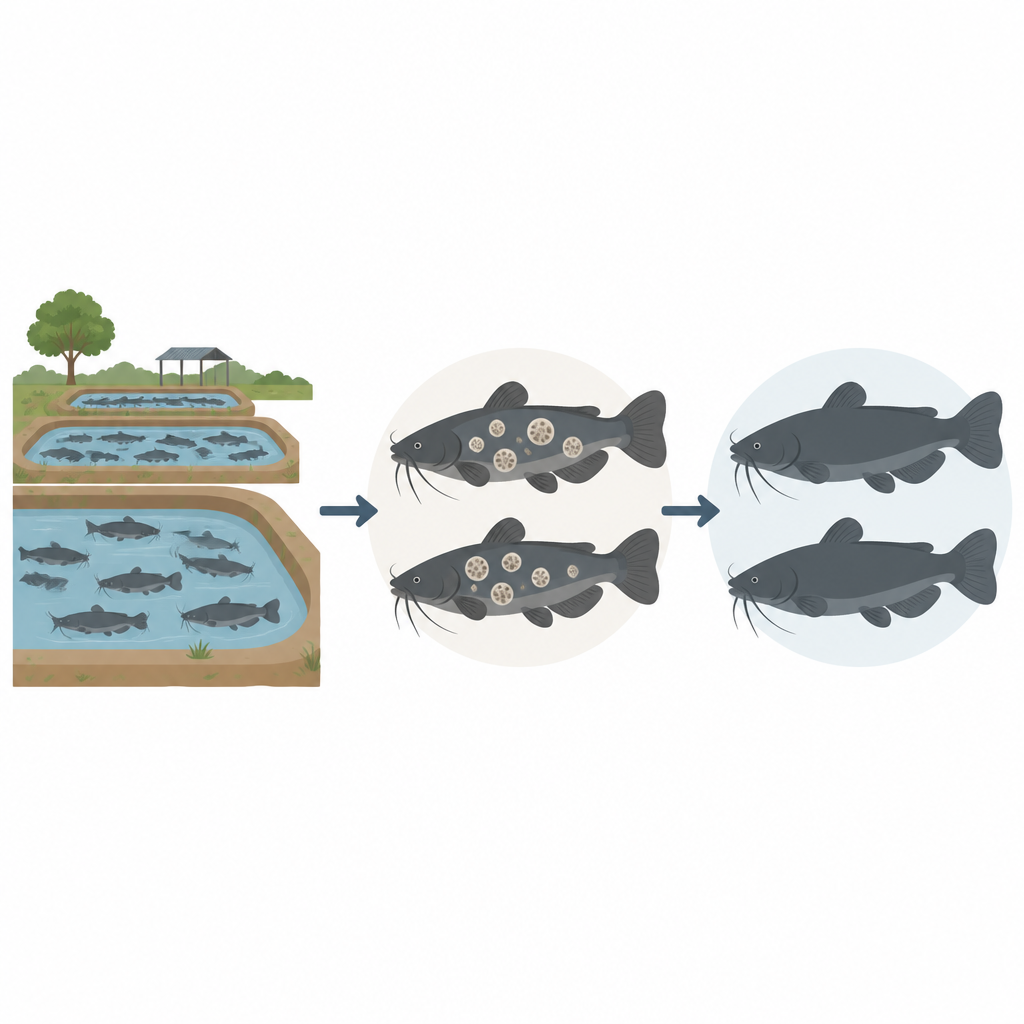
The parasite Prohemistomum vivax has a complex life cycle that moves between water birds, snails, and fish. In African catfish, its larval stage forms tough-walled cysts in the muscles and liver. Heavy infections scar tissues, trigger strong inflammation, slow growth, and can increase deaths in crowded ponds. In some Egyptian catfish farms, more than eight out of ten fish carry these cysts. Traditional control methods such as killing snails in ponds or using older parasite drugs either miss the encysted stages or raise environmental and safety concerns, so farmers need better options.
Testing a familiar drug in catfish tanks
The researchers collected naturally infected African catfish from a commercial farm, confirmed the parasite’s identity using both microscopy and DNA sequencing, and then divided 105 fish into seven groups. One group stayed untreated, while the others were bathed in water containing different amounts of praziquantel for 24 hours, either once or twice a week apart. After two weeks, the team counted live and damaged cysts in muscle and liver samples, inspected tissue slices under the microscope, and measured the activity of two genes that signal inflammation in fish, TNF-alpha and IL-1 beta.
How well the treatment cleaned up the worms
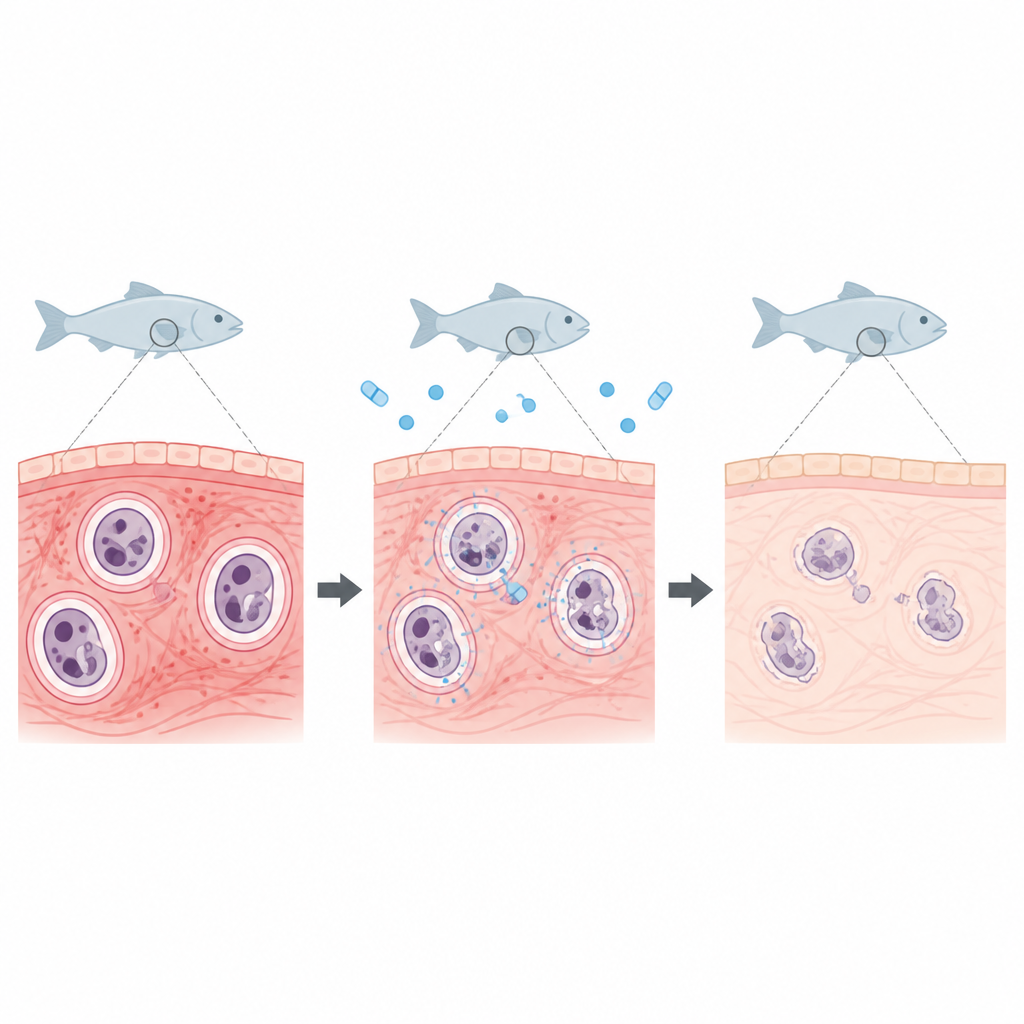
Praziquantel worked in a clear dose-dependent way. A single low bath removed about one third of the cysts, and a single higher bath removed roughly two thirds. When the same doses were repeated a week later, the impact grew stronger. The best result came from two baths at the highest tested dose, which cut the parasite load by about 94 percent without causing any drug-related deaths or abnormal behavior. Under the microscope, treated fish showed far fewer cysts, many of which were collapsed or degenerated, along with calmer liver and muscle tissues and much less inflammatory scarring compared with untreated fish.
Peeking inside the parasite’s power plants
Beyond counting cysts, the team asked how praziquantel might be harming the worms. They used computer models to see whether the drug could fit into cytochrome c oxidase, a key enzyme in the parasite’s mitochondria, the structures that generate energy. The simulations suggested that praziquantel can nestle into a pocket on this enzyme and form stable, mostly hydrophobic contacts with several conserved amino acids. Further modeling of molecular movement hinted that this binding site becomes relatively rigid, suggesting that the drug might disturb normal energy production. These digital results do not prove the target, but they support the idea that mitochondrial stress could add to the drug’s known effects on parasite calcium balance.
What this means for fish farms and medicine
Together, the tank experiments and computer modeling show that carefully dosed praziquantel baths can greatly reduce damaging worm cysts and inflammation in African catfish, helping fish recover without obvious side effects. Because the same drug is also vital for treating millions of people with parasitic diseases, the authors stress that its use in aquaculture must be tightly managed, with clear withdrawal periods for food safety and limits to avoid encouraging drug resistance. They argue that praziquantel should be reserved for confirmed heavy infections and combined with better pond management, snail control, and bird exclusion to keep parasite levels low in the long term.
Citation: Abdelsalam, M., Abdelkhalek, S., Korany, R.M.S. et al. Evaluation of the antiparasitic efficacy of praziquantel against Prohemistomum vivax (Cyathocotylidae) metacercariae in naturally infected African catfish (Clarias gariepinus). Sci Rep 16, 15741 (2026). https://doi.org/10.1038/s41598-026-46340-0
Keywords: African catfish, fish parasites, praziquantel, aquaculture health, mitochondrial mechanisms