Clear Sky Science · en
Effect of change-of-direction vs. linear repeated sprint training on physical performance in female college basketball players
Why quick turns matter on the court
For anyone who has watched a basketball game, the most striking moments are often the explosive bursts of speed, sudden stops, and sharp cuts as players fight for position. This study asked a simple, practical question: for female college basketball players, is it better to train by sprinting in straight lines or by sprinting with built‑in quick changes of direction? The answer could help coaches design smarter workouts that translate more directly to game performance and help athletes stay fast and resilient deep into the fourth quarter.
Two ways to train for the same game
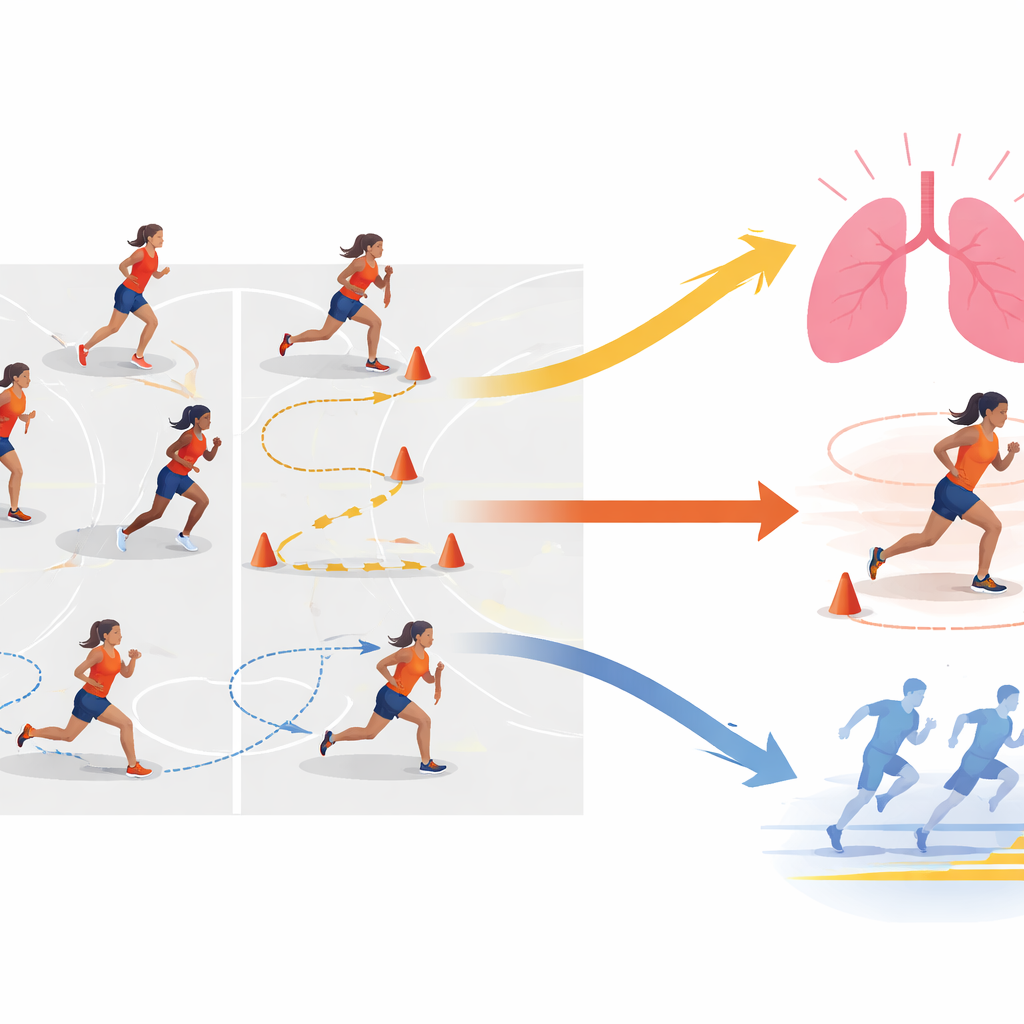
Researchers worked with 30 trained female college basketball players and divided them into two groups. One group practiced repeated sprints that included a sharp 180‑degree turn halfway through each effort, simulating the cuts and stops seen in real games. The other group ran the same number of high‑intensity sprints over the same distance but in a straight line. Both groups followed this added sprint program twice a week for six weeks during the pre‑season, on top of their usual team practices. Before and after the training block, the players were tested on short sprints, vertical jumps, a basketball‑style repeated sprint test, a zigzag agility run, and a treadmill test that estimated their maximum ability to use oxygen, a key marker of endurance.
What got faster and what stayed the same
After six weeks, both training styles produced some general gains. Players in both groups jumped higher and were slightly quicker over 10 meters, suggesting that any form of repeated high‑speed running can sharpen basic explosiveness. However, neither group improved much over longer sprint distances such as 20 and 30 meters, and the single best sprint in the repeated sprint test did not change meaningfully. This pattern suggests that the extra sessions were not powerful enough, or not targeted enough, to boost pure top‑speed sprinting, but they did help with overall short‑burst performance.
Sharp cuts boost staying power
The real differences appeared when the researchers looked at repeated effort and agility. Only the players who trained with rapid changes of direction clearly improved their ability to perform a series of short sprints with less slowdown from the first to the last effort. Their average time across six shuttle‑style sprints improved more, and their fatigue index dropped more, than in the straight‑line group. This means they could maintain speed better across repeated efforts—exactly what is demanded during intense defensive sequences or fast‑break exchanges. These same players also showed larger gains in the zigzag test, which measures how quickly an athlete can slow, cut, and accelerate around angled turns. In other words, practicing sharp turns made them noticeably better at handling sharp turns under test conditions.
Heart and lungs benefit from quick turns too
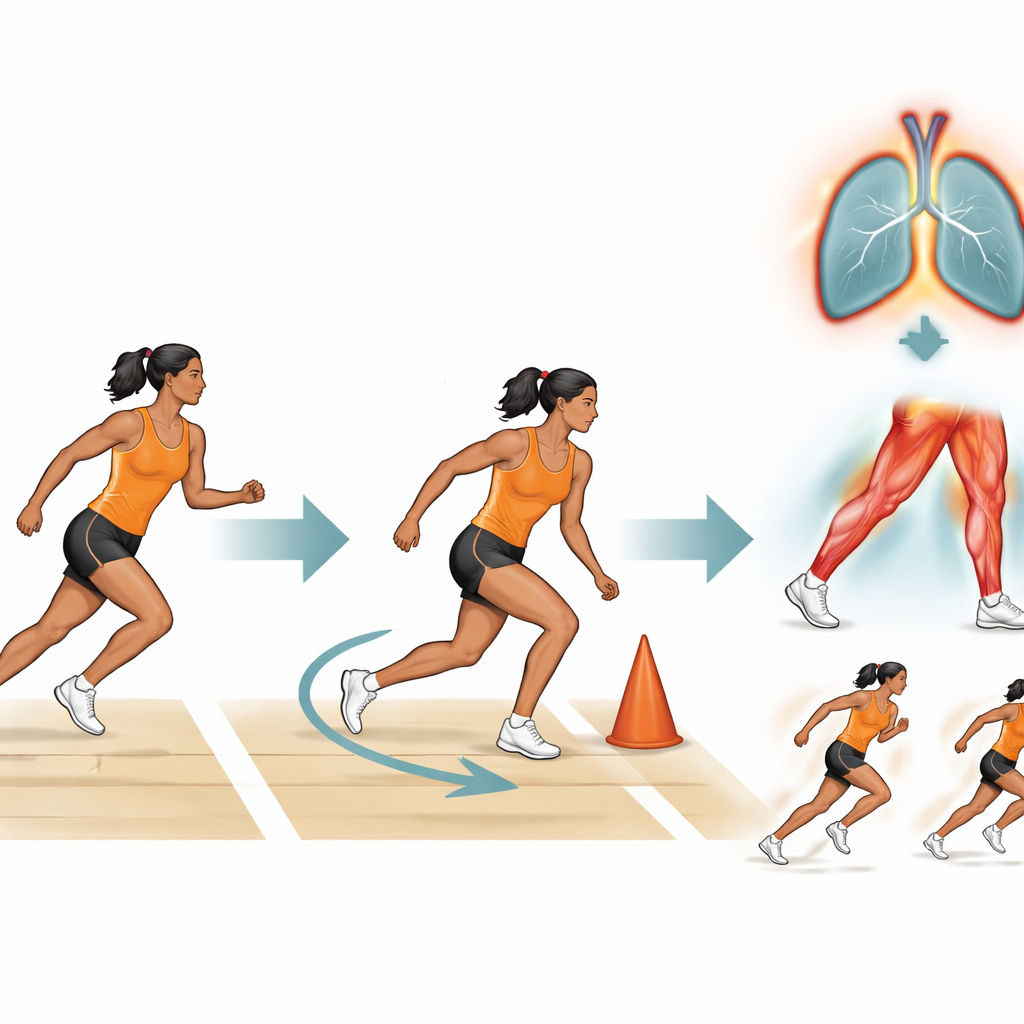
Interestingly, the change‑of‑direction group also improved their estimated maximal oxygen uptake more than the straight‑line sprinters. Although both groups did equally many sprints, the quick‑turn version likely placed extra stress on the muscles and energy systems because of the repeated braking and re‑acceleration. That extra challenge appears to have nudged their heart and lungs to adapt more, raising their capacity to take in and use oxygen. In a sport where players must sprint, stop, and sprint again for long stretches, this kind of hidden endurance gain can make the difference between finishing strong and fading late.
What this means for players and coaches
To a layperson, the takeaway is straightforward: for female college basketball players, sprint drills that mimic game‑like cutting and turning do more than just make you quick on a straight line. They seem to build better repeat‑sprint resilience, sharper agility, and stronger overall fitness than the same volume of straight‑line sprints. While both methods helped a bit with jumping and short acceleration, only the change‑of‑direction workouts clearly improved the qualities most critical for surviving the stop‑and‑go chaos of real games. Coaches designing conditioning sessions may want to favor shuttle‑style, direction‑changing sprints when the goal is to prepare players for the fast, multidirectional demands of competitive basketball.
Citation: Lin, Y., Zhang, W., Zhao, L. et al. Effect of change-of-direction vs. linear repeated sprint training on physical performance in female college basketball players. Sci Rep 16, 10939 (2026). https://doi.org/10.1038/s41598-026-45810-9
Keywords: basketball conditioning, female athletes, change-of-direction, repeated sprint training, agility