Clear Sky Science · en
The effects of social media addiction on depression and anxiety among university students: The mediating role of family environment
Why this topic matters to everyday life
Many university students spend hours each day scrolling through social media. This study looks at what happens when that use becomes hard to control and starts to feel like an addiction. Focusing on students in Saudi Arabia, the researchers ask how heavy social media use relates to depression and anxiety, and whether the tone of family life at home can soften or intensify those emotional struggles.
Social media use and emotional strain
The researchers describe social media addiction as a pattern where students feel compelled to check their feeds, struggle to cut back, and feel uneasy when they cannot go online. Earlier work has linked this kind of use to loneliness, stress, and low mood. Two ideas help explain why. Mood enhancement theory suggests that people who feel bad may turn to social media for quick relief, but over time this habit deepens dependence instead of solving problems. Social comparison theory adds that constant exposure to polished images of other people’s lives can make users feel inferior, feeding both sadness and nervousness.
Why the Saudi setting is important
Most research on social media addiction has been carried out in Western countries, which represent only a small slice of the world. Saudi Arabia offers a different picture: it is highly connected digitally yet strongly centered on family ties. The authors argue that in such a culture, the family environment could play a bigger role in how online habits affect mental health. To explore this, they surveyed 627 full time students from four public universities across three major regions, using well established questionnaires on social media addiction, depression, anxiety, and family relationships.
How family life fits into the picture
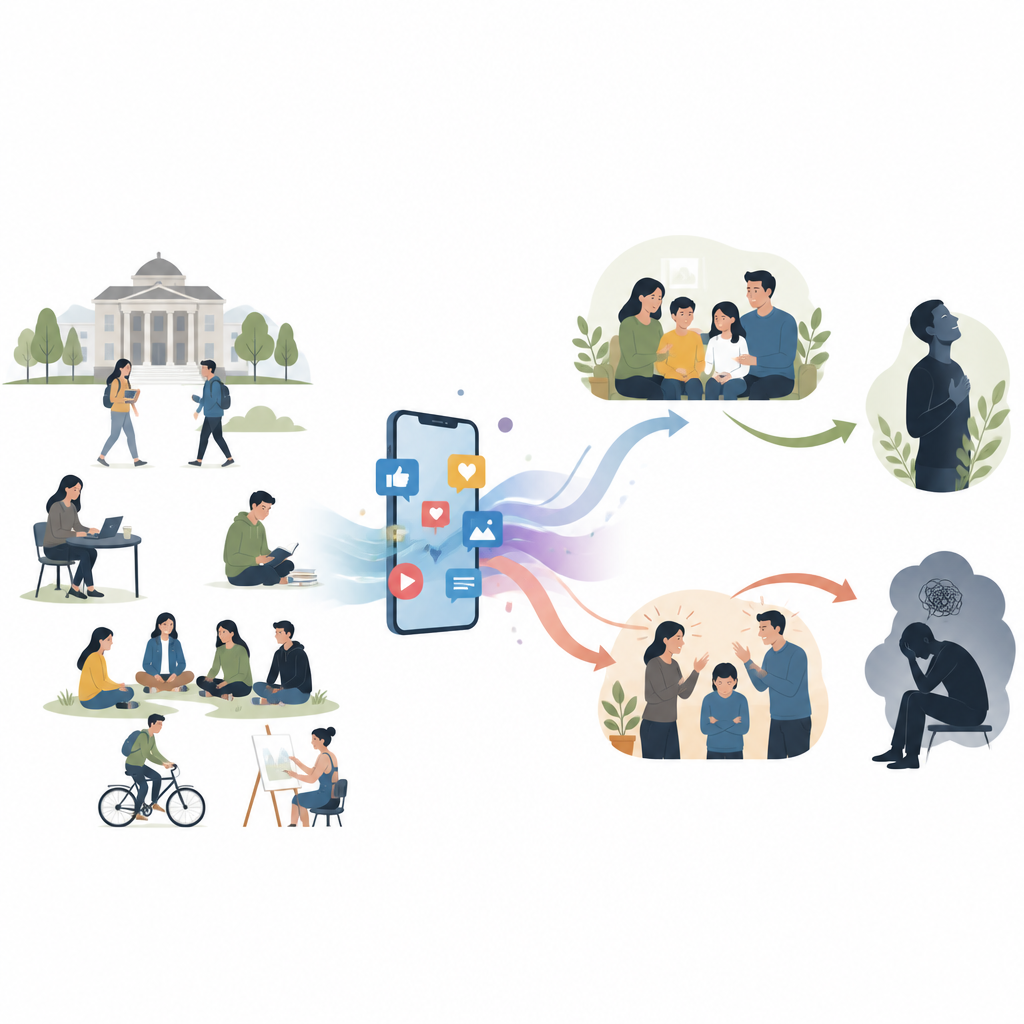
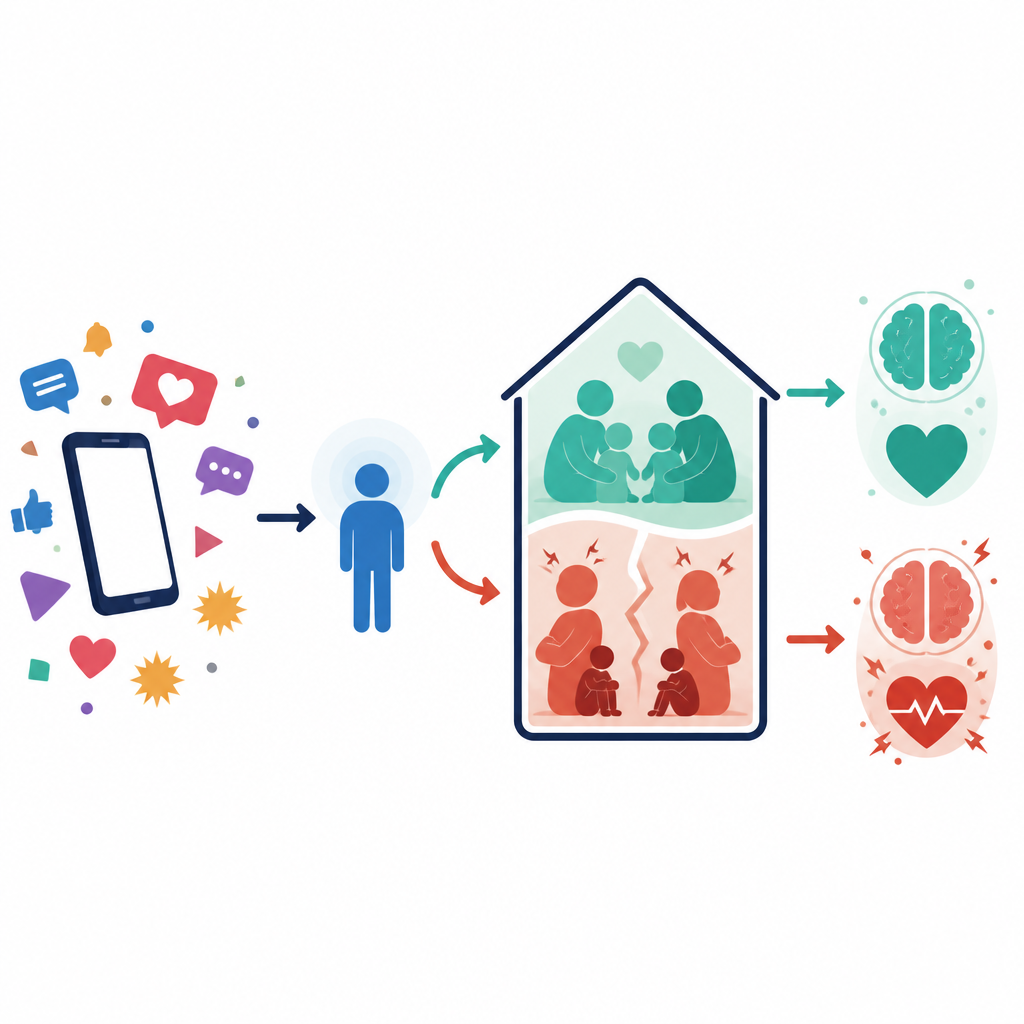
The study measured family environment through signs of closeness, open talk, and conflict at home. Statistical analyses showed that students with stronger signs of social media addiction tended to report higher levels of both depression and anxiety. At the same time, social media addiction was linked to poorer family environment scores, and a better family environment was linked to lower depression and anxiety. When the researchers modeled all of these links together, the direct connection from social media addiction to depression and anxiety faded once family environment was taken into account, while the indirect path through family life remained strong.
What the numbers suggest
This pattern means that family environment fully carried, or mediated, the relationship between social media addiction and emotional distress in this sample. In simple terms, heavy and compulsive social media use was tied to worse mood especially when home life was tense, distant, or filled with conflict. When families were warm, communicative, and involved, they appeared to cushion students from some of the emotional fallout of their online habits. The study’s models fit the data well, but because the survey captured only a single point in time, the authors stress that they cannot prove cause and effect.
What this means for students and families
Because the findings are based on self reports from public universities in one country, they may not apply to all students or clinical cases. Still, the results point toward practical steps. Universities and policymakers could design programs that combine digital awareness with support for family communication, helping parents and students talk about online use, set shared boundaries, and build offline connections. For families, the message is that their everyday interactions—listening, guidance, and warmth—may make a real difference in how young people cope with the pressures of a hyper connected world.
Take home message
Overall, the study suggests that social media addiction and mental health are closely linked, but the family home is a powerful part of that story. Among Saudi university students, a caring and communicative family setting seems to protect against the depression and anxiety often associated with compulsive online behavior. Supporting students’ well being may therefore require more than telling them to log off; it also calls for strengthening the relationships waiting for them when they put their phones down.
Citation: Jameel, A., Xu, H., Guo, W. et al. The effects of social media addiction on depression and anxiety among university students: The mediating role of family environment. Sci Rep 16, 14878 (2026). https://doi.org/10.1038/s41598-026-45666-z
Keywords: social media addiction, university students, family environment, depression, anxiety