Clear Sky Science · en
Restorative benefits of nature-related wooden elements in virtual reality settings for visual (eye-tracking) attention, performance, and experience
Why a digital room’s “feel” matters
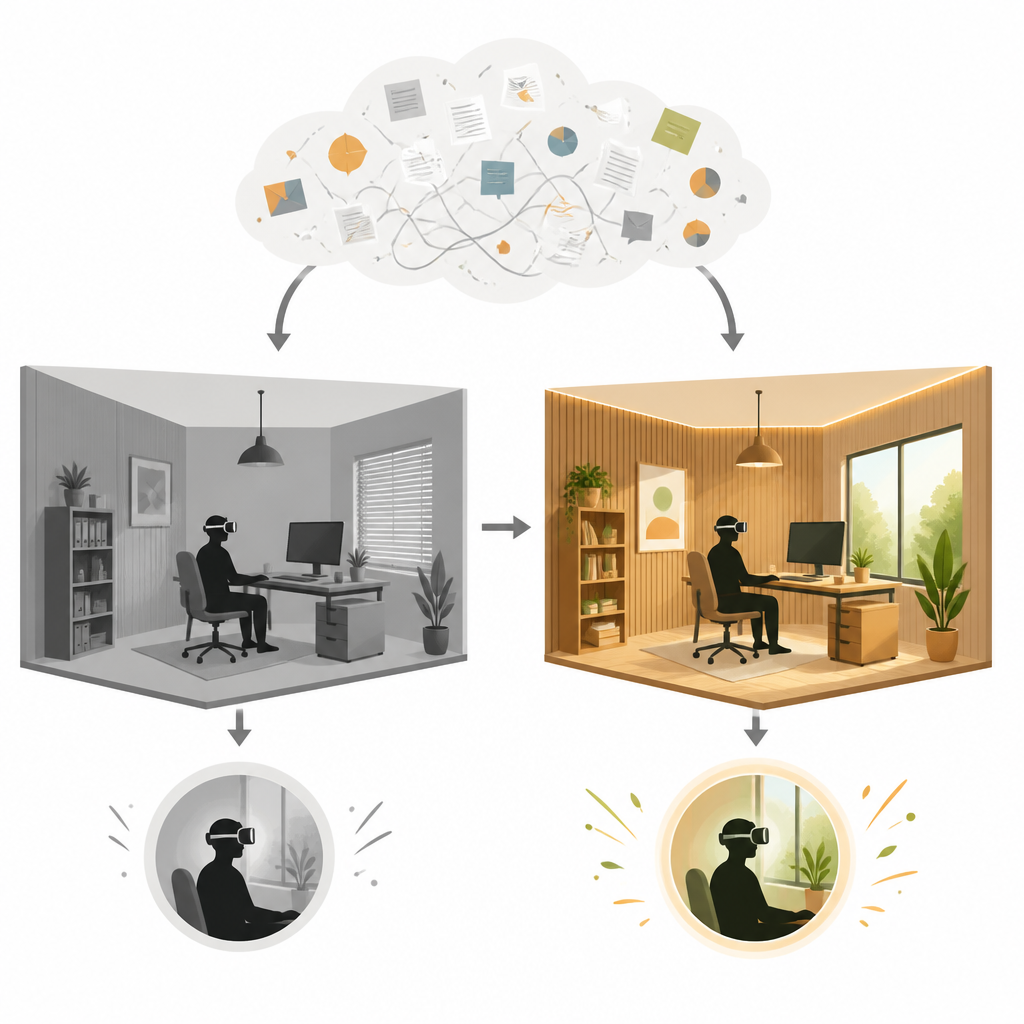
Many of us now learn, work, and relax in virtual reality, where long stretches of intense focus can leave us mentally drained. This study asks a simple question that matters to anyone who uses screens all day: can a virtual room lined with warm wood help our minds stay sharper and more comfortable than a plain, bare digital room? By measuring both performance on thinking tasks and how people’s eyes move, the researchers explore whether small design choices in VR can gently support attention and ease mental fatigue.
Two virtual rooms, one key difference
The team built two nearly identical virtual office rooms. Both had a desk, chair, and large screen, and participants viewed them through a head-mounted VR display with built-in eye tracking. In one room, the walls, furniture, and decor featured clear wooden textures and warm colors. In the other, surfaces were smooth and non-wood, with cooler, more neutral tones. Fifty four adults were randomly assigned to spend about 20 minutes in one of these rooms while completing a short battery of thinking tasks and questionnaires, allowing the researchers to compare how the two settings influenced attention and experience.
Testing memory and mental control
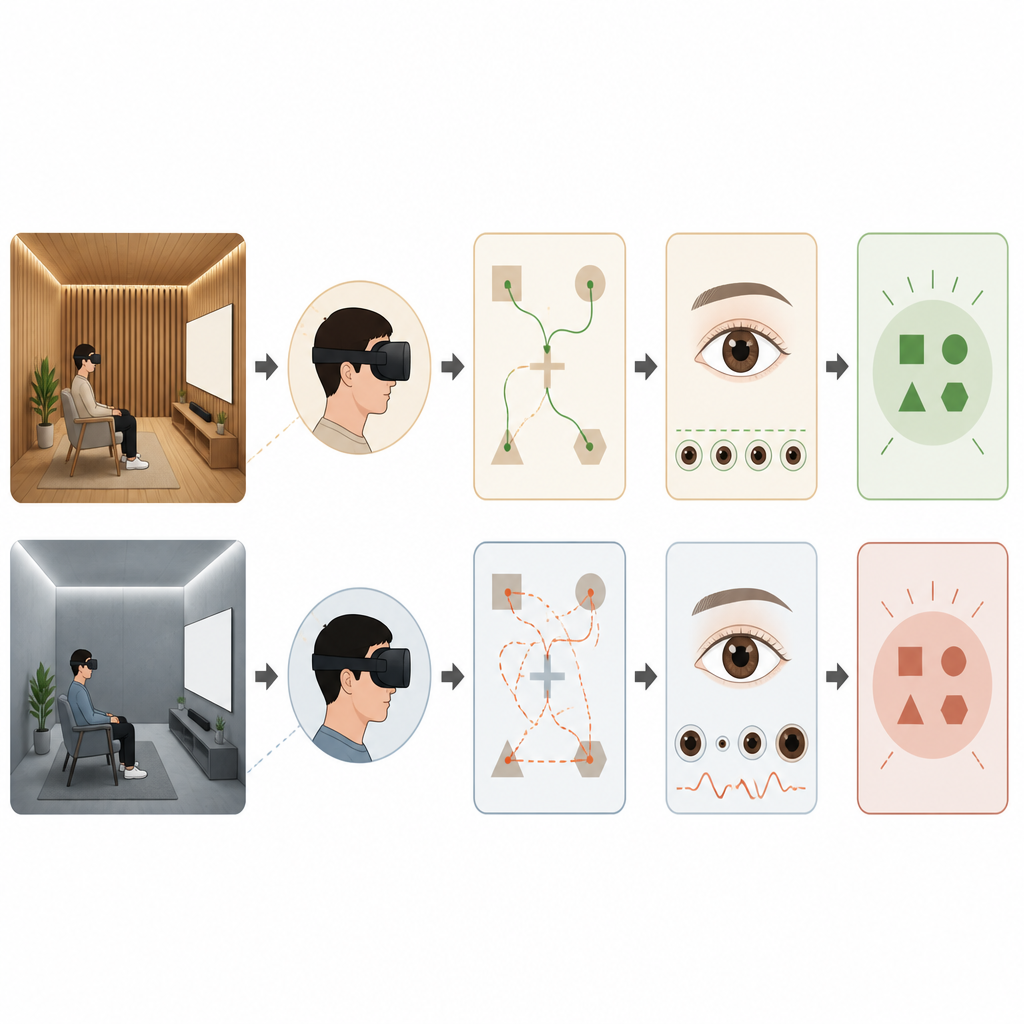
To probe how well people could hold and process information, the study used two standard one minute tests. The first, a working memory task, asked participants to solve quick math problems while also remembering sequences of letters, mimicking the mental juggling required in modern multitasking. The second, a color naming task, forced people to say the color of a word rather than read the word itself, which measures how effectively the brain can suppress automatic habits. At the same time, the VR headset tracked where and how long participants looked at the screen, how often their eyes jumped or blinked, and how their pupils changed in size, which offers clues about effort and strain.
Wooden rooms support quicker, more accurate thinking
People in the wooden room consistently performed better on both tasks. In the working memory challenge, they made fewer mistakes when recalling letter sequences and earned higher overall scores, suggesting that their minds handled the dual demands of solving and remembering more efficiently. In the color naming task, they answered faster and with fewer errors, cutting response time by roughly one sixth compared with those in the plain room. These behavioral gains point to smoother information processing and steadier mental control when the virtual surroundings feature warm, natural like wood rather than stark surfaces.
What eye movements reveal about focus
Eye tracking added a window into how attention unfolded. In the wooden room, participants showed patterns consistent with more stable focus: their gaze and blinking varied less from moment to moment, and their scanning across the screen appeared more orderly. Subtle shifts in pupil size suggested that, during the memory task, the wooden setting helped people draw on cognitive resources when needed, while during the color naming task it may have reduced unnecessary extra effort. Although not every eye measure differed clearly between rooms, several trends lined up with the idea that wood surfaces support a calmer yet engaged visual state.
Feeling present in a virtual wooden space
Participants also rated how “there” they felt in the virtual room. Both rooms created a strong general sense of presence, but the wooden environment scored higher for involvement: people reported feeling more engaged with what they were doing. Interestingly, the plain room was judged slightly more realistic, hinting that visual comfort and immersion are not the same as photo like accuracy. The wooden textures seemed to draw users in and support their concentration, even if they did not look perfectly lifelike from a technical standpoint.
What this means for everyday VR use
For non specialists, the takeaway is straightforward: the look and feel of a digital room can nudge how well we think inside it. In this study, simply adding nature related wooden elements to a virtual office helped people remember better, respond more quickly, and maintain steadier focus, without changing the tasks themselves. As VR becomes part of classrooms, remote offices, and training centers, thoughtful use of warm, natural style materials could make demanding sessions feel less draining and more mentally supportive, much like bringing plants or wood furniture into a physical workspace.
Citation: Zhang, S., Lv, J. & Pan, W. Restorative benefits of nature-related wooden elements in virtual reality settings for visual (eye-tracking) attention, performance, and experience. Sci Rep 16, 14768 (2026). https://doi.org/10.1038/s41598-026-45074-3
Keywords: virtual reality, wooden environments, attention, eye tracking, cognitive performance