Clear Sky Science · en
Mixed order single variable intuitionistic fuzzy time series forecasting method based on a new artificial neural network and grey wolf optimization algorithm
Why this forecasting idea matters for everyday data
From cryptocurrency prices to the cost of filling a gas tank or buying gold, financial numbers jump up and down in ways that are hard to predict. This study introduces a new way to turn yesterday’s noisy price curves into better guesses about tomorrow, by mixing human-like shades of doubt with an advanced type of neural network inspired by how signals travel through branches of real nerve cells.

Handling uncertainty more like people do
Most forecasting tools treat each data point as either belonging or not belonging to a pattern, much like a light switch that is on or off. Fuzzy time series methods soften this view and allow data to “partly” fit several patterns at once. The approach in this paper goes a step further by also tracking how much a data point does not fit a pattern, and how much hesitation remains in between. This richer description, called an intuitionistic fuzzy time series, lets the model represent not only partial agreement but also explicit disagreement and remaining uncertainty about where a value truly belongs.
Letting two views of the data learn together
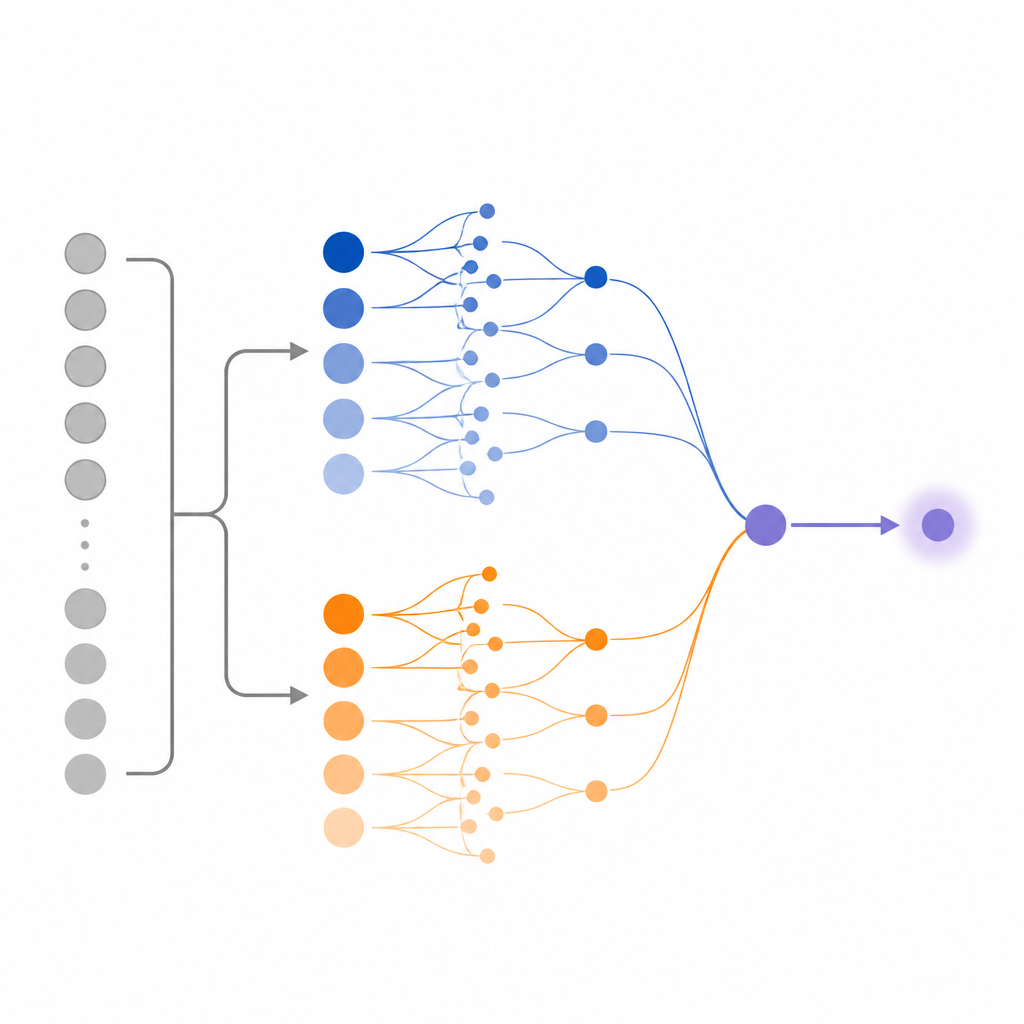
The authors design a forecasting model that treats membership and non-membership information as two parallel views of the same time series. First, a clustering procedure groups past data into fuzzy regions and assigns each point three scores: how much it belongs, how much it does not belong, and how unsure the model is. These scores, together with the raw past values, are then fed into a special neural network. One part of the network focuses on the membership side, while another part focuses on the non-membership side. Each part learns its own internal relationships and produces its own forecast of the next value.
A neural network shaped like branching neurons
Instead of using a standard layered network, the method relies on a dendritic neuron model that mimics the branching structure of biological neurons. Signals first pass through a synaptic layer, then are multiplied together along dendritic branches, added up in a membrane layer, and finally transformed into an output in the soma layer. In the proposed combined design, there are separate dendritic pathways for membership and non-membership inputs. Their outputs are then blended using a weight that the system learns automatically. This structure allows the model to capture complex interactions in the data while still keeping the overall architecture compact.
Grey wolves tune the network’s many knobs
Training such a detailed network means adjusting many internal weights and thresholds. Rather than relying on ordinary gradient-based training, which can get stuck in poor solutions, the authors adopt a nature-inspired strategy called the grey wolf optimization algorithm. Here, virtual “wolves” explore different settings for the network parameters, guided by a hierarchy that imitates how real wolf packs hunt. Over time, the pack closes in on parameter values that minimize forecasting errors, including the crucial balance between the membership and non-membership branches.
Better forecasts on key financial series
The research team tests their method on four familiar financial time series: Bitcoin, crude oil, the Euro against the US dollar, and gold prices. They divide each dataset into training, validation, and test parts, and compare their approach against several well-known fuzzy and intuitionistic fuzzy forecasting models. Across these cases, the new method often achieves the lowest average forecasting error, and when it does not rank first it still remains very close to the best competitor. The results suggest that letting the model learn from both agreement and disagreement with each pattern, within a dendritic-style network tuned by grey wolves, can provide more accurate and stable forecasts.
What this means for future forecasting tools
In simple terms, the paper shows that treating uncertainty more carefully, and giving a neural network a richer, more biologically inspired structure, can improve short-term predictions for real-world financial data. The approach remains focused on one variable at a time, but it points toward forecasting systems that use multiple shades of belief and doubt instead of a single sharp line. With further extensions, similar ideas could help analysts and automated systems make more informed decisions wherever uncertain time-based data play a key role.
Citation: Cansu, T., Bas, E. & Egrioglu, E. Mixed order single variable intuitionistic fuzzy time series forecasting method based on a new artificial neural network and grey wolf optimization algorithm. Sci Rep 16, 15682 (2026). https://doi.org/10.1038/s41598-026-45059-2
Keywords: financial forecasting, fuzzy time series, artificial neural networks, grey wolf optimization, intuitionistic fuzzy sets