Clear Sky Science · en
Evaluation of groundwater quality in the bouanane plain using the groundwater pollution index, nitrate pollution index, and microbiological indicators
Why the hidden water under our feet matters
In dry regions, many communities survive thanks to water stored out of sight, in rocks and sands beneath the ground. In southeastern Morocco’s Bouanane plain, families, farmers, and livestock rely heavily on this underground reserve. The study behind this article set out to answer a simple but crucial question: Is this water safe to drink now, and how might it be changing as climate pressures and human activity grow?
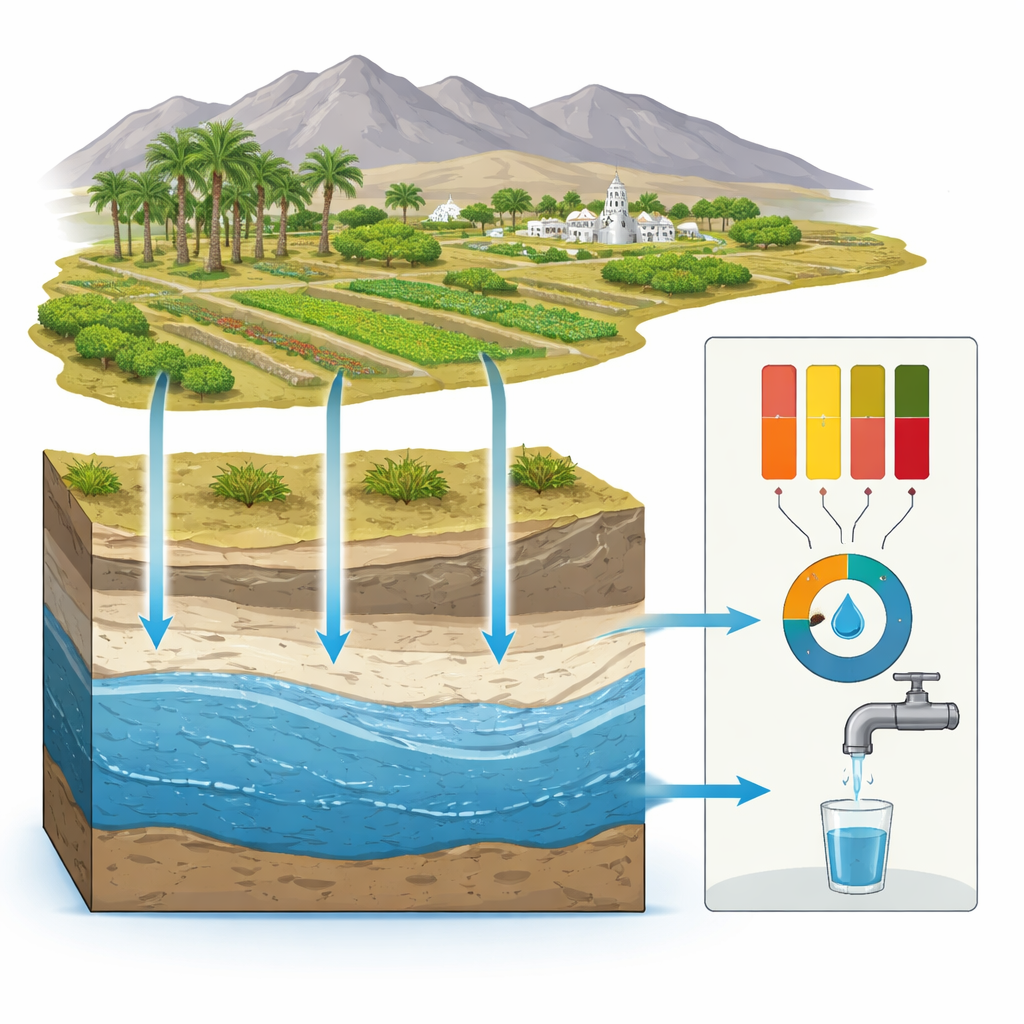
A closer look at a desert valley
The Bouanane basin lies in a semi-arid corner of the Moroccan High Atlas, where winters are cold, summers are hot, and rain is scarce and irregular. Two main rivers, fed by springs in the surrounding mountains, cut across a landscape of rocky ridges, oases, and scattered fields. Beneath this scenery lies a complex stack of water-bearing layers made of limestone, sandstone, and salty evaporite rocks such as gypsum and halite. These rocks slowly dissolve as water passes through them, picking up minerals that shape the taste and quality of the groundwater drawn from wells and springs.
How the water was tested
To understand the state of this underground resource, the researchers collected nine groundwater samples from wells, springs, and underground flow zones in April 2024. In the field, they measured basic traits such as acidity, temperature, electrical conductivity, and total dissolved solids. In the laboratory, they analyzed major dissolved ingredients like calcium, magnesium, chloride, sulfate, bicarbonate, potassium, and nitrate. They also checked for signs of fecal pollution using standard tests for different groups of bacteria. To move beyond a simple “pass or fail” against guidelines, the team used several combined indicators: a Pollution Index of Groundwater (called PIG), a Nitrate Pollution Index (NPI), and a human health risk model commonly used by the U.S. Environmental Protection Agency. They then mapped all of these results in a geographic information system (GIS) to see how water quality varies across the basin.
Salty water, hard water, and what it means
The chemistry results paint a clear picture. The water is mostly neutral in acidity, staying within international standards for drinking. However, many samples show very high amounts of dissolved minerals. Electrical conductivity, total dissolved solids, and hardness often exceed guideline ranges, especially downstream, meaning the water is both salty and very hard. Calcium, magnesium, chloride, sulfate, and bicarbonate dominate the mix, pointing to intense interaction with carbonate and evaporite rocks along the flow path. In contrast, nitrate levels are low everywhere, far below the threshold associated with health problems such as “blue baby” syndrome. When the researchers combined all the chemical information into the PIG score, almost half of the sampled points fell into the “very highly polluted” class, but this “pollution” is largely due to natural mineral enrichment rather than farm fertilizer or sewage.
Germs, health risks, and who is most exposed
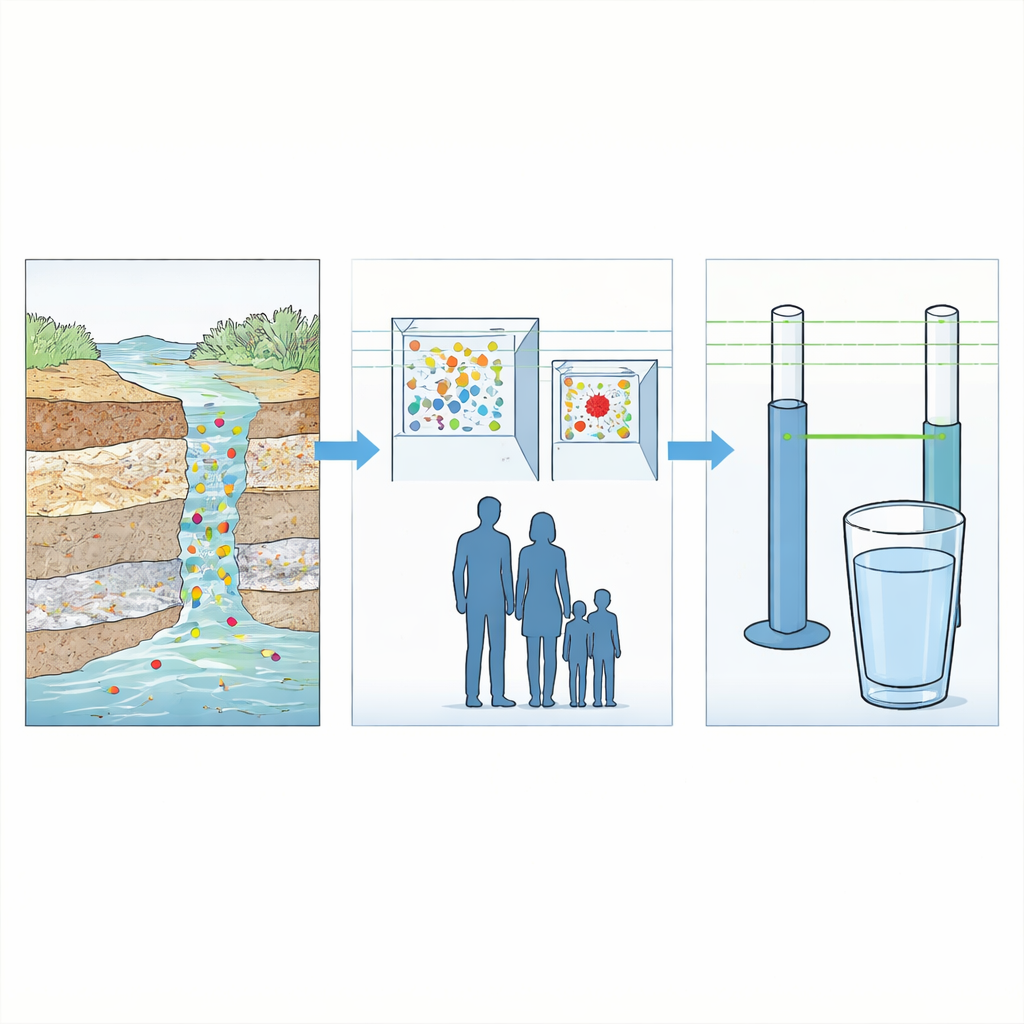
The biological tests brought a different perspective. Classic fecal indicators like coliform bacteria and Escherichia coli were absent in all samples, which is good news for recent contamination. Yet Staphylococcus aureus, a bacterium linked to various infections, appeared in about one in five sites, hinting at local sanitary problems, such as leaky septic systems or poorly protected wells. Using the observed nitrate levels, the team then estimated long-term health risks for both adults and children through drinking and skin contact. All hazard index values were well below the level of concern, meaning nitrate in the current groundwater poses little non-cancer health risk, even for children who drink more water relative to their body weight.
Natural forces, human footprints, and the road ahead
Putting the pieces together, the study concludes that groundwater in the Bouanane basin is shaped mainly by natural rock–water interaction, which raises salt and hardness, while human impacts on nitrate remain modest so far. However, the occasional detection of harmful bacteria and the presence of very mineralized water in some wells show that quality is uneven and can be fragile. The authors argue that their combined toolkit—chemical indices, health-risk calculations, statistical analysis, and mapping—offers a powerful, repeatable way to track this hidden resource. For local communities, the message is twofold: today’s groundwater is generally safe from nitrate but can be very hard and salty, and some wells show signs of sanitary weakness. Protecting this lifeline in a warming, drying climate will require better wastewater treatment, careful land use, and regular monitoring so that the water beneath the Bouanane plain remains a reliable source of life in the years to come.
Citation: Nouayti, A., Mansour, A.E., Nouayti, H. et al. Evaluation of groundwater quality in the bouanane plain using the groundwater pollution index, nitrate pollution index, and microbiological indicators. Sci Rep 16, 13937 (2026). https://doi.org/10.1038/s41598-026-44619-w
Keywords: groundwater quality, semi-arid Morocco, nitrate pollution, drinking water safety, aquifer salinity