Clear Sky Science · en
Measuring SNARC effect: different task setups reveal divergent spatial-numerical associations
How Our Minds Picture Numbers in Space
When you think of the number 2, do you somehow feel it belongs more on the left, and 9 more on the right? Many people do, without ever noticing it. Psychologists call this family of phenomena spatial–numerical associations, and one famous example is the SNARC effect: people tend to respond faster with their left hand to small numbers and with their right hand to large ones. This study asks a deceptively simple question with big implications: are such number–space links truly stable features of the human mind, or do they change depending on how we are tested?
Numbers on an Invisible Line
For decades, researchers have proposed that we carry a mental “number line,” where small numbers live on the left and large numbers on the right. Evidence for this comes from many kinds of tasks: judging whether a number is odd or even, deciding if it is big or small, or even just responding to color or font while the number itself seems irrelevant. In Western countries, where both text and numbers are typically read from left to right, the SNARC effect is remarkably reliable. But in Middle Eastern cultures, where people read text from right to left but numbers still from left to right, findings are much more mixed. Some studies find a standard left-to-right pattern, some find no effect, and others suggest hints of a right-to-left mapping. These inconsistencies raise doubts about how fixed our mental number line really is.
Why Culture and Testing Style Matter
Turkey is an especially intriguing case. Modern Turkish uses a left-to-right alphabet and number system, yet earlier generations used right-to-left Ottoman script for centuries. Previous work with Turkish university students often failed to find a clear SNARC effect, or found it only weakly. The authors of the current study suspected that the problem might not lie in the minds of the participants, but in the way experiments were designed. Many earlier studies used relatively small samples and few trials, which reduces the chance of detecting subtle patterns. They also tended to rely on a single kind of task, where numbers appear at the center of a screen and people respond with left or right hand keys. The team set out to test whether higher statistical power and different task setups would reveal hidden number–space links in Turkish participants.
Putting Number–Space Links to the Test
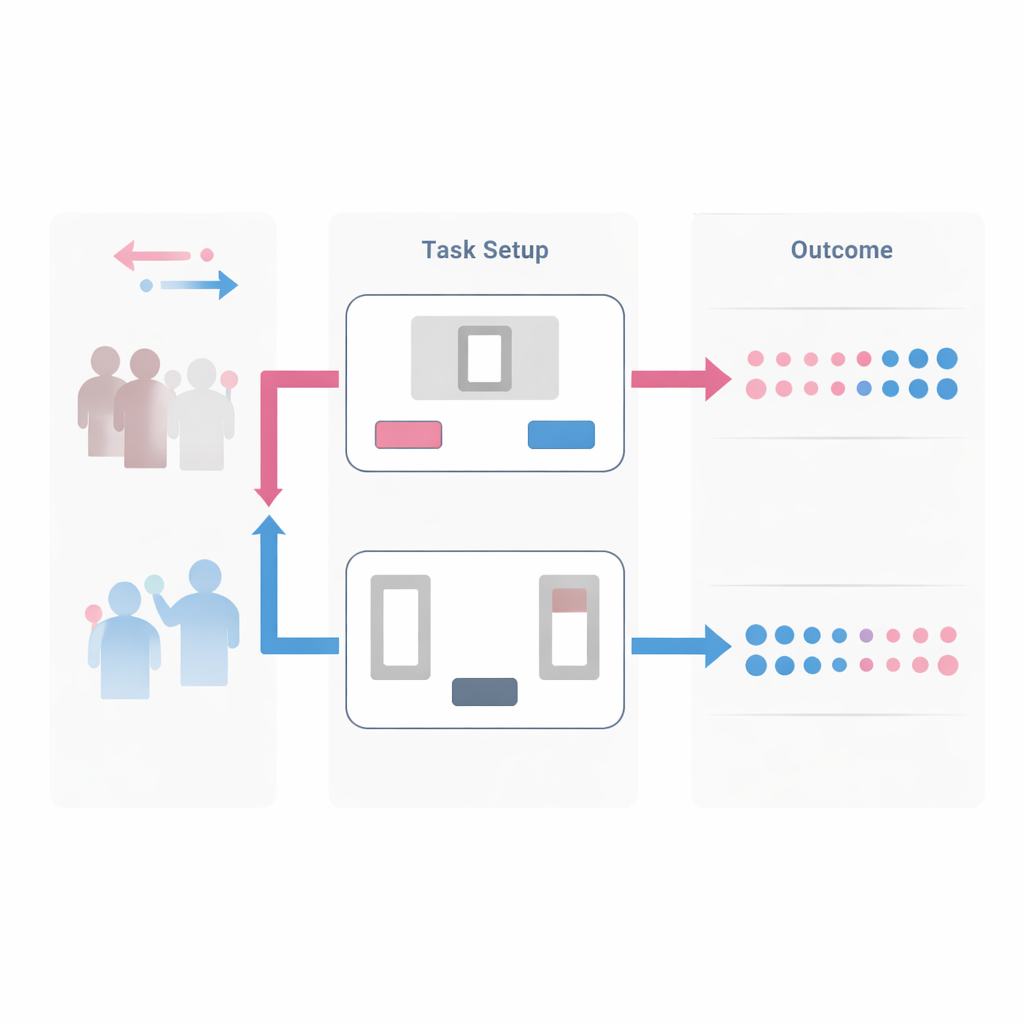
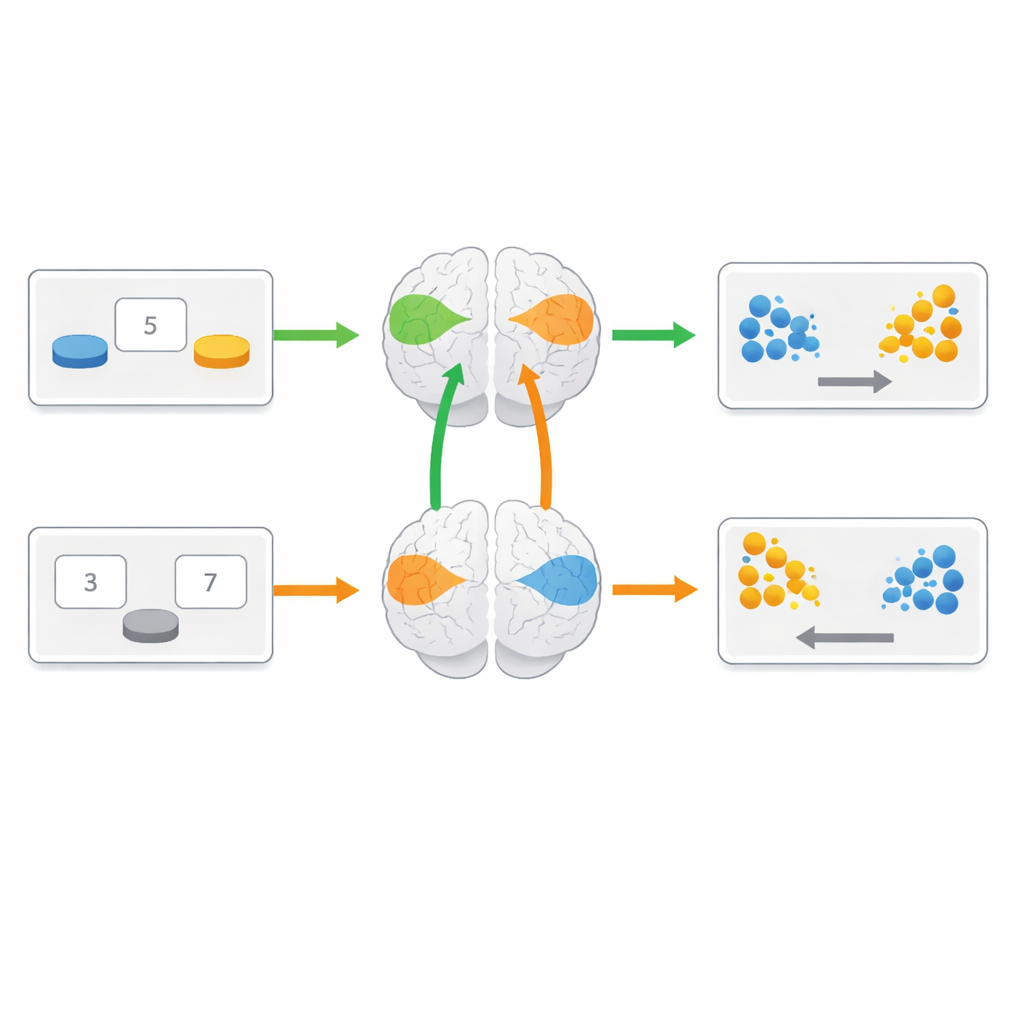
The researchers recruited large groups of Turkish-speaking students and had them perform two classic tasks, each in a traditional and a novel format. In the standard parity judgment task, people pressed a left or right key to say whether a centrally shown digit (1–9, except 5) was odd or even. In the standard magnitude task, they pressed left or right to judge whether the digit was smaller or larger than 5. In the new Go/No-go versions, the setup was flipped: digits appeared either on the left or right side of the screen, but participants responded only with a single central key, either pressing or withholding a response depending on parity or size. This allowed the team to separate effects linked to where the response happens (left hand versus right hand) from those linked to where the number appears (left side versus right side), while keeping the overall difficulty and timing tightly controlled.
Surprising and Conflicting Patterns
The results show that there is no single, stable number–space pattern in this group. In the standard parity task, the researchers actually found a weak reverse effect: faster right-hand responses to small numbers and faster left-hand responses to large numbers, the mirror image of the classic SNARC pattern. In the standard magnitude task, however, there was no reliable group-level effect at all. The Go/No-go parity task told a different story. Here, participants responded slightly faster when the pattern matched a left-to-right mapping (small numbers on the left, large on the right) than when it was reversed, revealing a modest left-to-right association—despite the fact that they only used a central response key. The Go/No-go magnitude task again showed no clear directional bias. Taken together, the same people could show opposite patterns or no pattern at all, depending solely on whether space was built into the response, the stimulus, or both.
Why This Matters for Understanding Minds and Cultures
To add another layer, the team also measured how volunteers naturally arranged objects along a row of indentations on a table. Those who tended to place balls from right to left showed stronger hints of a reversed number–space link than those who placed them from left to right. This suggests that everyday habits, not just reading direction or formal schooling, shape how numbers are linked to space in the mind. The overall picture that emerges is that spatial–numerical associations are highly context-dependent rather than hard-wired. The same brain can activate different “mental metaphors” for numbers depending on which task it is given, how space is built into that task, and what directional habits the person brings from daily life. For readers, this means that the simple idea of a universal mental number line is too rigid. Instead, our brains appear to construct and tune number–space links on the fly, guided by culture, experience, and the fine details of how we are asked to think about numbers.
Citation: Bulut, M., Candemir, A., Şefikoğlu, M. et al. Measuring SNARC effect: different task setups reveal divergent spatial-numerical associations. Sci Rep 16, 12358 (2026). https://doi.org/10.1038/s41598-026-44140-0
Keywords: mental number line, spatial numerical associations, SNARC effect, cultural influences on number processing, cognitive task design