Clear Sky Science · en
Biogeography from a food matrix: a temporal distribution map of Apis mellifera mitochondrial DNA lineages across Italy, obtained from honey samples
Why This Matters for Bees and Our Food
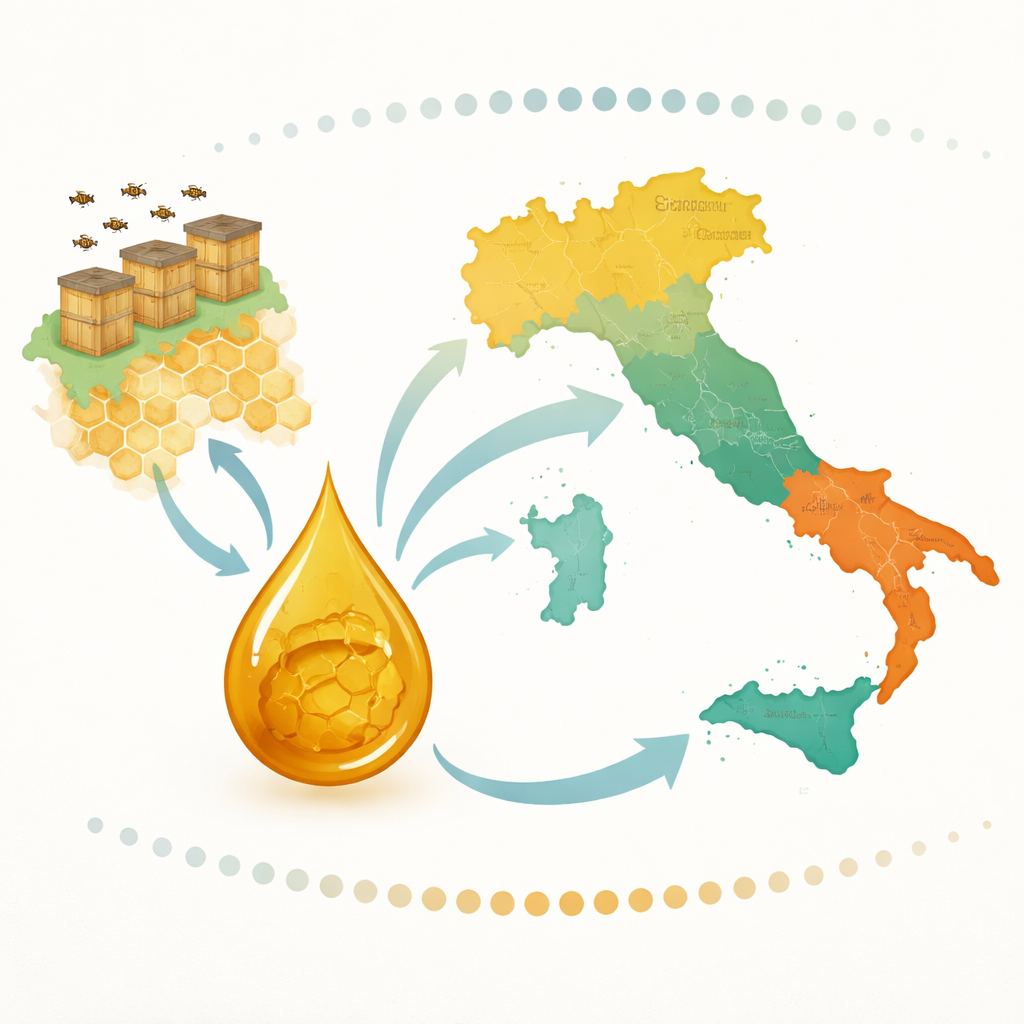
Honey is more than a sweet treat. Hidden inside each jar are microscopic traces of DNA from the bees that made it. By reading this genetic fingerprint, scientists can track how different types of honey bees are spreading and mixing across a country. This study used thousands of honey samples from all over Italy, spanning almost four decades, to reveal how the genetic makeup of honey bee populations is changing over time—information that matters for pollination, agriculture, and the survival of locally adapted bees.
A New Way to Read History from Honey
The researchers focused on the Western honey bee, a species that includes many regional forms, or subspecies, originally adapted to different climates across Europe, Africa, and Western Asia. These bee groups can be distinguished by the DNA in their mitochondria, tiny structures in cells that are passed down through the maternal line. Instead of capturing and testing individual bees, the team extracted environmental DNA from honey itself. Because honey is produced by thousands of worker bees from many colonies, each sample offers a pooled snapshot of the maternal lineages present in the area where it was made.
Collecting Bee Clues Across Italy and Time
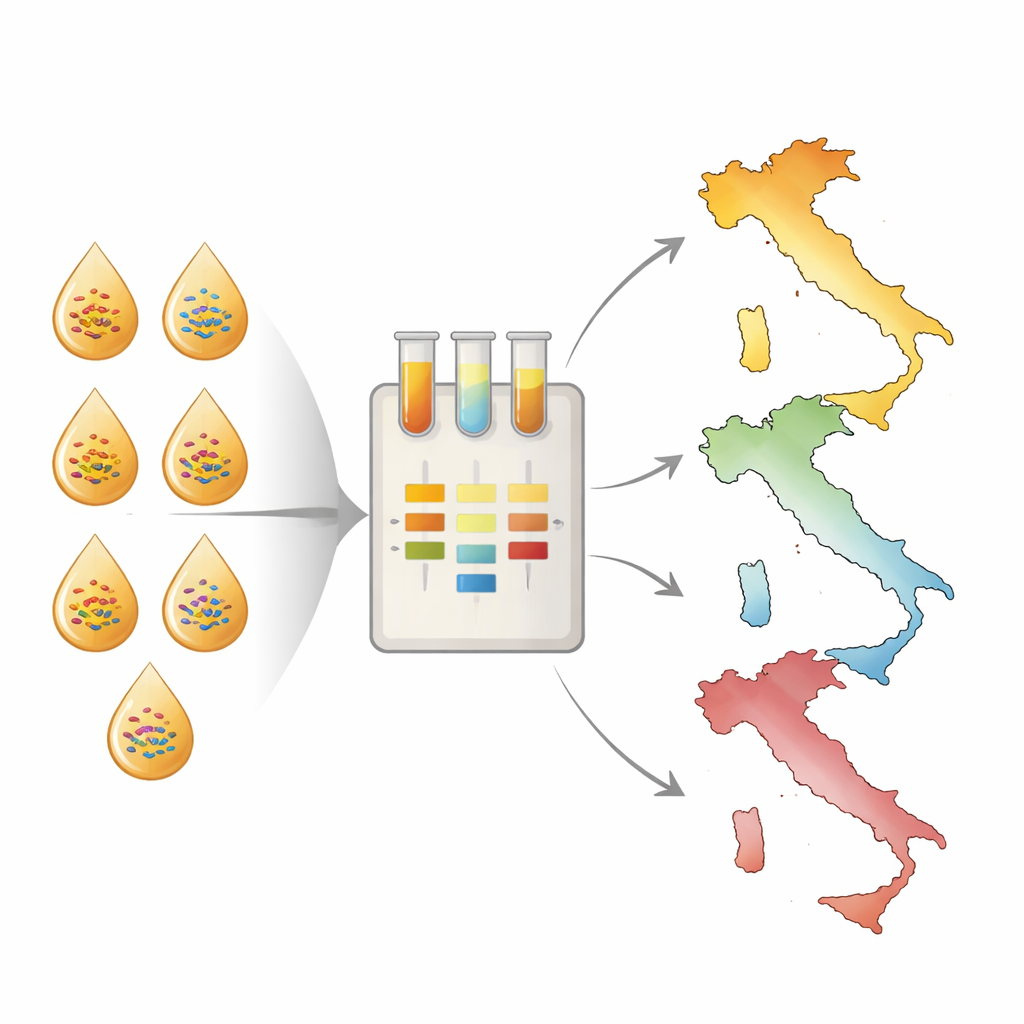
The study analysed DNA from 4,292 honey samples produced in every Italian region, including the islands of Sicily and Sardinia. Most of these (4,150) were made between 2018 and 2023, while 142 older samples dated back as far as 1986. The scientists looked for three major mitochondrial lineages, labelled A (African origin), C (South‑Eastern European origin, including Italy’s native bees), and M (Northern and Western European origin. Many commercial honeys blend nectar from multiple colonies, so a single jar could contain one lineage or combinations of two or all three, revealing how mixed local bee populations have become.
Where Different Bee Lineages Now Live
Across Italy, lineage C clearly dominated: about three‑quarters of recent honey samples showed only this lineage, reflecting the long-standing presence of native Italian and related bees. However, traces of A and M were found in every Italian region. Sicily was unique, with most honeys including the A lineage, in line with its native African‑derived subspecies. On the mainland, the frequency of A and M lineages increased from north to south, matching a climatic gradient from cooler to warmer, drier conditions. In northern Italy, another pattern emerged from west to east: samples with only C became more common toward the eastern border, where a different C‑type subspecies is naturally found.
How Bee Genetics Are Shifting Over Recent Years
Older honeys from before 2010 were almost entirely dominated by the C lineage, suggesting that Italian bees were once genetically more uniform. In contrast, honeys from 2018 to 2023 show growing genetic mixing. In central and southern Italy, the frequencies of A and M lineages have increased in recent years, while honeys containing only C have decreased. Even when the same beekeeper submitted samples over multiple years, their honeys increasingly showed mixtures of different lineages, indicating that apiaries themselves are becoming more genetically diverse.
What May Be Driving the Changes
The study points to human activity as a major force reshaping bee genetics. Beekeepers routinely buy queens from distant regions or even other continents, move hives over long distances for pollination, and use hybrid commercial stocks such as Buckfast bees. These practices can introduce African or other foreign lineages into local populations. Climate may also play a role: bees carrying African‑type mitochondrial DNA may be better suited to Italy’s hotter, drier southern conditions, which are becoming more common with climate change. Together, trade and climate likely explain the rising presence of A and M lineages and the north–south and west–east gradients observed.
What This Means for Bees and Beekeepers
To a layperson, the takeaway is that Italian honey bees are becoming more of a genetic mosaic, with local types increasingly mixed with imported strains. This can bring benefits, such as new traits that help bees cope with parasites or heat, but it also threatens the loss of locally adapted subspecies that evolved over thousands of years. By showing that honey itself can be used as a large-scale, cost‑effective genetic monitoring tool, the study offers a practical way to track these changes over time. The resulting “genetic map” of bee lineages can guide policies and conservation efforts aimed at protecting native bees while still supporting productive beekeeping and reliable pollination for crops.
Citation: Taurisano, V., Ribani, A., Calabri, M.L. et al. Biogeography from a food matrix: a temporal distribution map of Apis mellifera mitochondrial DNA lineages across Italy, obtained from honey samples. Sci Rep 16, 13280 (2026). https://doi.org/10.1038/s41598-026-43936-4
Keywords: honey bee genetics, environmental DNA, mitochondrial lineages, bee conservation, Italian beekeeping