Clear Sky Science · en
Water-energy-food nexus assessment in the transboundary harirud river basin using the MUSIASEM framework
Why this river matters to people and livelihoods
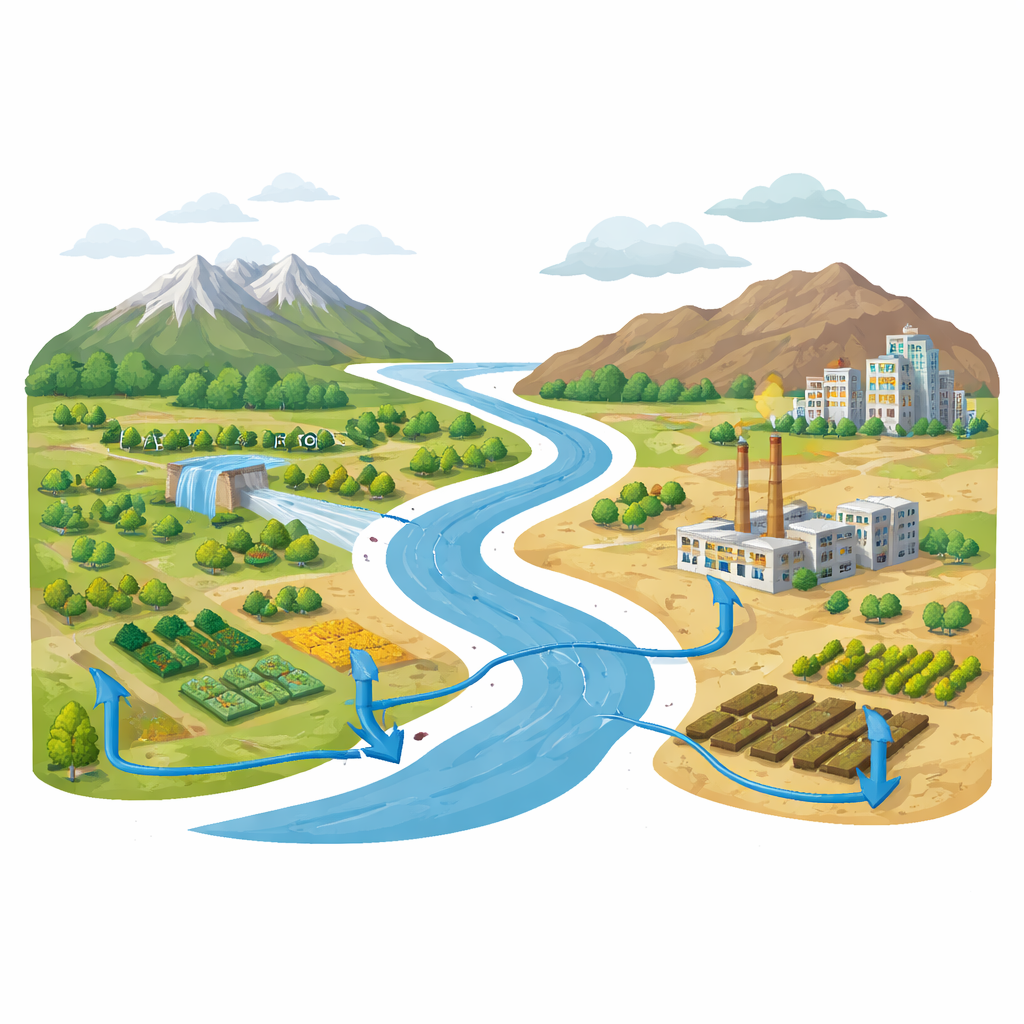
The Harirud River winds through Afghanistan and Iran, supplying drinking water to cities, powering lights, and feeding farms. In this semi‑arid region, water is limited, populations are growing, and both countries are building dams and wells to secure their future. This study asks a simple but urgent question: how are water, energy, and food tied together along this shared river—and what happens downstream when upstream use grows? By tracing how every unit of water and energy supports crops, electricity, and daily life, the authors show where the system is robust, where it is fragile, and how cooperation could ease tensions and sustain livelihoods.
Looking at water, energy, and food as one system
Instead of studying irrigation, power plants, or farms separately, the researchers treat the Harirud Basin as a living system that “metabolizes” resources. Using a method called MUSIASEM, they track funds (long‑lasting capacities such as land, dams, wells, and power stations) and flows (throughput such as river water, groundwater, fuel, and harvested crops) on both sides of the Iran–Afghanistan border from 2011 to 2021. They assemble data from ministries, global databases, and satellite‑based rainfall and evaporation estimates to reconstruct how much water enters the basin, how much is withdrawn, how much energy is used to move it, and what quantity of food and electricity ultimately reaches people.
Two neighbors sharing one strained river
The analysis reveals stark contrasts between the upstream Afghan side and the downstream Iranian side. Afghanistan receives more rain and has about 29% more renewable water per year, yet it withdraws much less—around 660 million cubic meters annually, most of it from rivers and canals. It produces roughly 0.78 million tons of crops and only a small amount of electricity from the Salma hydropower dam, while importing most of its power. Iran, downstream, withdraws about 2.3 billion cubic meters of water a year, one and a half times its renewable supply. Nearly four‑fifths of this comes from groundwater pumped from thousands of wells. With this water and 10,839 terajoules of input energy, Iran produces about 2.88 million tons of crops and generates over 11,700 gigawatt‑hours of fossil‑fuel‑based electricity, some of which it exports back to Afghanistan.
Hidden links and rising stresses
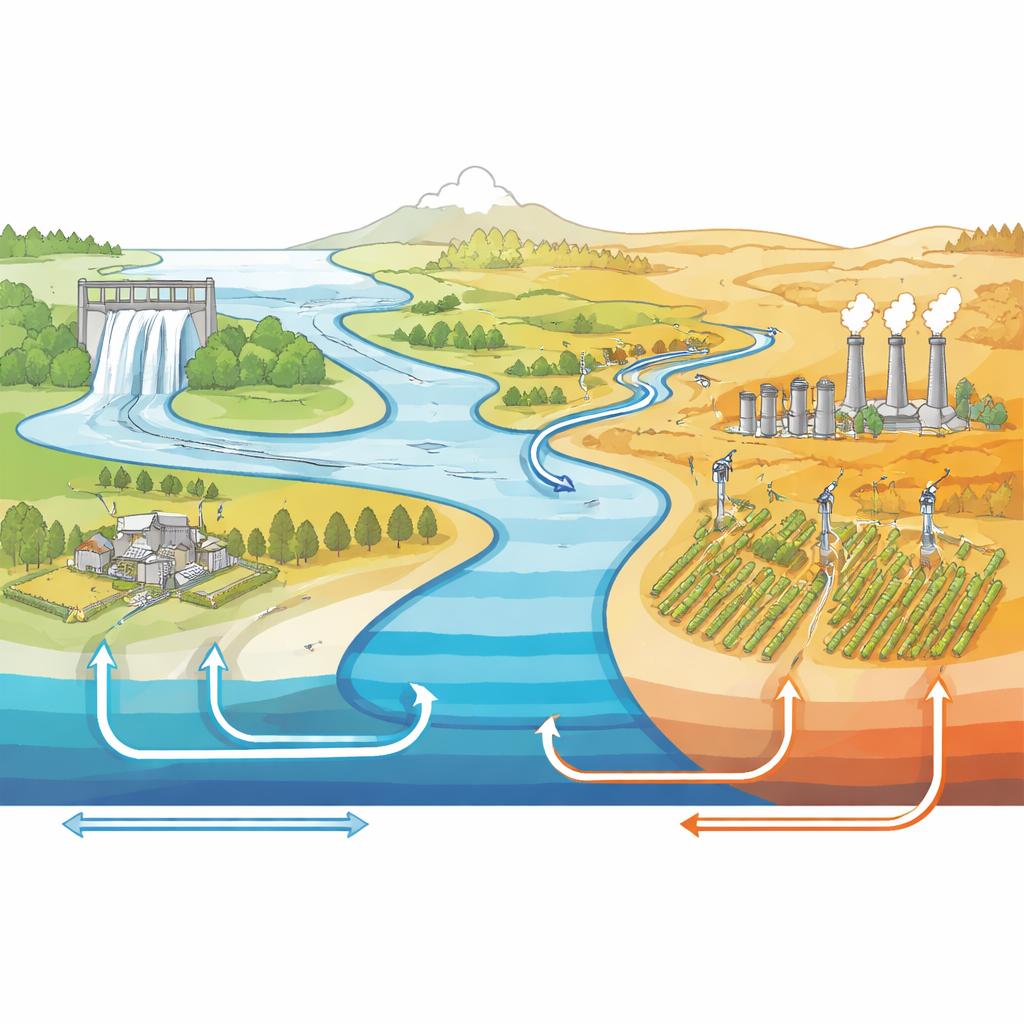
By following these flows together, the study exposes feedbacks that are hard to see when sectors are examined in isolation. Iranian farms depend heavily on pumped groundwater, which in turn depends on electricity from gas‑fired power plants that also use water for cooling. This creates a loop: scarce water demands more pumping, which burns more fuel and uses more water at power plants, deepening both energy use and water stress. Indicators confirm the strain: in Iran, annual withdrawals are about 145% of renewable water, per‑person availability is only 362 cubic meters, and more than three‑quarters of withdrawals come from aquifers—clear signs of severe stress. Afghanistan, relying more on surface canals and less on pumps and fertilizers, uses energy more efficiently per kilogram of food but achieves lower yields and remains highly exposed to climate swings and to imported electricity.
Opportunities for smarter sharing and cooperation
The authors argue that these intertwined pressures turn the Harirud into a shared risk, but also a shared opportunity. They show that over 70% of all water withdrawals in both countries go to irrigation, meaning that even modest gains in irrigation efficiency or crop choice could ease stress throughout the system. Sensitivity checks suggest that a 10% drop in irrigation efficiency in Iran would demand an extra 160–180 million cubic meters of water each year, much of it from already overdrawn aquifers, whereas similar gains in efficiency could significantly slow depletion. In Afghanistan, improving storage, modernizing canals, and better using the existing hydropower capacity at Salma could boost food and energy security without dramatically raising water use. Because upstream dams such as Salma and planned structures like Pashdan shape the river’s flow into Iran, coordinated operation and data sharing become essential to avoid shifting hardship downstream.
What this means for people along the Harirud
To a lay observer, the main message is that water, energy, and food along the Harirud Basin cannot be managed separately or by one country alone. Iran currently secures more food and electricity but at the cost of severe groundwater decline and high fuel use. Afghanistan uses fewer inputs and has more renewable water per person but remains short of power and modern farm productivity. The study concludes that a shift to joint “nexus” governance—combining better irrigation, more renewable power such as solar‑driven pumping, reduced losses in electricity networks, and a formal Iran–Afghanistan coordination body for dams, data, and trade—could ease tensions while protecting the river’s lifeline role. In short, smarter cooperation, not just more infrastructure, is key to keeping taps running, fields productive, and lights on for communities that depend on this shared, fragile river.
Citation: Talaei, E., Delavar, M., Salehi, Y.S. et al. Water-energy-food nexus assessment in the transboundary harirud river basin using the MUSIASEM framework. Sci Rep 16, 14464 (2026). https://doi.org/10.1038/s41598-026-43368-0
Keywords: water-energy-food nexus, transboundary river, Harirud Basin, groundwater depletion, hydropower and agriculture