Clear Sky Science · en
Radiological characteristics in coronal and sagittal planes and short-term postoperative outcomes in patients with lumbar disc herniation accompanied by sciatic scoliosis
Why back pain can twist the spine
Many people think of a slipped disk in the lower back as a painful but simple problem. Yet in some patients, the body responds to that pain by bending the spine into a sideways curve, a condition called sciatic scoliosis. This study looks at how that twist shows up on full‑spine X‑rays and compares two modern surgical approaches for straightening the spine and easing nerve pain.
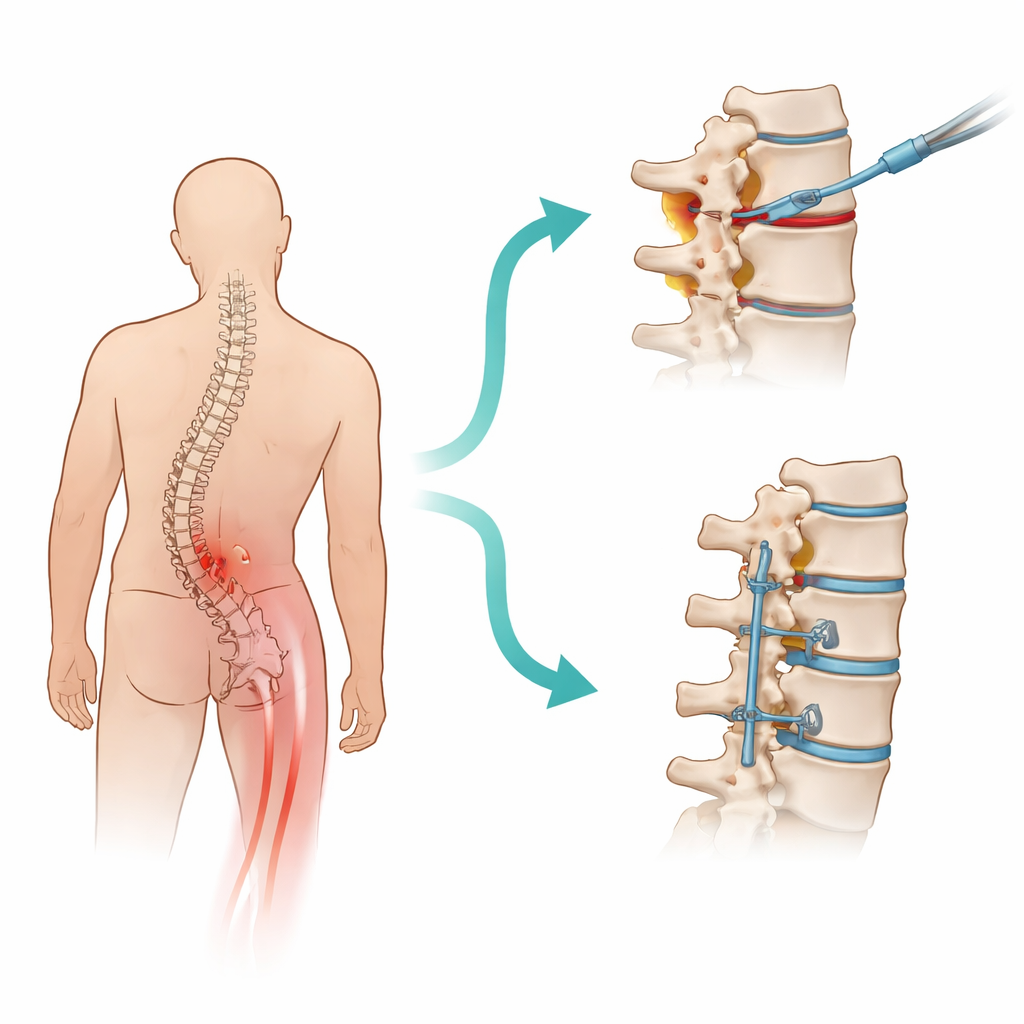
When a bad disk bends the body
In lumbar disc herniation, soft material from a spinal disc bulges out and presses on nearby nerves. To reduce the stabbing leg pain that follows the nerve path—often called sciatica—patients unconsciously lean and twist their trunks. Over time, this pain‑driven posture can turn into a clear sideways curve of the spine. The authors studied 137 such patients whose full‑length standing X‑rays showed both the side‑to‑side curve and forward‑backward imbalance of the spine. Using earlier work as a starting point, they sorted the curves seen from the front view into three main patterns, depending on where the bend was centered and how it related to the body’s midline.
Looking at the spine from the side
Beyond the obvious side bend, the team focused on how the spine looked from the side—whether the normal inward curve of the lower back was preserved, reduced, or even reversed. They combined this with a measure of how far the upper body’s center of gravity drifted forward relative to the pelvis. This produced four “sagittal” types, ranging from a near‑normal curve and good balance to severe forward lean with the lower back curved the wrong way. Almost one in five patients fell into this most disturbed pattern, showing that sciatic scoliosis is not just a sideways problem but often a three‑dimensional shift of posture.
Two different surgical paths
The patients underwent one of two operations. One, percutaneous endoscopic lumbar discectomy (PELD), uses a thin tube and camera through a small incision to remove the offending disc material with minimal disruption of muscles and joints. The other, transforaminal lumbar interbody fusion (TLIF), is a more open procedure that removes the damaged disc, inserts a cage filled with bone between the vertebrae, and stabilizes the segment with screws and rods. TLIF can more forcefully reshape the lower spine but requires a longer operation, more blood loss, and a longer hospital stay. The researchers compared pain scores, disability questionnaires, and detailed X‑ray measurements before surgery and one week afterward.
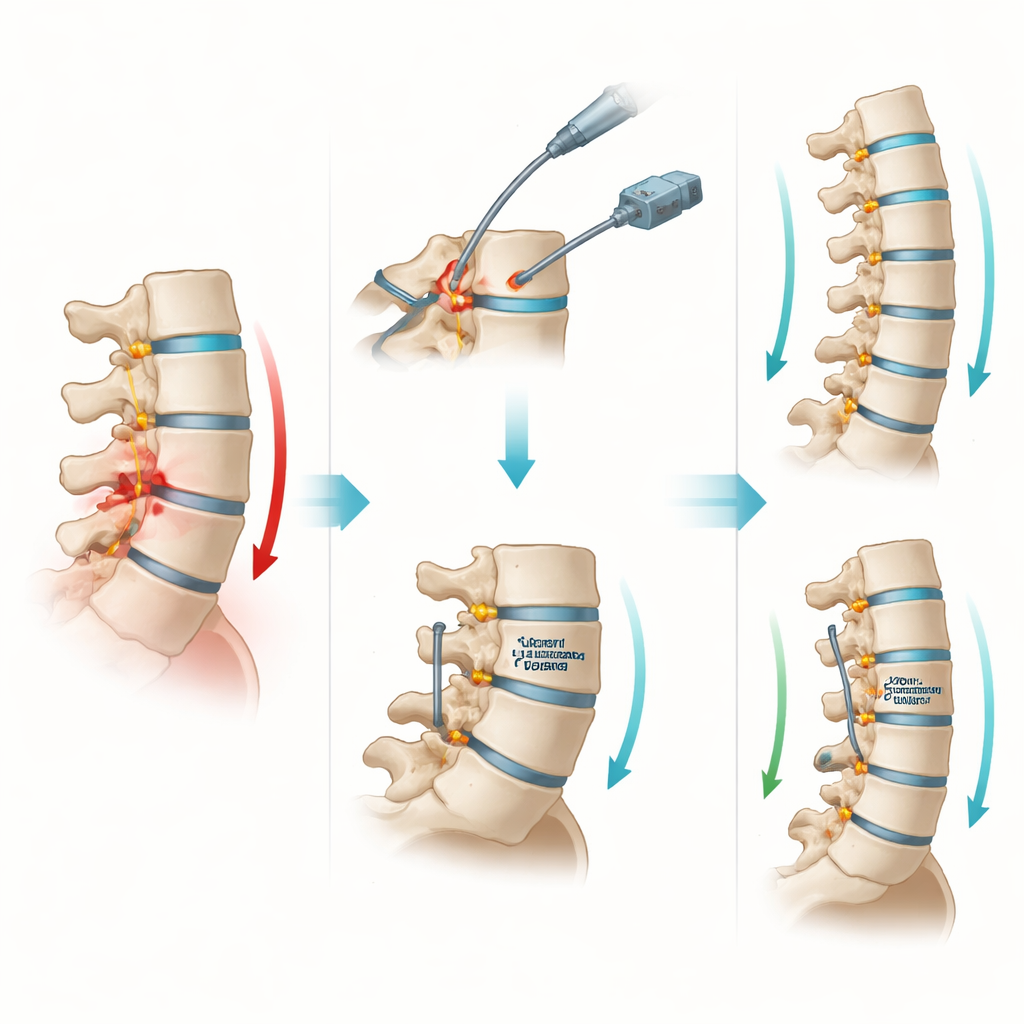
What changed after surgery
Both procedures quickly eased leg pain, and both sharply reduced the side‑to‑side curve and off‑center shift of the spine within a week. Patients reported less disability and walked more upright, while X‑rays showed that the tilted trunks and displaced vertebrae had largely realigned. However, early recovery differed. PELD patients had shorter surgeries, lost far less blood, went home sooner, and reported less low‑back pain in the first week. TLIF patients, whose muscles and bones had been more extensively handled, still hurt more in the back and functioned slightly worse that early on, even though their leg pain had improved just as much.
When fusion gains an edge
The advantage of the bigger TLIF operation emerged in patients whose posture was most distorted before surgery—those whose lower backs had lost their natural inward curve and whose bodies pitched forward. In these groups, the rate at which the scoliosis nearly vanished on X‑ray was much higher after TLIF than after PELD. The fusion cage and screw‑rod system seemed to help restore a healthier arch in the lower spine and bring the body’s weight back over the pelvis. Even so, the ideal amount of curvature was not fully regained within a week, hinting that deeper reshaping and muscle adaptation require more time.
What this means for patients
For people whose slipped disk has literally twisted their spine, both minimally invasive PELD and more extensive TLIF can rapidly straighten the back and ease nerve pain. PELD offers a quicker, gentler recovery in the short term, with less bleeding and shorter hospital stays. TLIF demands more up front but can better correct severe posture problems when the spine is already leaning and the natural lower‑back curve is lost. The study suggests that choosing between these surgeries should not be based on pain alone, but also on how much the spine’s overall alignment has shifted.
Citation: Yang, J., Xie, X., Sheng, W. et al. Radiological characteristics in coronal and sagittal planes and short-term postoperative outcomes in patients with lumbar disc herniation accompanied by sciatic scoliosis. Sci Rep 16, 12440 (2026). https://doi.org/10.1038/s41598-026-43074-x
Keywords: lumbar disc herniation, sciatic scoliosis, spine alignment, minimally invasive spine surgery, spinal fusion