Clear Sky Science · en
Establishing baselines for echolocating bat activity at wind farms in mainland Southeast Asia
Why bats and wind power matter
As countries race to replace fossil fuels with cleaner energy, wind farms are rising across coastlines and mountain passes. But for bats—which reproduce slowly and already face many threats—spinning turbine blades can be deadly. This study from southern Vietnam asks a simple but crucial question: when and under what conditions are bats most active around wind turbines, and how can operators cut deaths without wasting valuable wind power?
Watching the night sky for a year
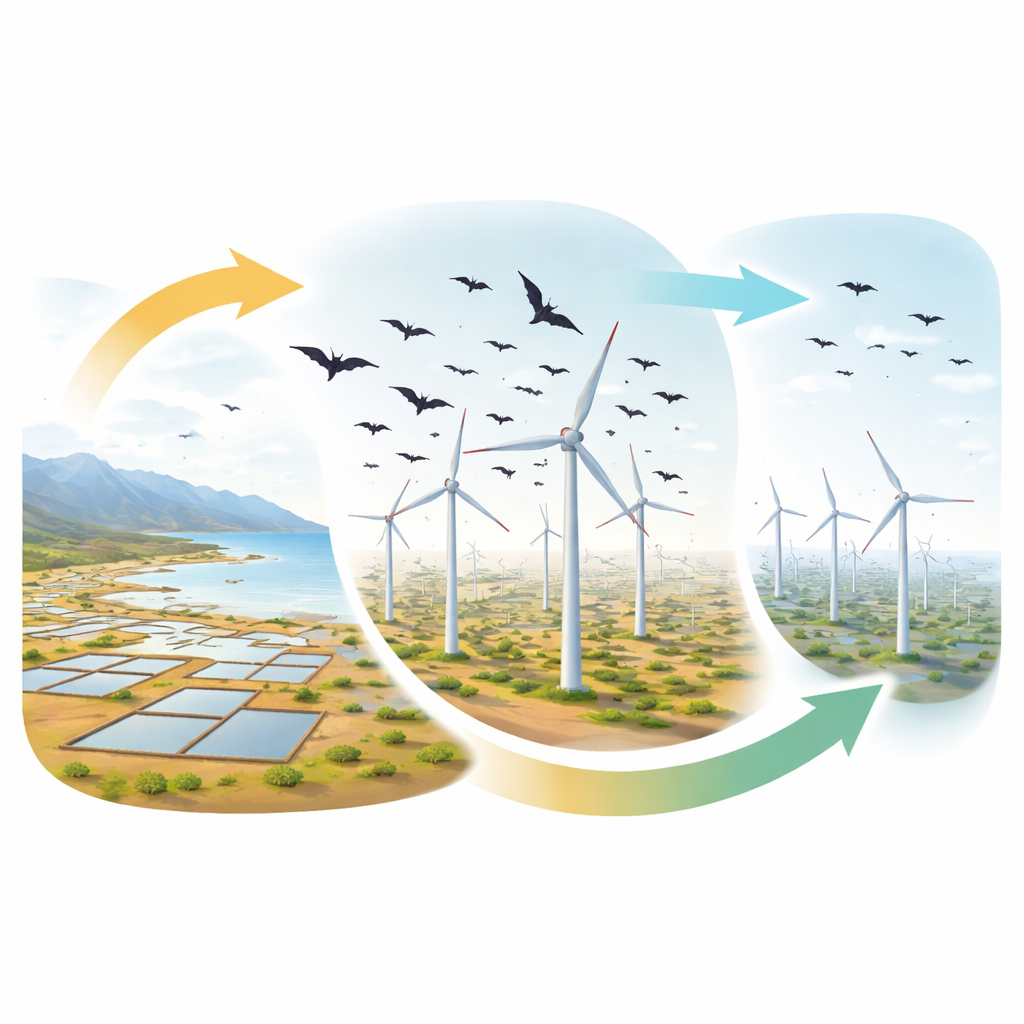
The researchers monitored a coastal wind farm in Ninh Thuan Province, Vietnam, an arid, windswept landscape dotted with salt ponds, scrub, and nearby mountains. Although earlier environmental surveys had noted only a handful of bat species, intensive trapping and listening revealed 22 species in the wider area. To understand which ones actually come near the turbines, the team placed ultrasonic detectors at the base of four turbines and recorded every night for a full year. In total, they logged more than 329,000 bat “detections”—bursts of sonar calls that signal a bat flying past.
Who is flying near the blades
From these recordings, 12 distinct call types were identified, representing 11 bat species plus one unassigned call type. Most of the regular visitors were small insect-eating bats that forage in open airspace, the very zone swept by turbine blades. Six species or call types were heard on most nights at most turbines, indicating that they likely live in the area all year, while a few others appeared mainly in particular months. A small group of cave- and forest-dwelling bats showed up only rarely, probably passing through rather than hunting near the turbines.
Busy nights and quiet months
Bat activity was far from uniform. Overall, detections were highest from May to October, but the fine-scale pattern was more revealing. On many nights in every month, activity reached moderate or high levels at one or more turbines. Typically, bats were most active soon after sunset and again before dawn, with a lull in the middle of the night. Importantly, activity at the four turbines rose and fell together from night to night, suggesting that wider environmental factors—such as insect swarms or regional weather—shape when bats decide to fly.
What weather really matters
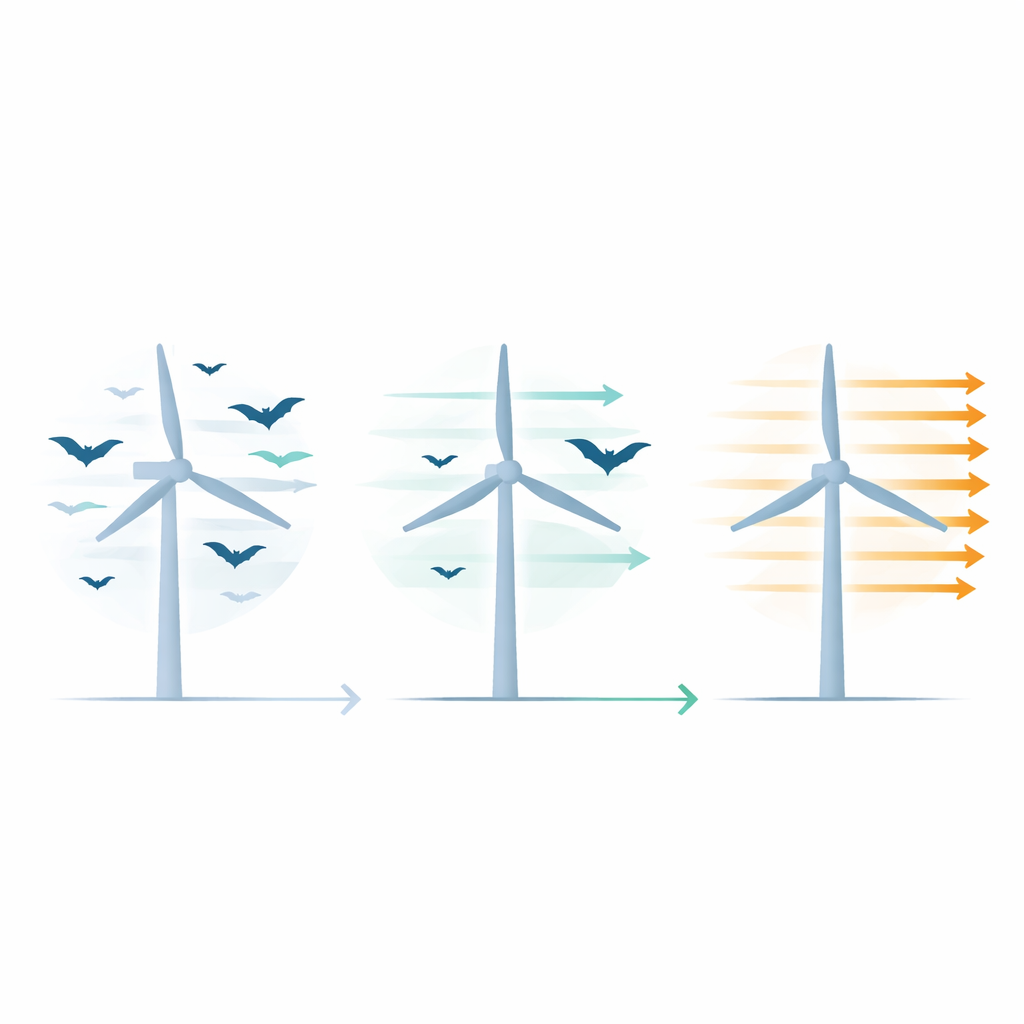
To see which conditions made a difference, the team used a statistical model that related hourly bat detections to wind speed, temperature, and rain. Wind speed stood out: bat activity was highest when the air was calm and dropped sharply as winds strengthened. Almost three quarters of all detections occurred when wind speeds were at or below 5 meters per second, and activity became very low once speeds passed about 7 meters per second. Rain, by contrast, had almost no effect at this dry site, and temperature showed only a modest positive link, likely reflecting the fact that both bats and warmth peak soon after dusk. The timing of activity also shifted with wind: when early-evening winds were strong, bats tended to delay their peak foraging to later hours, presumably to avoid the extra flying cost of battling strong gusts.
What this means for safer wind power
The study’s main message is that carefully timed turbine slowdowns at low wind speeds—when bats are active but turbines generate relatively little power—can greatly reduce bat deaths without large energy losses. At this Vietnamese wind farm, fine-tuning curtailment rules based on local bat activity and wind patterns should perform better than a simple, one-size-fits-all shutdown schedule. While rain and temperature may be more useful in wetter or cooler parts of Southeast Asia, here the key lever is wind speed. More site-specific monitoring across the region, coupled with transparent reporting of bat deaths, will be essential to make sure that the push for clean energy does not come at the cost of some of the world’s richest bat diversity.
Citation: Furey, N.M., Tu, V.T., Hitch, A. et al. Establishing baselines for echolocating bat activity at wind farms in mainland Southeast Asia. Sci Rep 16, 10207 (2026). https://doi.org/10.1038/s41598-026-41384-8
Keywords: bats, wind turbines, Southeast Asia, wildlife conservation, renewable energy impacts