Clear Sky Science · en
Triggering anger using a virtual reality social scene
A New Way to Safely Explore Hot Emotions
Many people struggle with anger that flares up quickly in everyday situations, straining relationships and sometimes leading to violence. Yet it is hard, and often unsafe, to practise calmer responses in the real world while tempers are running high. This study asks a simple but important question: can a virtual reality (VR) scene that feels like an awkward, tense elevator ride reliably spark anger in men, especially in those who already find anger hard to control? If so, VR could become a powerful tool for testing new approaches to managing this difficult emotion.
Stepping Into a Tense Elevator Ride
The researchers built an immersive VR scenario that mimics a common uncomfortable moment: standing in a crowded lift with strangers who seem just a bit too close and too focused on you. Participants, all adult men, put on a VR headset and found themselves first in a foyer, then automatically transported into a dimly lit lift. Inside were seven virtual people, several taller than the user, making frequent eye contact and wearing subtly mixed expressions—some seeming interested, others unimpressed or distant. The aim was not to create an extreme confrontation, but a mildly intimidating scene that might nudge feelings of irritation or threat, similar to what could happen in everyday life. 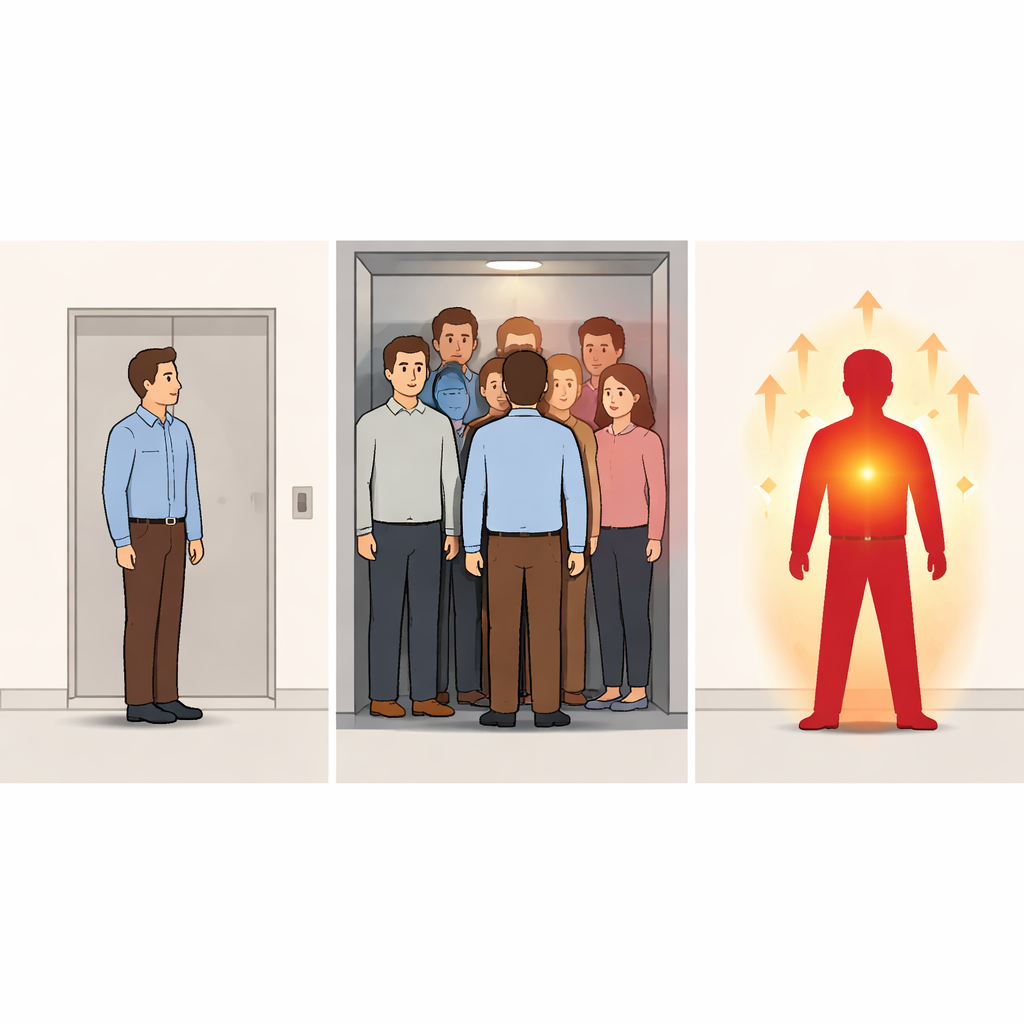
Comparing Men With and Without Anger Difficulties
From more than 250 men who were screened, the team selected two groups: one with very low levels of problematic anger and one whose anger scores were high enough to be considered clinically concerning. Before entering VR, all participants rated how irritated, annoyed, and angry they felt, along with other emotions so that anger would not stand out as the obvious focus. After the lift ride, they rated these feelings again and also judged how they saw the virtual characters—whether they seemed friendly, neutral, judgemental, or deliberately hostile. This design allowed the researchers to see not only if anger rose, but whether the way participants interpreted others’ behaviour helped drive that change.
When Suspicion Fuels the Fire
Across the whole sample, anger rose noticeably after the VR experience: even a short, mildly stressful scene was enough to push feelings upward. But the increase was much larger in the high-anger group. These men started off angrier and ended the scenario with far stronger angry reactions than the low-anger group. A key factor was how they read the room. Men who saw the virtual people as trying to intimidate or look down on them tended to become angrier, regardless of which group they were in. Those with high anger also reported higher levels of general suspicion about other people outside the VR setting. This suggests that a background belief that others may wish you harm can colour how you read ambiguous social signals, turning a stare or neutral face into a personal slight or threat. 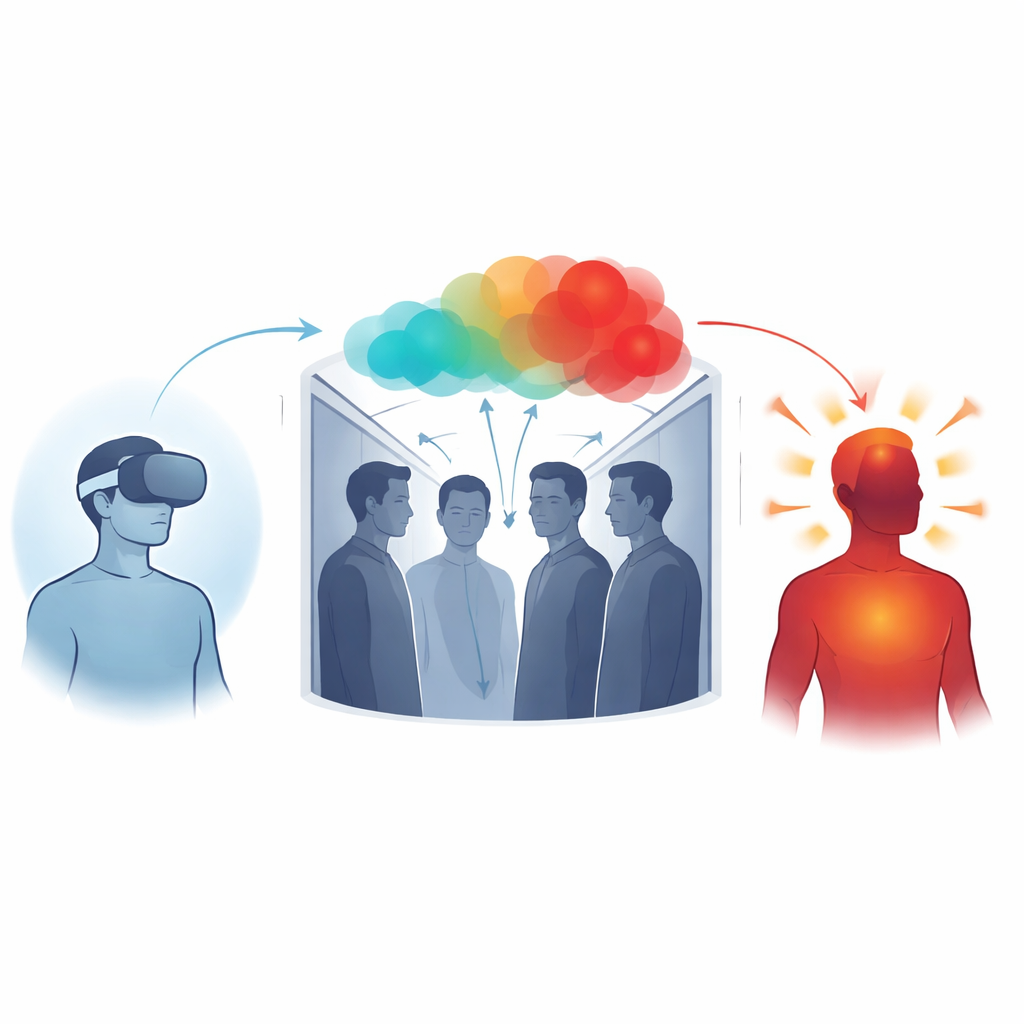
What VR Reveals About Anger Triggers
The findings indicate that anger does not arise solely from what happens on the surface—such as standing too close or making eye contact—but from how those moments are interpreted. Men with problematic anger were more likely to give hostile meanings to subtle cues and, in turn, to feel stronger anger. Yet the study also showed that not everyone with high anger reacted in the same way. Some experienced strong surges, others much milder ones. This diversity hints that people’s triggers are varied: for some it might be feeling disrespected, for others crowded spaces, loud environments, or reminders of past conflict. VR offers a flexible way to explore these differences by safely varying scenarios and observing how people respond in real time.
Building Safer Ways to Learn Calm Responses
To a lay reader, the main message is straightforward: a carefully designed VR elevator scene can reliably stir anger, particularly in men who already struggle with it, and this reaction is tightly linked to seeing others as hostile. Because the simulation is controlled and carries no real-world risk, it opens the door to new kinds of training where people can practise noticing and rethinking angry interpretations while still feeling emotionally engaged. Although this initial study used self-report measures and included only men, it provides a crucial first step toward virtual environments that help people understand their anger and rehearse safer, more constructive ways of responding before they face similar moments in everyday life.
Citation: Lambe, S., Miguel, A., Bousfield, M. et al. Triggering anger using a virtual reality social scene. Sci Rep 16, 10156 (2026). https://doi.org/10.1038/s41598-026-36653-5
Keywords: virtual reality therapy, anger management, hostile appraisals, social stress, emotional regulation