Clear Sky Science · en
A neural signature of adaptive mentalization
How We Read Minds in Everyday Games
When you bargain over a car price, play poker, or decide how honest to be in an email, you quietly ask yourself, “What is the other person really thinking?” This skill—figuring out what others know, want, or plan—is called mentalizing. The study summarized here asks a deeper question: not just whether we can read minds, but how we adjust our mind-reading strategies on the fly when other people change their tactics. Understanding this “adaptive mentalizing” matters for everyday social life and could help explain difficulties seen in conditions such as autism or certain personality disorders.
A Simple Game with Deep Social Thinking
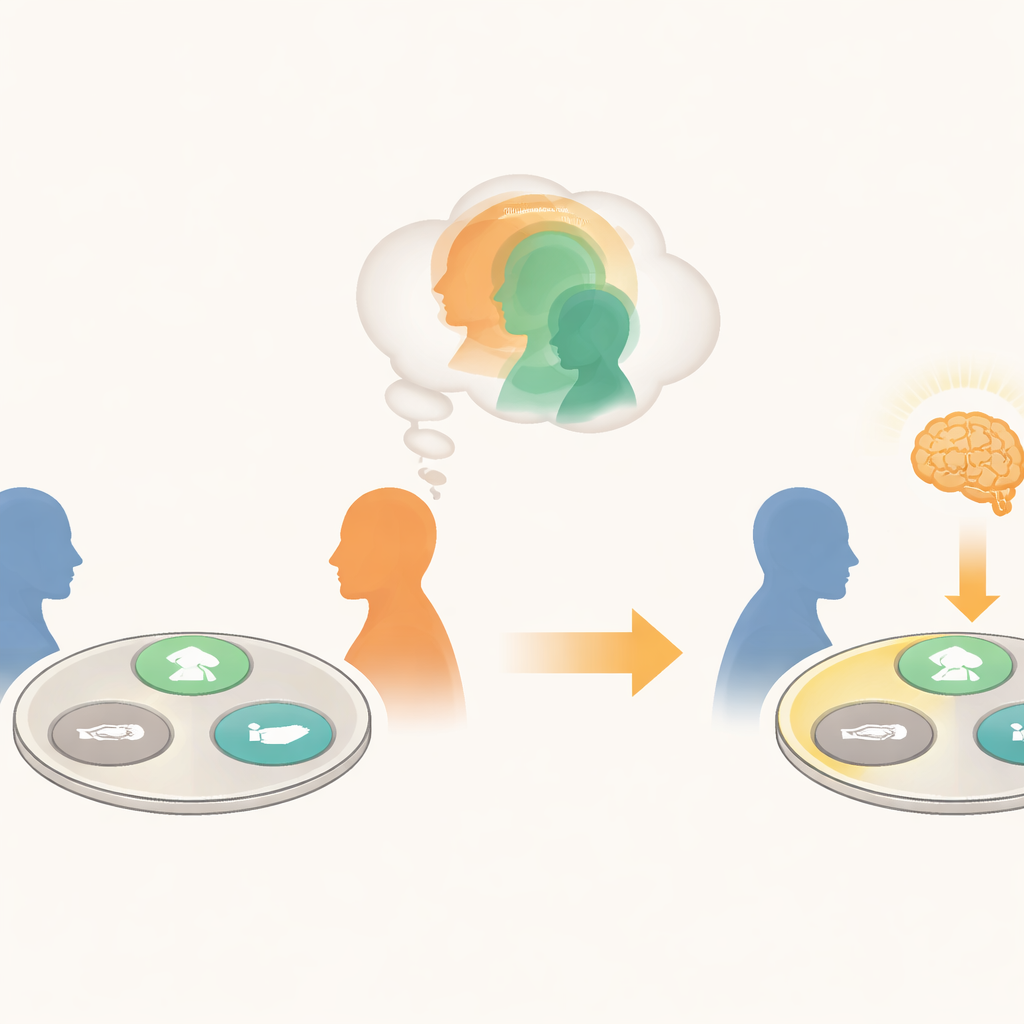
To probe adaptive mentalizing, the researchers turned to a humble childhood game: rock–paper–scissors, reworked into a clean, number-based circle. Participants repeatedly played against either other humans or carefully designed computer opponents. On the surface, the best tactic in this game is to be perfectly unpredictable. In reality, people show habits and patterns, which creates chances to outsmart one another. Players might think one step ahead—“you will repeat rock, so I play paper”—or several steps ahead—“you think I expect rock, so you play scissors, so I play rock,” and so on. The key question was whether people could detect how many “steps ahead” their opponent was thinking and then dial up or down their own level of reasoning to match.
A New Way to Track Changing Beliefs
The team built a computational model, called CHASE (for Cognitive Hierarchy Assessment), to make these hidden thought processes measurable. CHASE assumes that players keep track of how often each move is played, imagine how an opponent of different sophistication levels would respond, and then update their belief about how sophisticated the opponent currently is. Each new round nudges this belief, sometimes a lot and sometimes a little, depending on how surprising the opponent’s move is. By feeding people’s actual choices into the model, the researchers could estimate, trial by trial, how strongly each participant revised their view of the opponent. This allowed them to separate basic action execution from the more abstract process of deciding “how deeply should I think about this person right now?”
People Can Flex Their Social Reasoning
Across nine different studies with more than 500 volunteers, CHASE consistently explained behavior better than classic learning models that ignore changing mentalizing depth. Most participants performed above chance against all types of artificial opponents, from simple pattern followers to more cunning strategists. Crucially, the model showed that about four in five people successfully shifted their reasoning to stay one step ahead of opponents with different levels of sophistication. Still, individuals varied widely: some needed only a few rounds to lock onto the opponent’s style, while others updated their beliefs more slowly or noisily. A key model parameter captured this sensitivity to new information, effectively acting like a “social learning rate” for how quickly people revise their view of another mind.
The Brain’s Network for Updating Social Guesses
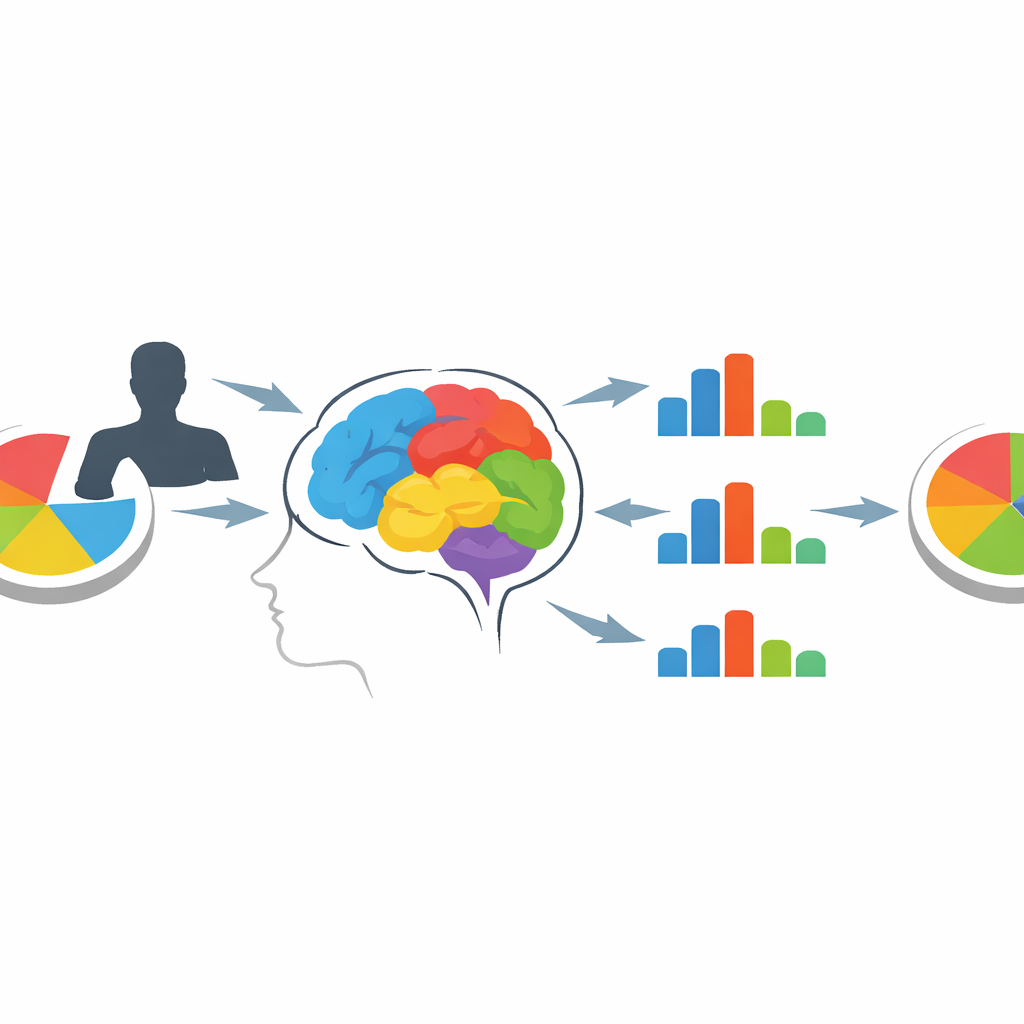
In a subset of participants, the researchers recorded brain activity with functional MRI while people played against artificial opponents. They looked for brain signals that tracked three ingredients from the model: how good a chosen move was expected to be, how surprising the opponent’s action was, and how strongly the player updated their belief about the opponent’s reasoning level. As expected, regions long linked to valuing options, such as the ventromedial prefrontal cortex, responded to expected payoff. But the belief-updating signal—how much a player revised their model of the opponent—was tied to a wider “social brain” network, including the temporoparietal junction, insula, and parts of prefrontal cortex. Moreover, people who were better, according to the model, at picking up on opponent strategies showed stronger functional connections between these regions, especially involving the right temporoparietal junction.
A Neural Signature of Flexible Mind-Reading
To test whether adaptive mentalizing leaves a reliable fingerprint in the brain, the team trained machine-learning methods on whole-brain activity patterns. The goal was to predict, from brain scans alone, how strongly a person was updating their belief about the opponent at each moment. The resulting multiregion pattern predicted belief updates with striking accuracy, both in the original group and in a second, more demographically varied sample, without retraining. This suggests that adaptive mentalizing is supported by a consistent, distributed code rather than a single “mind-reading spot.” In everyday terms, the study shows that our brains do not just guess what others think—they also continually adjust how hard they try to think ahead, and this flexible tuning leaves a measurable, generalizable trace in brain activity.
Citation: Buergi, N., Aydogan, G., Konovalov, A. et al. A neural signature of adaptive mentalization. Nat Neurosci 29, 934–944 (2026). https://doi.org/10.1038/s41593-026-02219-x
Keywords: theory of mind, social decision-making, fMRI, computational psychiatry, rock paper scissors