Clear Sky Science · en
Chemokine-defined macrophage niches establish spatial organization of tumor immunity
How Neighborhoods Inside Tumors Shape the Immune Battle
Why do some tumors stay under control while others grow unchecked, even when they contain many immune cells? This study looks inside lung tumors at a very fine scale and finds that not all immune cells are equal. In particular, different groups of macrophages—immune cells that act as both cleaners and coordinators—set up distinct “neighborhoods” that can either help the body fight cancer or quietly help tumors thrive. Understanding this internal map of good and bad immune zones could point the way to smarter cancer therapies and better vaccines.
Two Faces of Tumor Macrophages
Macrophages are often lumped together as a single cell type, but in the lung they fall into several resident and incoming groups. The authors focused on interstitial macrophages, which live in the tissue between air sacs and blood vessels, and on recruited macrophages that arrive from the bloodstream during disease. Using single-cell gene profiling, they showed that resident interstitial macrophages split into two main camps. One camp, found near airways and blood vessels, showed a molecular profile linked to immune support and carried signals known to attract helpful lymphocytes. The other camp, together with the incoming recruited macrophages inside tumor cores, carried gene programs more closely tied to tumor growth and suppression of immune attack.
Mapping the Immune Landscape in 3D Space
To see where these cells actually sit inside tumors, the researchers combined their single-cell data with spatial transcriptomics—an imaging approach that charts gene activity directly in tissue slices. They found that protective resident macrophages line bronchial and vascular regions and produce chemokines that draw in T and B cells, encouraging the formation of small, organized immune hubs called tertiary lymphoid structures. 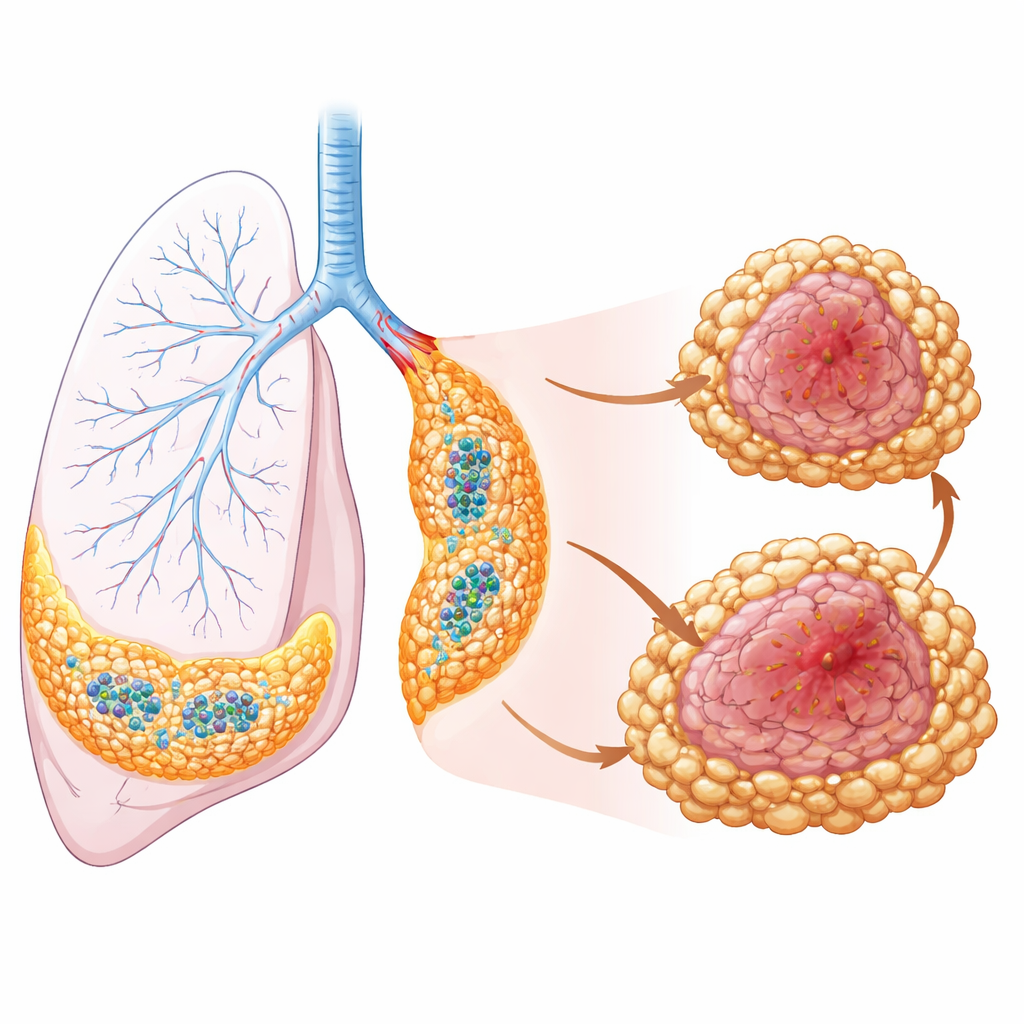
Signals That Feed Tumors Versus Signals That Guard Them
By selectively removing the protective resident macrophages in mouse models of melanoma and lung adenocarcinoma, the team saw tumors grow faster and tertiary lymphoid structures disappear. Levels of key chemokines that attract lymphocytes dropped in the lungs, and fewer T and B cells accumulated near tumors. On the flip side, the chemokine CCL2, produced mainly by interstitial macrophages, turned out to be critical for calling in recruited macrophages from the blood. When the researchers eliminated CCL2 production only from bone marrow–derived immune cells, or more specifically from short-lived myeloid cells while preserving long-lived resident macrophages, fewer recruited macrophages entered the lungs and tumor growth was sharply reduced. These experiments showed that macrophage-derived CCL2 acts as a nonredundant fuel line for bringing in tumor-supporting cells.
How Traveling Cells Quiet Vaccine Responses
The story does not end inside the tumor. Some of the incoming macrophages turn into monocyte-derived dendritic cells that carry tumor material to nearby lymph nodes, where immune responses are initiated. Surprisingly, in this context these travelers act more like brakes than accelerators. The team found that these cells rely on a different homing signal, CCR5, to reach lymph nodes. In mice engineered so that only monocyte-derived cells lacked CCR5, both melanoma and lung cancer grew less. 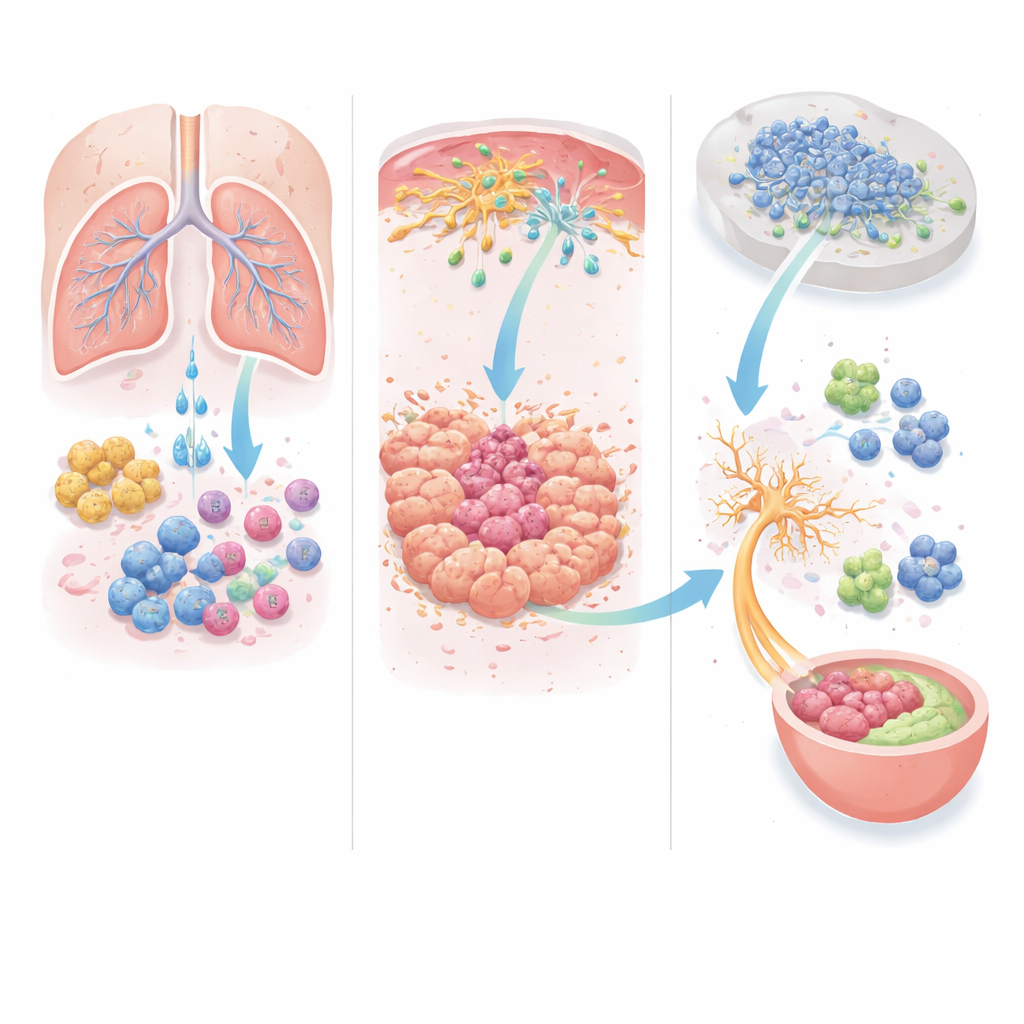
What This Means for Future Cancer Treatments
This work shows that where macrophages live inside the lung, and which chemical signals they send out, largely determines whether they help or hinder tumor control. Resident macrophages along airways and vessels build immune-rich neighborhoods that favor tumor rejection, while other macrophages in and around tumor cores create chemokine-defined zones that recruit suppressive cells and feed tumor growth. The findings suggest that effective immunotherapy will need to be more precise than simply “boosting” or “blocking” macrophages as a whole. Instead, future strategies may aim to preserve or even expand the protective resident macrophage niches, while cutting off key pathways—such as CCL2-driven recruitment and CCR5-dependent trafficking—that allow suppressive monocyte-derived cells to dominate the tumor environment and nearby lymph nodes.
Citation: Ghosh, S., Li, X., Rawat, K. et al. Chemokine-defined macrophage niches establish spatial organization of tumor immunity. Nat Immunol 27, 715–724 (2026). https://doi.org/10.1038/s41590-026-02445-2
Keywords: tumor microenvironment, lung cancer immunity, macrophage niches, chemokines, cancer immunotherapy