Clear Sky Science · en
2′-O-Methyl-guanosine RNA fragments antagonize TLR7 and TLR8 to limit autoimmunity
Why our immune system must tell friend from foe
Every day, our bodies quietly clear away billions of dying cells without sparking harmful inflammation. At the same time, the immune system must stay ready to pounce on viruses and bacteria, many of which carry similar genetic material to our own. This paper uncovers a built‑in safety mechanism that helps immune sensors avoid overreacting to the body’s own RNA, offering new clues to why some people develop autoimmune diseases like lupus and how we might better design vaccines and anti‑inflammatory drugs.
Guardians that listen for danger signals
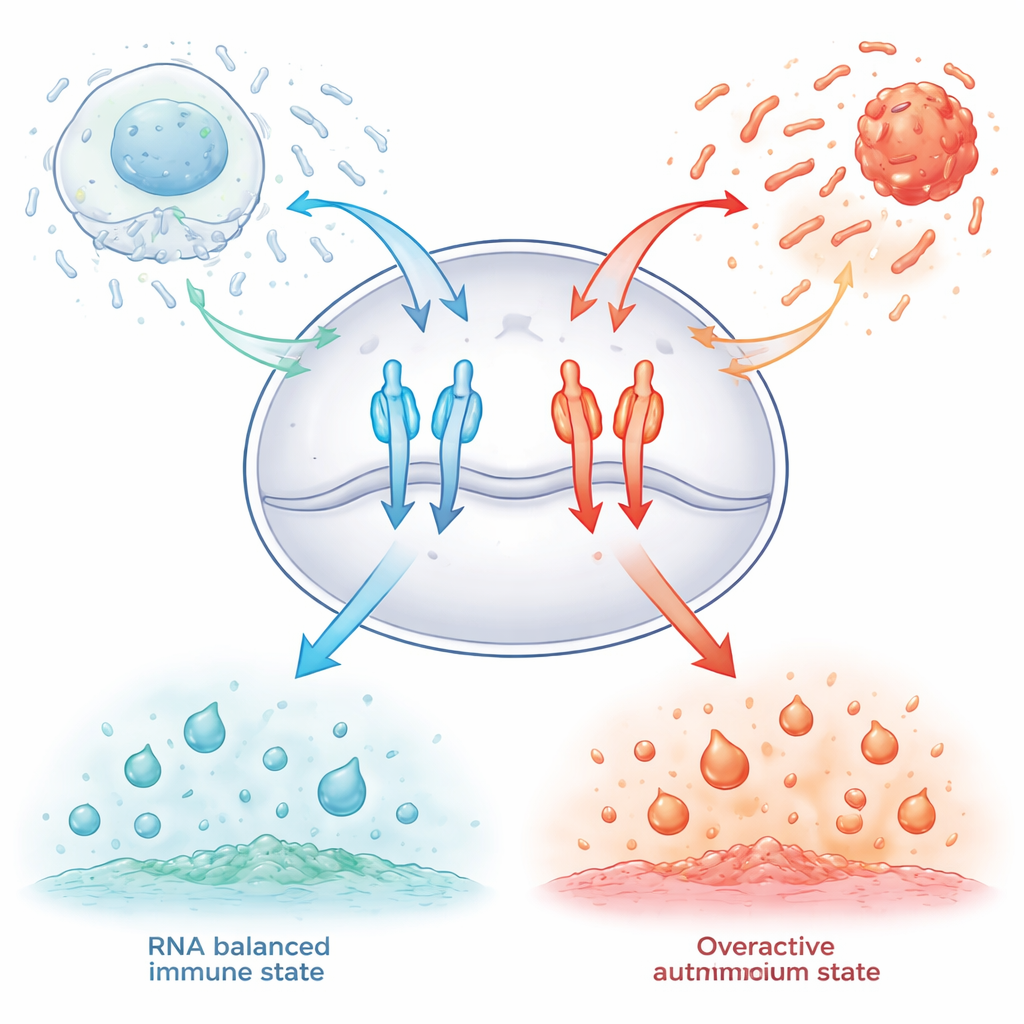
Deep inside immune cells sit two molecular “listening posts” called TLR7 and TLR8. They patrol tiny membrane bubbles that swallow bits of RNA from viruses, bacteria, or dying cells. When these receptors detect the right kind of short RNA fragments, they snap into an active shape and trigger production of antiviral and inflammatory molecules. If they respond too weakly, infections such as severe COVID‑19 can become life‑threatening; if they fire too easily, the immune system may attack healthy tissues. Until now, researchers did not fully understand how these sensors ignore the flood of harmless RNA fragments produced when the body quietly recycles its own cells.
Special RNA fragments that act like molecular brakes
The authors focused on very short, three‑letter‑long pieces of RNA carrying a subtle chemical tweak: a methyl group on the sugar of a guanosine base, known as 2′‑O‑methyl‑guanosine. By systematically testing all 64 possible three‑letter combinations in human cells engineered to express TLR7 or TLR8, they found that fragments starting with this modified guanosine can strongly dampen receptor activity. Some combinations quieted TLR7, others TLR8, and a few even boosted TLR8 responses, showing that the exact sequence fine‑tunes how these immune switches behave. Importantly, these short pieces worked not only against artificial drug‑like stimulants but also against genuine RNA agonists from viruses and bacteria, and they could tone down immune signaling in human blood cells.
A hidden off‑switch pocket revealed
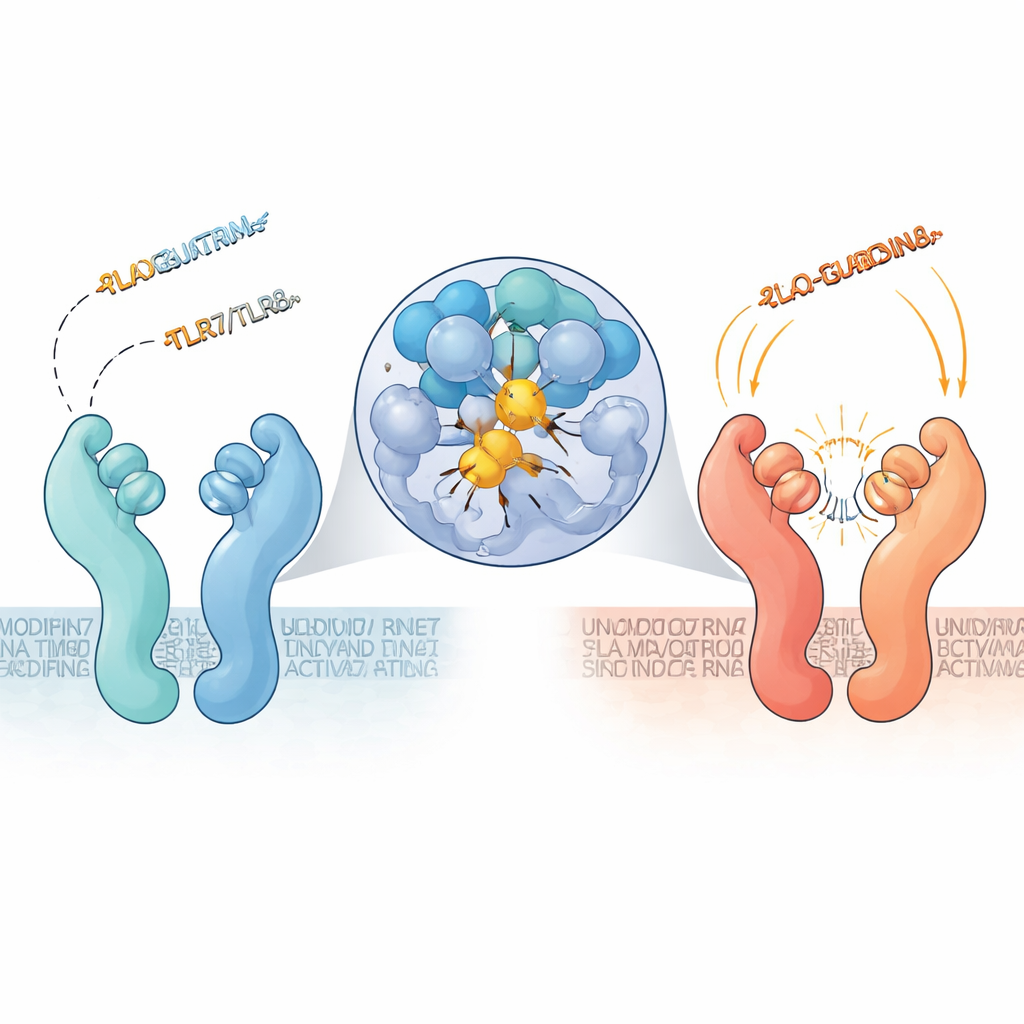
To see how these fragments work, the team combined advanced microscopy with computer simulations. High‑resolution cryo‑electron microscopy showed that particular three‑letter fragments containing 2′‑O‑methyl‑guanosine latch onto a previously underappreciated groove formed between the two halves of the TLR7 protein. When this pocket is filled, the receptor stays in an “open” resting shape that cannot signal, even if activating RNA is present elsewhere. The modified guanosine at the front of the fragment nestles deeply into a cluster of aromatic amino acids, forming snug stacking and hydrogen‑bond interactions. Ordinary, unmodified RNA cannot grip this site nearly as well, making these methylated fragments powerful natural antagonists.
Natural brakes from ribosomal RNA and disease‑linked mutations
The story becomes even more intriguing when considering where such fragments come from. The authors point out that our ribosomes—the cellular machines that build proteins—are packed with over a hundred 2′‑O‑methyl marks, many of them on guanosine in three‑letter patterns that match the best inhibitory motifs. When ribosomal RNA is chopped up during normal cell turnover, these fragments appear inside immune cells. Experiments showed that purified ribosomal RNA can suppress TLR7 and TLR8 activity, and that reducing the methyl‑adding enzyme fibrillarin weakens this effect. Moreover, rare human mutations found in patients with lupus or related conditions alter key amino acids in the antagonist pocket of TLR7 or TLR8. These changes reduce binding of the modified fragments, loosening the natural brake and promoting autoimmune inflammation.
Implications for vaccines and autoimmune therapy
In mice, synthetic three‑letter fragments designed to mimic these natural motifs successfully dampened TLR7‑driven inflammation in models of skin disease and reduced the inflammatory side effects of an unmodified mRNA delivered in lipid nanoparticles, similar to those used in vaccines. To a non‑specialist, the take‑home message is that our cells constantly generate small, chemically marked RNA pieces that plug a special off‑switch on key immune sensors, preventing them from misreading everyday cellular debris as a threat. When that off‑switch is weakened—by genetic mutation or perhaps by imbalanced RNA processing—the immune system is more likely to misfire against the body itself. Understanding and harnessing these natural RNA “brakes” could help design safer vaccines and new treatments for autoimmune diseases.
Citation: Alharbi, A.S., Sapkota, S., Zhang, Z. et al. 2′-O-Methyl-guanosine RNA fragments antagonize TLR7 and TLR8 to limit autoimmunity. Nat Immunol 27, 762–775 (2026). https://doi.org/10.1038/s41590-026-02429-2
Keywords: innate immunity, Toll-like receptors, RNA modifications, autoimmunity, ribosomal RNA