Clear Sky Science · en
Land vertebrates increasingly exposed to multiple extreme events by 2085
Why this matters for life on land
From kangaroos and parrots to frogs and lizards, animals that live on land are increasingly facing not just one kind of harsh weather, but several. This study asks a simple but pressing question: as the climate warms, how often will land animals be hit by heatwaves, fires, droughts and floods, sometimes in quick succession? The answer helps us understand where nature is under greatest pressure and where conservation efforts could matter most.
Many kinds of extremes, many ways to be harmed
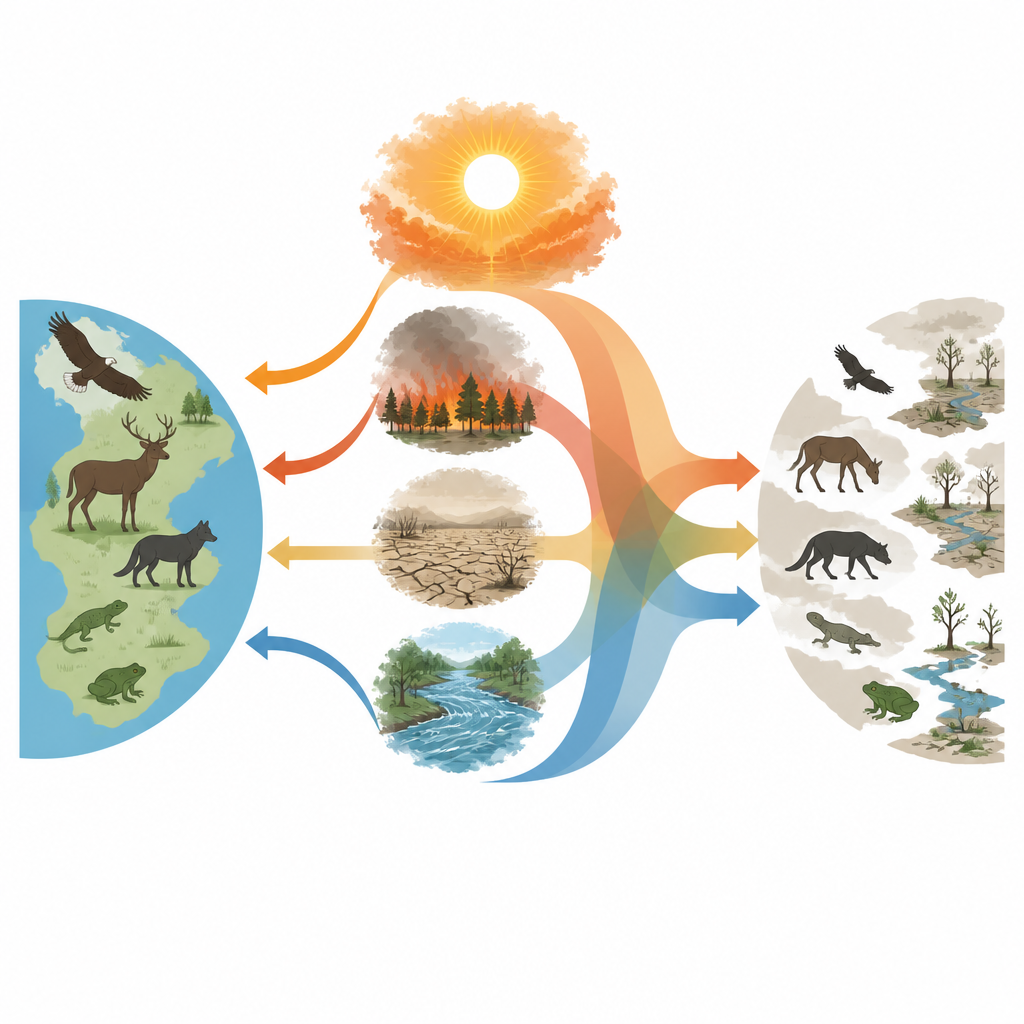
Extreme events are more than uncomfortable heat or a heavy rainstorm. Heatwaves can cause dehydration, reduce fertility and kill animals outright. Wildfires can burn and suffocate wildlife or strip away the food and shelter they need. Drought drains wetlands and ponds, leaving frogs without breeding sites, while floods can drown animals or wash away nests and burrows. Some species benefit in certain cases, such as those that thrive in freshly burned or flooded areas, but many more suffer serious losses or even local disappearance.
A global checkup for 33,000 species
The researchers combined global maps of four hazards heatwaves, wildfires, droughts and river floods with range maps for 33,936 species of amphibians, birds, mammals and reptiles. Using climate and impact models, they compared a recent baseline period around the year 2000 with future periods up to 2085 under different greenhouse gas pathways. For each species, they calculated how much of its current range is likely to experience each kind of extreme, and how often, treating an event as extreme when it diverged strongly from the local pre industrial climate.
Heat and fire rise almost everywhere
The clearest signal is the spread of extreme heat. Under a medium high emissions pathway that broadly matches today’s track, by 2050 an average of 74 percent of the land within species current ranges is projected to face extreme heatwaves, compared with much lower levels around 2000. By 2085 that figure climbs to about 93 percent. Extreme wildfires become the next most common hazard, affecting about 16 percent of species ranges by 2050 and 25 percent by 2085. Regions rich in species, such as the Amazon basin, tropical Africa and Southeast Asia, are projected to see sharp increases in both heat and fire, putting large numbers of animals at risk.
Stacked hazards and regional hotspots
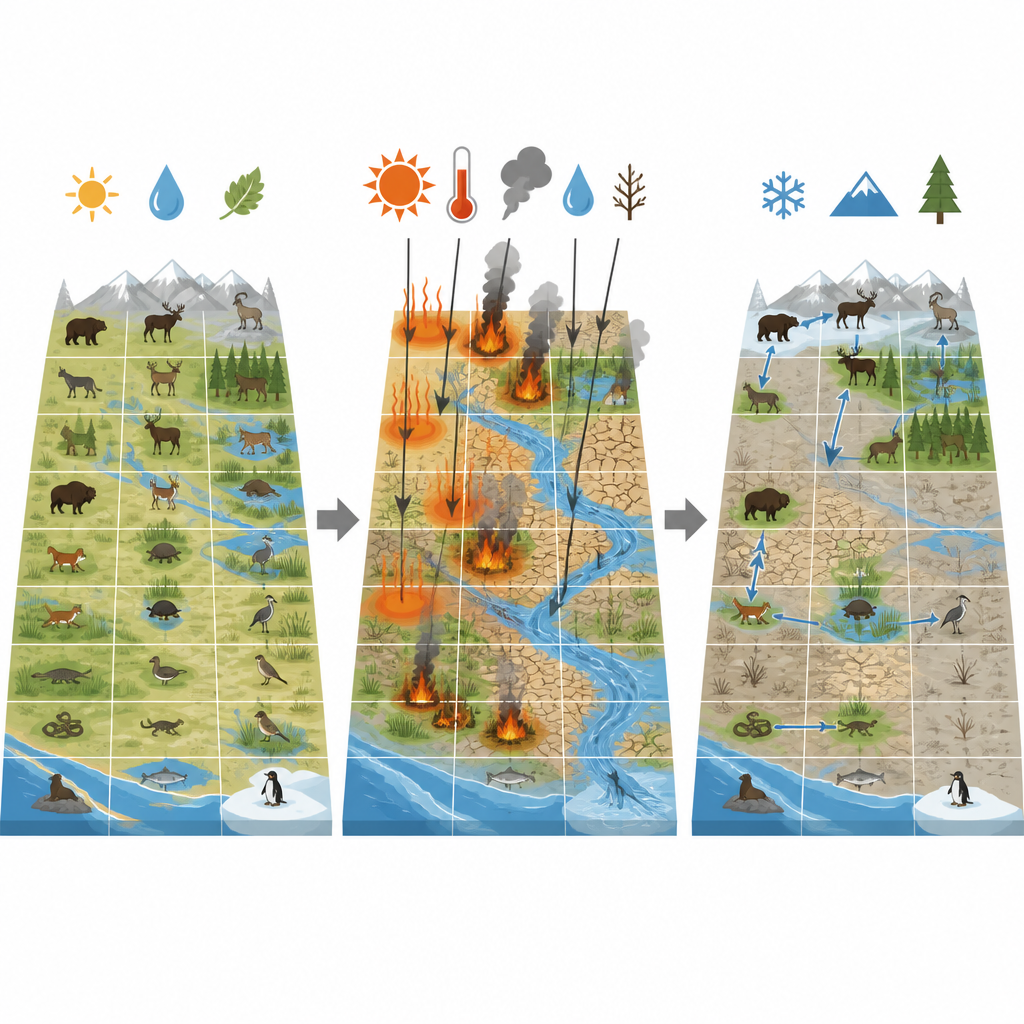
While each type of event is worrying on its own, the picture becomes more troubling when hazards overlap. By 2050, about 14 percent of the area within species ranges is expected to be exposed to at least two kinds of extreme events, such as a heatwave and a fire in the same year or close together in time. By 2085 that share grows to 36 percent for the medium high emissions pathway, and even higher under a more extreme scenario. Mid latitude regions begin to stand out as hotspots, with more than half of some ecoregions experiencing multiple event types. Amphibians, which depend heavily on moist habitats, face particularly strong exposure to drought by the end of the century.
Limits to coping and what can still be done
Species are not completely helpless. Some are adapted to regular fires or seasonal floods, and many can change their behavior, such as moving to shade or drinking more often during hot days. Yet the pace and intensity of projected extremes may exceed what many animals can handle, especially those with small ranges and limited ability to move. The study also notes that its results probably underestimate risks for species confined to small islands and do not include future shifts in where species live. Even so, one message is clear for a broad audience lower greenhouse gas emissions significantly reduce the share of wildlife exposed to frequent, overlapping extremes, and conservation planning needs to prepare for a world where multiple hazards strike the same places again and again.
Citation: Heinicke, S., Zantout, K., Kühl, H.S. et al. Land vertebrates increasingly exposed to multiple extreme events by 2085. Nat Ecol Evol 10, 854–863 (2026). https://doi.org/10.1038/s41559-026-03050-0
Keywords: extreme climate events, biodiversity, vertebrates, heatwaves, wildfires