Clear Sky Science · en
Cancer-associated fibroblasts drive metabolic heterogeneity in colorectal cancer cells: predictions from metabolic modeling
Why cell neighbors matter in colon cancer
Colorectal cancer is not just a mass of rogue cells growing on their own. Tumor cells live in a crowded neighborhood filled with support cells, connective tissue, and chemical signals, all of which can shape how the cancer behaves and responds to treatment. This study asks a deceptively simple question: how do helper cells called cancer‑associated fibroblasts change the way colon cancer cells use nutrients and energy, and could those changes help explain why some tumors resist drugs aimed at their metabolism?
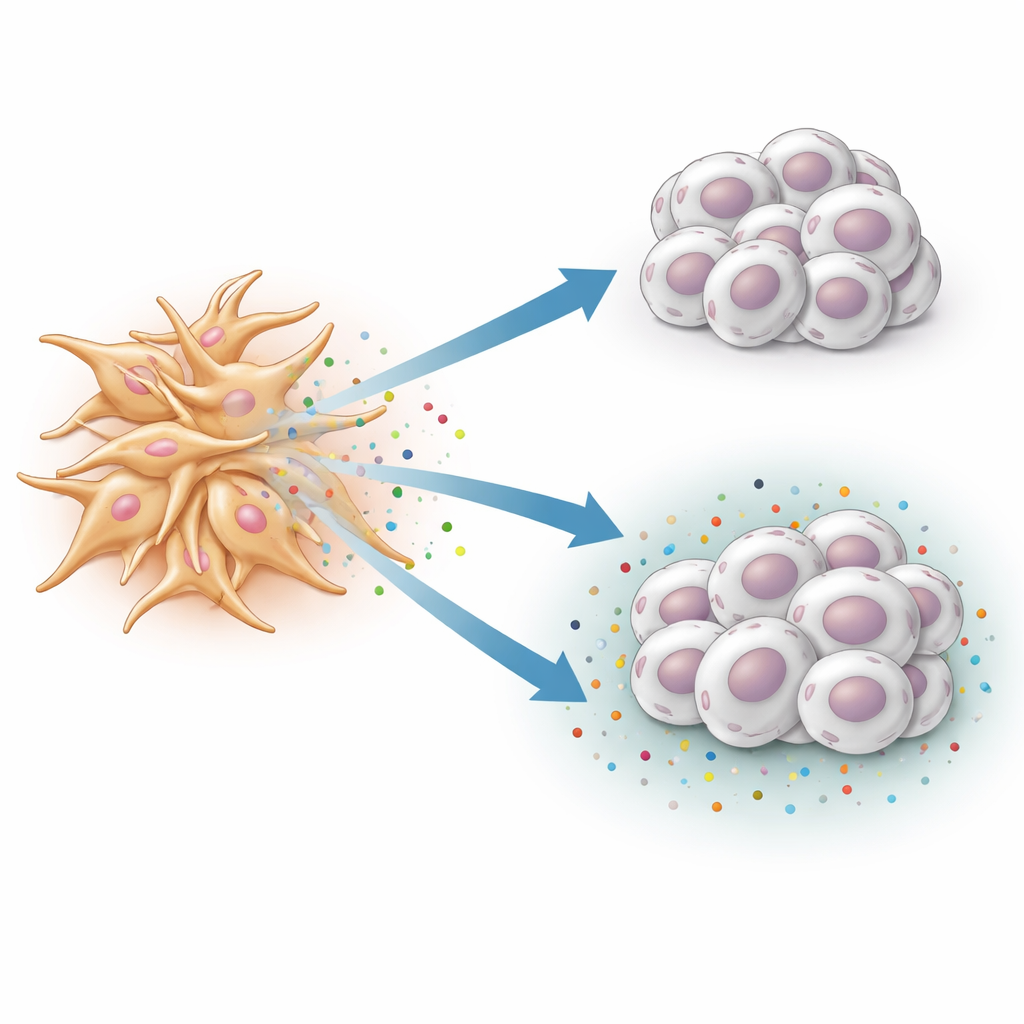
Hidden helpers in the tumor neighborhood
Fibroblasts are normally quiet builders of connective tissue, but inside tumors they often become activated and are then called cancer‑associated fibroblasts (CAFs). In colorectal cancer carrying mutations in the KRAS gene—a common and hard‑to‑drug driver of tumor growth—CAFs do more than provide structure. They release metabolites and growth factors that can feed tumor cells and encourage them to rewire how they process sugar, amino acids, and other nutrients. Experiments have shown that when cancer cells are grown in liquid that previously housed CAFs, called CAF‑conditioned media, they rely more heavily on sugar‑burning pathways and show signs of resistance to some metabolic drugs.
Using computer models to explore many possible futures
Instead of tracking a single “best” way a cancer cell might run its metabolism, the authors used a computational approach that samples thousands of possible metabolic states consistent with basic constraints such as nutrient uptake and growth. They started from an existing, experimentally informed model of central carbon metabolism in KRAS‑mutant colorectal cancer cells, including key pathways that process glucose and glutamine and generate building blocks for growth. They then simulated partial or complete slowdowns of 12 important enzymes, mostly in the main sugar‑breakdown route and a connected branching pathway. Each slowdown was explored in two virtual environments: standard cancer cell media and CAF‑conditioned media.
Many routes through the metabolic maze
For every simulated condition, the model produced 1,000 different ways flux—the flow of material through each metabolic reaction—could be arranged. The team applied modern pattern‑recognition tools to these high‑dimensional data, compressing them into two‑dimensional maps where each point represents one possible metabolic state. Clusters of points correspond to typical states that cells might adopt. Comparing these maps across conditions, the authors found that cells in CAF‑conditioned media occupied a wider and more varied region of metabolic space than cells in standard media. In other words, CAF‑derived factors encouraged a broader mix of metabolic strategies after enzyme perturbations, with fewer cases where different knockdowns converged on the same state.
Pathway shifts and growth under stress
By summing fluxes through whole pathways, the study revealed that CAF‑conditioned media consistently pushed colorectal cancer cells toward heavier use of the main sugar‑processing route and away from certain mitochondrial and branching‑pathway activities, even when enzymes along these routes were partially inhibited. Some perturbations reversed the direction of flow through parts of the branching pathway, suggesting that cells could reroute intermediates to regenerate key molecules needed for growth and protection against stress. When the researchers examined the model’s proxy for cell growth—biomass production—they found that every enzyme slowdown reduced growth, but often less so in CAF‑conditioned media. In several cases, especially when blocking enzymes at early decision points, growth in CAF‑conditioned media was more resilient, highlighting a protective effect of the tumor neighborhood.
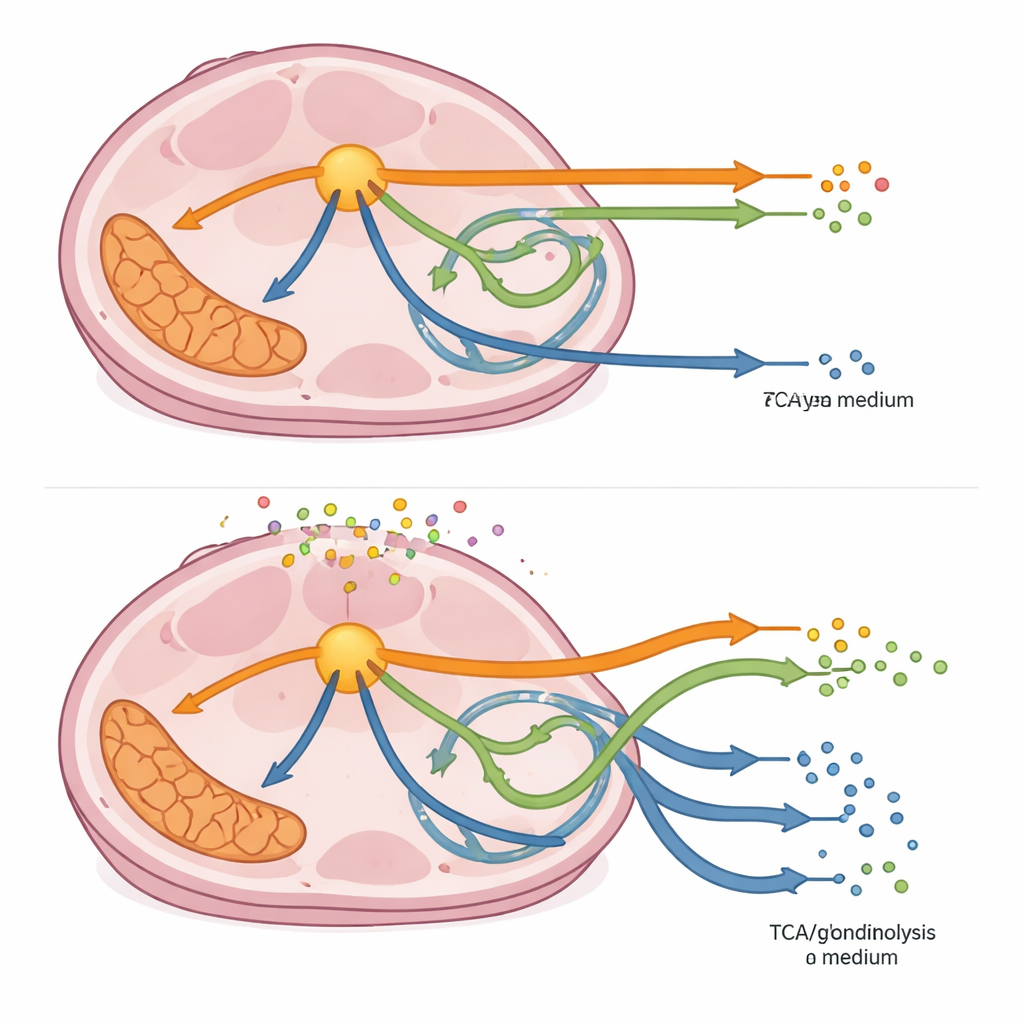
What this means for future treatments
To a non‑specialist, the main message is that cancer cells do not respond to metabolic drugs in isolation; their neighbors and the surrounding soup of secreted molecules can open up backup routes that let them survive. CAF‑conditioned media made KRAS‑mutant colorectal cancer cells more metabolically diverse and, in many cases, better able to withstand simulated enzyme‑targeting therapies, even though some targets still sharply curtailed growth. This work suggests that successful metabolic treatments will need to account for, or even directly disrupt, the support that fibroblasts provide. By mapping not just a single optimal pathway but an entire landscape of possible metabolic states, the study offers a richer view of where the tumor is most vulnerable—and how its microenvironment can shift those weak spots.
Citation: Elton, E., Tavakoli, N., Cetin, H. et al. Cancer-associated fibroblasts drive metabolic heterogeneity in colorectal cancer cells: predictions from metabolic modeling. npj Syst Biol Appl 12, 54 (2026). https://doi.org/10.1038/s41540-026-00673-8
Keywords: colorectal cancer metabolism, cancer-associated fibroblasts, tumor microenvironment, metabolic heterogeneity, computational modeling