Clear Sky Science · en
Soft bionic actuation explains the functional role of whisking in seal whisker sensing
A seal’s secret underwater sense
Seals can chase fish in dark, murky water where eyesight is nearly useless, yet still follow the invisible paths left by their prey. This study explores how the special shape and motion of seal whiskers turn faint water movements into clear signals, and how engineers built a soft robotic copy to understand and one day reuse this ability in underwater technology. 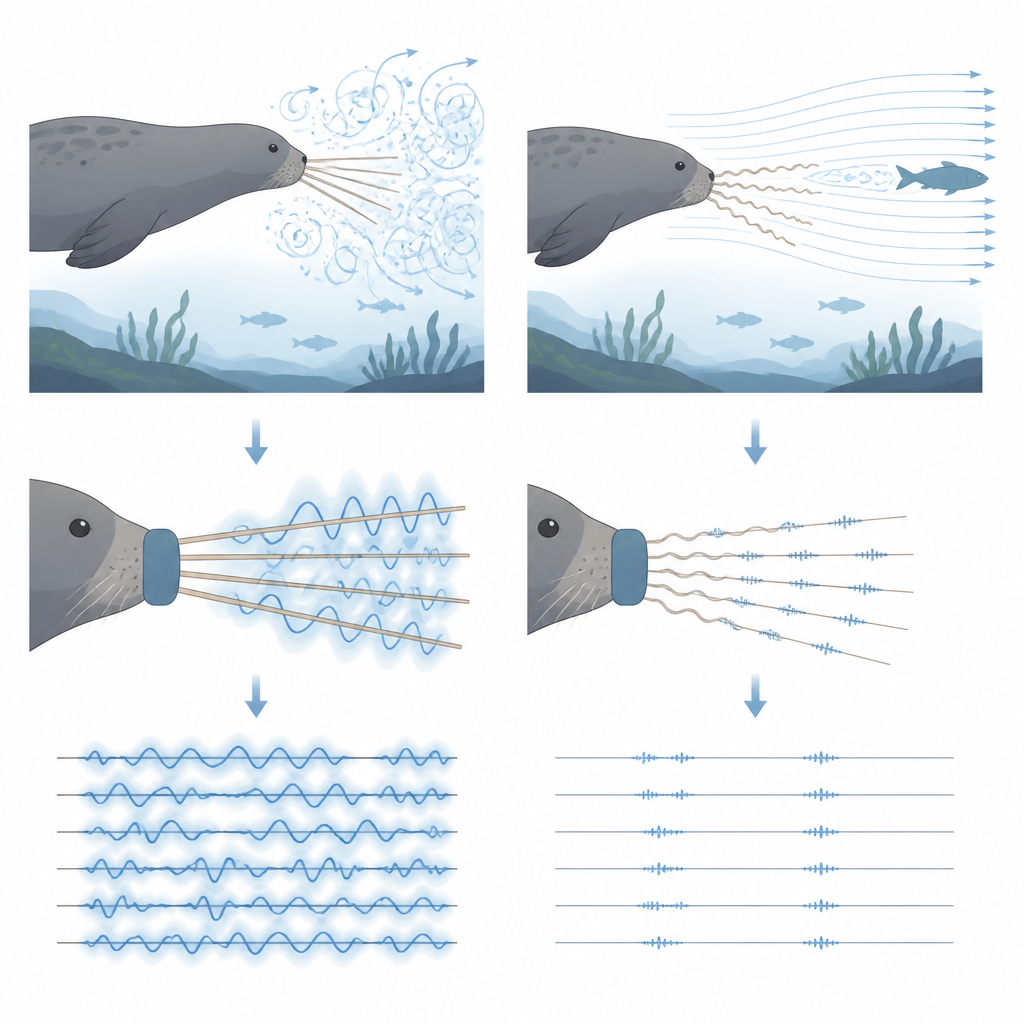
How whiskers read the water
Many animals use motion to sense their world: bats send out sound, while rats sweep their whiskers over objects. Seals do something similar in water. Their whiskers are packed with nerves and can detect tiny ripples created by swimming fish. Harbor seals have wavy, beaded whiskers, while California sea lions have smooth ones. The wavy shape was suspected to calm unwanted vibrations caused by the seal’s own swimming, so that only the flow from prey stands out. Until now, though, most tests used rigid plastic models or treated the whiskers as motionless feelers, ignoring the fact that real seals actively move them.
Testing real whiskers in flowing water
The researchers compared real whiskers from a harbor seal and a California sea lion in a water tunnel. Using a laser to measure microscopic motion, they first looked at how much each whisker shook when only steady water flow passed by. The smooth sea lion whisker vibrated strongly, while the wavy harbor seal whisker moved about three times less. When the team added a cylinder upstream to mimic the swirling wake of a fish, both whiskers began to sway in step with the repeating vortices. For the harbor seal whisker, the useful signal from this wake was more than fifty times stronger than the background noise from self-induced shaking, far higher than for the sea lion whisker.
Building a soft artificial muscle
In the wild, seals do not simply hold their whiskers stiff; they whisk them back and forth and push them forward when they sense prey. To study this active behavior, the team created a soft artificial muscle using an electrohydraulic actuator, a flexible pouch filled with liquid and patterned with thin electrodes. When high voltage is applied, the pouch bulges and bends, just like a contracting muscle. The scientists attached a real seal whisker, set in a soft artificial follicle, to this actuator. The device could swing the whisker through about 17 degrees, matching the angles measured in living seals, even while resisting drag from moving water. It responded in a few hundredths of a second and worked reliably over many cycles, much like natural muscle. 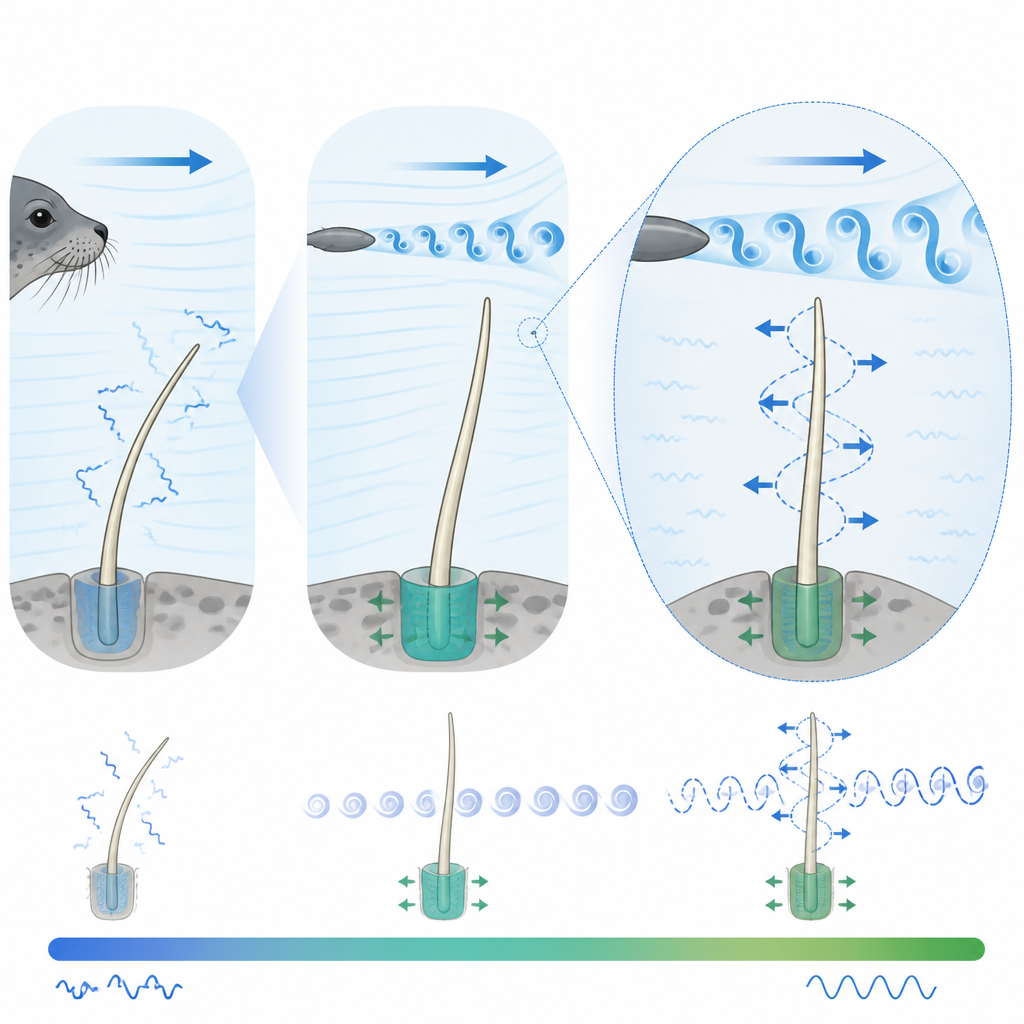
Active whisking sharpens the signal
With this bionic setup, the team measured whisker motion in three states: rigidly clamped, loosely held and angled backward (retracted), and actively pushed forward (protracted). In all cases, an upstream cylinder produced a repeating wake like that from a fish. The protracted state gave the clearest result: the signal from the wake stood out more than three times better than in the rigid case, and roughly twice as well as in the retracted state. In other words, actively pushing the whisker into the flow, by stiffening its base, greatly improves its ability to pick up prey trails, although it likely costs more energy for the animal.
From single whisker to robotic muzzle
Seals do not rely on just one whisker, so the researchers built a full bionic muzzle carrying 60 real harbor seal whiskers, arranged in rows like on a real face. Each group of whiskers was driven by soft actuators, allowing the array to whisk rhythmically, hold a protracted pose, or even move only one side at a time for directional sensing. This robotic muzzle shows that combining wavy whiskers with controllable motion can form a powerful, flexible “water camera” that may guide future underwater robots.
What this means for sensing and robotics
Together, the experiments show that both the wavy shape of harbor seal whiskers and their active forward motion are key to turning faint water trails into strong, readable signals. The wavy surface cuts down useless shaking as the animal swims, and the muscle-powered push into the flow boosts the contrast between prey wake and background noise. Understanding and copying this natural design could inspire new flow sensors and soft robotic systems that navigate and detect objects in dark or cluttered waters as skillfully as a hunting seal.
Citation: Gupta, C., Krushynska, A.O., Jayawardhana, B. et al. Soft bionic actuation explains the functional role of whisking in seal whisker sensing. npj Flex Electron 10, 62 (2026). https://doi.org/10.1038/s41528-026-00565-1
Keywords: seal whiskers, underwater sensing, soft robotics, active whisking, flow detection