Clear Sky Science · en
Extensive cryptic circulation sustains mpox among men who have sex with men
Why quiet infections matter
Mpox has faded from the headlines, but it has not disappeared. This study looks beneath the surface in Los Angeles to ask a simple question with big consequences: how many mpox infections are we missing, especially among men who have sex with men? The answer, the researchers find, is that silent and very mild infections are far more common than official case counts suggest, and they may be quietly keeping the virus in circulation.
Looking for what routine care misses
The team worked within a large health system that serves thousands of men who have sex with men. These patients already give anorectal swabs regularly to check for common sexually transmitted infections like chlamydia and gonorrhea. The researchers used leftover material from these routine tests to search for mpox genetic material, while also tracking who received a formal mpox diagnosis during regular medical visits. This setup let them compare two views of the same population: the visible infections that reached the clinic, and the hidden ones that showed up only in lab testing.

Many more infections than official case counts
Among nearly eight thousand men followed over the summer and fall of 2024, only 15 were diagnosed with mpox through normal care. Yet when the researchers tested 1,190 leftover swabs from just over a thousand men, they found mpox in seven samples from six people. None of these men sought care for mpox-like symptoms or were tested specifically for mpox, suggesting their infections were either symptom-free or so mild they were overlooked. Using statistical models that account for how long the virus is detectable, the team estimated that for every diagnosed mpox case there were about 33 actual infections, with a plausible range from 16 to 68. In other words, roughly 97 percent of infections in this group were going unnoticed.
Hidden spread and the role of vaccines
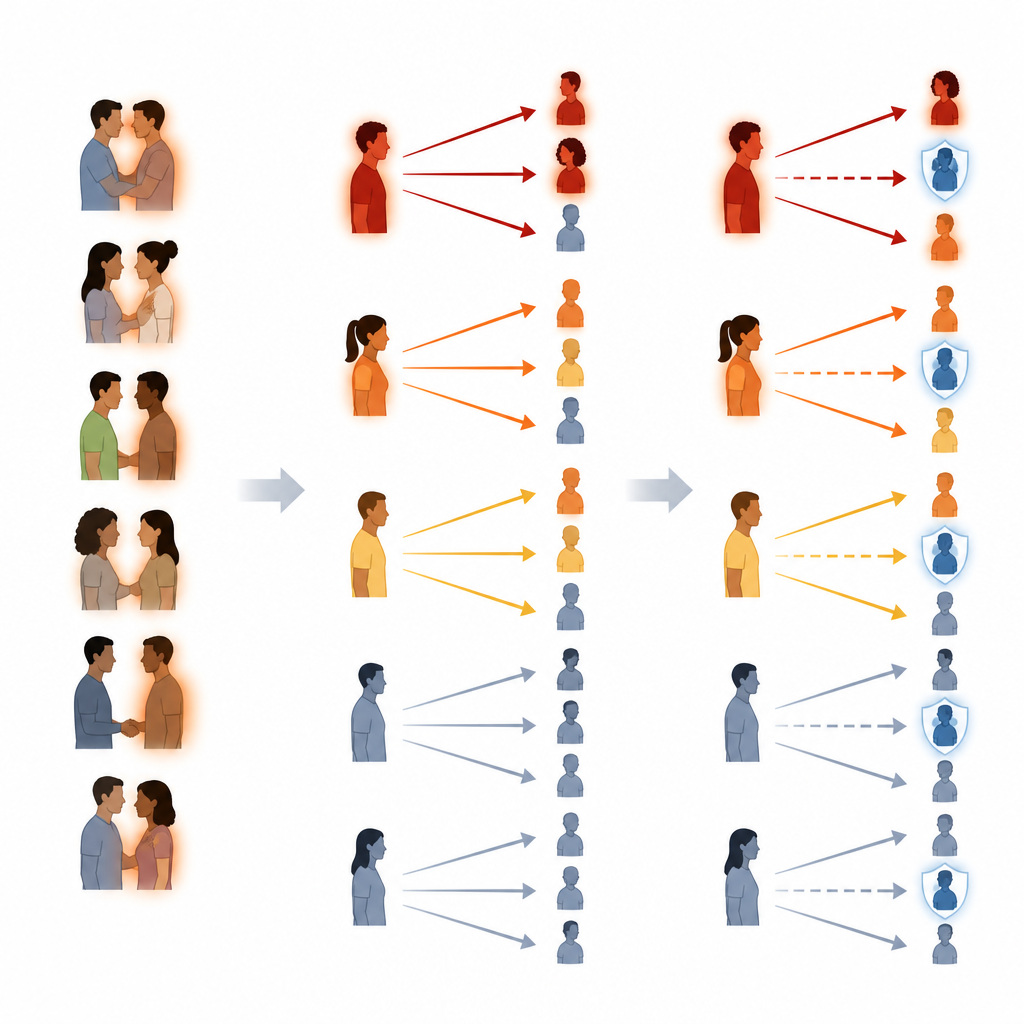
The researchers then asked whether these quiet infections could really matter for spread, or whether most transmission still comes from obviously sick people. By combining their undercount estimates with patterns seen in virus family trees, they showed that the numbers only make sense if undiagnosed infections pass the virus on. Even under generous assumptions, at least one third and likely more than half of all new infections had to come from people who were never diagnosed. Vaccination added another layer of complexity. The JYNNEOS vaccine still appeared to cut the risk of diagnosed mpox and probably reduces disease severity. Yet most of the silent infections in this study occurred in people who had already been vaccinated, suggesting that shots may turn some would-be obvious cases into milder, easily missed ones rather than blocking infection altogether.
Why case counts can be misleading
Because so many infections escape notice, the usual public health rule of thumb for declaring “elimination” becomes shaky. Current guidance says that if a region sees no new locally acquired mpox cases for three months, transmission is likely over. The models here tell a different story. With only about three in one hundred infections being detected, it would still be quite possible for dozens, and in some scenarios nearly a hundred, true infections to occur without any new diagnosed cases. Simulations showed that even after three quiet months, there could still be a substantial chance that the virus is simmering below the radar, especially if it spreads in dense sexual networks.
Rethinking how we track and control mpox
To a lay reader, the core message is that mpox can behave more like a mostly silent sexually transmitted infection than a disease that always causes dramatic rash and pain. In this study and in supporting data from other cities and countries, infections among men who have sex with men were far more common than official reports, and undiagnosed cases seemed to drive a large share of transmission. This does not mean vaccines and symptom-based testing are useless, but it does mean they are unlikely to stamp out mpox on their own. The authors argue that long-term control will require both sustained vaccination in at-risk groups and smarter surveillance that looks directly for quiet infections, rather than assuming that falling case counts mean the virus is gone.
Citation: Lewnard, J.A., Paredes, M.I., Yechezkel, M. et al. Extensive cryptic circulation sustains mpox among men who have sex with men. Nat Commun 17, 4198 (2026). https://doi.org/10.1038/s41467-026-72749-2
Keywords: mpox, asymptomatic infection, sexual networks, vaccine impact, disease surveillance