Clear Sky Science · en
No evidence that hominin dispersal across Eurasia was part of a wider turnover in mammal distributions
Why this ancient travel story matters today
Humans have long been fascinated by how our ancestors first walked out of Africa and spread across the world. One popular idea is that early humans simply moved alongside waves of other large animals, following familiar prey and predators into new lands. This study takes a hard look at that story using a huge fossil and modern dataset of big mammals from Africa and Eurasia over the last 10 million years, asking whether human wanderings were part of a broader reshuffling of wildlife—or something more unique.
Tracing the journeys of big animals
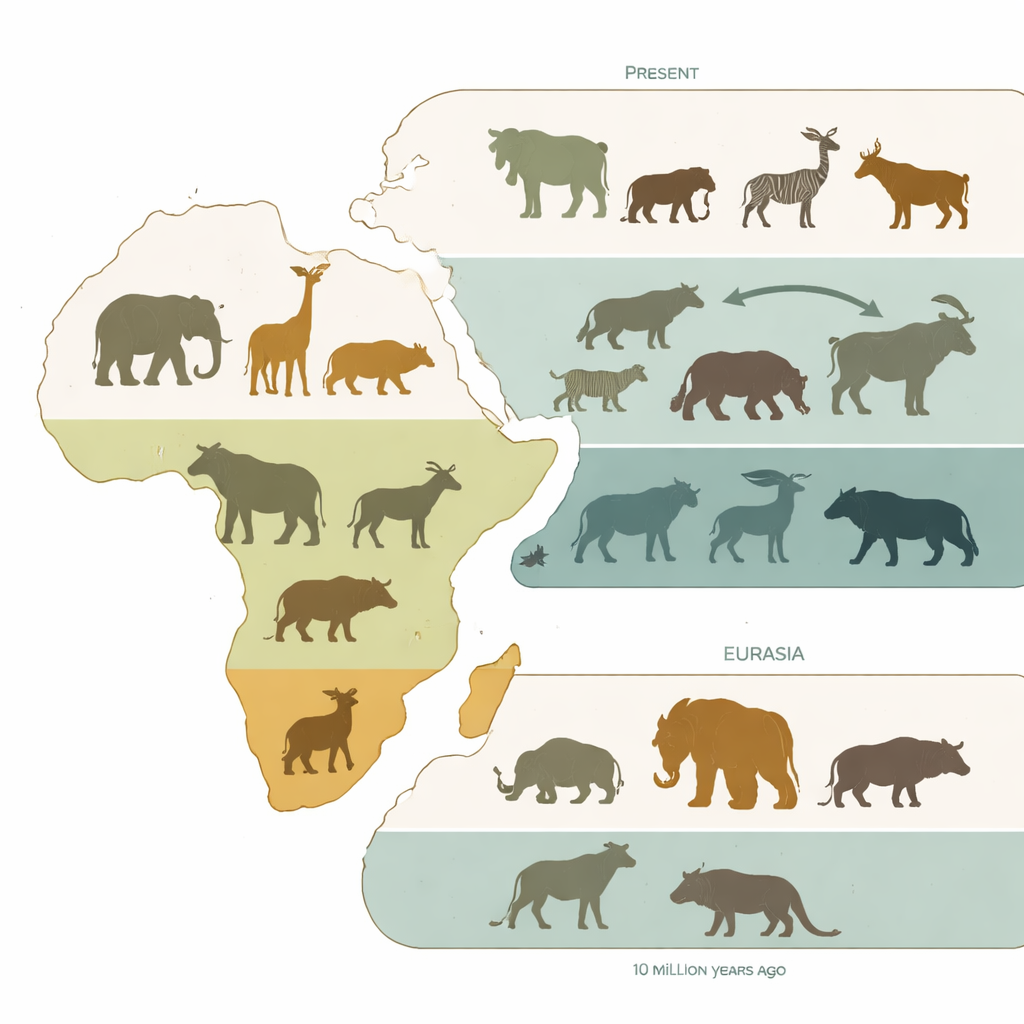
The researchers assembled records of more than 500 fossil genera of large mammals—hoofed animals, carnivores, primates, elephants and others—from hundreds of sites across Africa, Europe and Asia. They compared which kinds of animals lived together in different places and times, and they did the same with today’s mammal communities using global conservation databases. By grouping communities according to which genera they shared, and by how their ecological roles lined up, they could see when and where faunas blended or split apart. This allowed them to ask whether the spread of early humans around two million years ago matched a wider wave of animal movement out of Africa.
Africa apart, Europe and Asia entwined
The fossil patterns paint a clear picture: during the Late Miocene, around 10 to 7 million years ago, African and Eurasian communities were relatively similar, supporting the idea of a broad Old World savanna stretching across continents. But by about 7–6 million years ago, African faunas began to go their own way. Meanwhile, a major reshuffling happened within Eurasia itself. New genera that first appeared in Europe between 7 and 5 million years ago spread eastward and eventually replaced older Asian forms by about 3 million years ago. From that point onward, Africa remained taxonomically distinct from Eurasia, while Europe and Asia continued to exchange many species with each other.
Early humans as special travelers
One key question was whether the first major expansions of the genus Homo into Eurasia roughly two million years ago lined up with a broader wave of large mammals leaving Africa. The answer is no. The analyses show no sign of a continent-wide surge of African mammals into Eurasia at that time, or at any other point in the last 10 million years. In fact, African and Eurasian mammal communities were especially different when early humans were establishing themselves in places like Georgia, the Levant and northern China. This suggests that our ancestors were not simply following the same routes as herds of African animals. Instead, human dispersal was likely driven by factors specific to our lineage, such as new tools, diets or social behaviors, rather than by a sweeping environmental push that affected many large mammals in the same way.
Similar lifestyles in a changing cast of characters
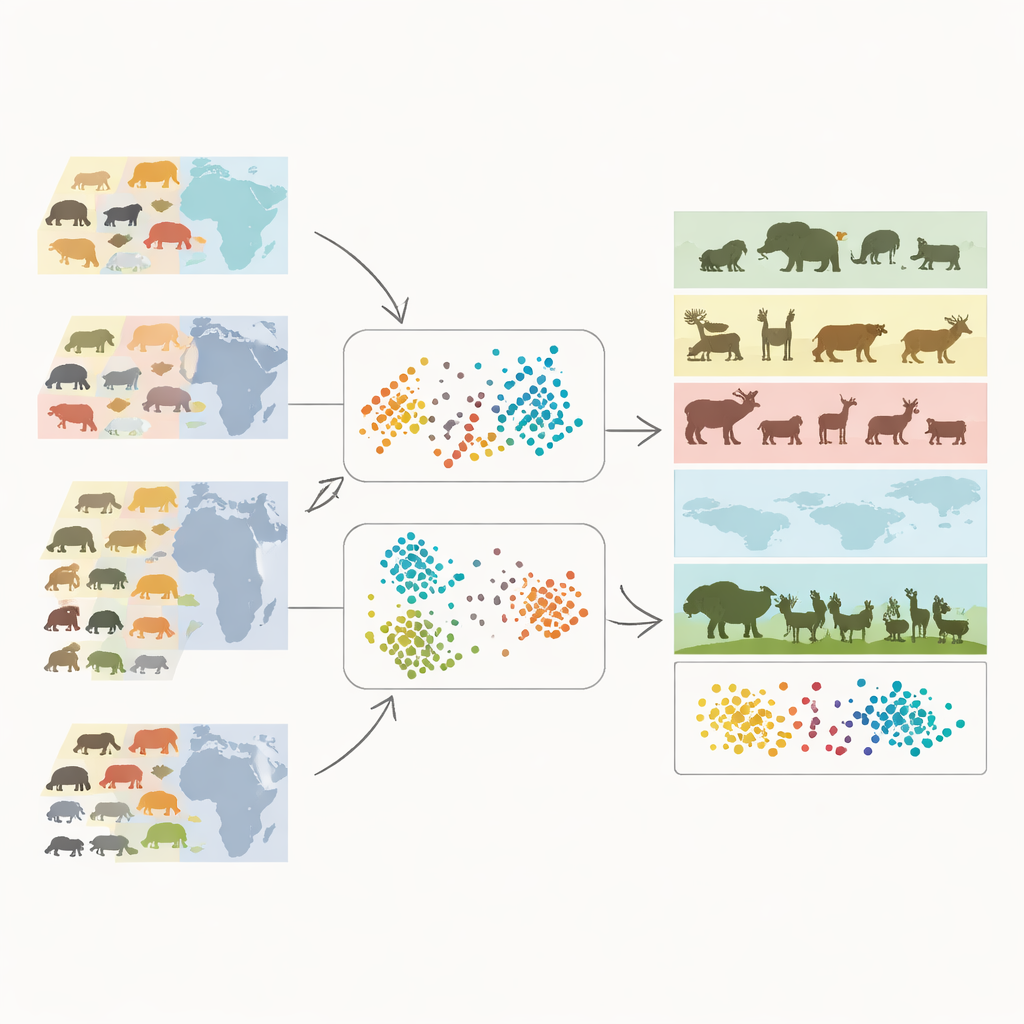
The authors also looked beyond species lists to the roles animals played in their ecosystems—their typical body size, whether they ate plants or meat, and how they moved (for example, ground-dwelling versus tree-living or amphibious). Surprisingly, when they clustered fossil communities by these functional traits, they found little geographic pattern over the last 10 million years. Across Africa, Europe and Asia, most large mammal communities were dominated by medium to very large, ground-dwelling plant-eaters, along with their predators and a few omnivores. In other words, even as the specific genera changed and continents diverged taxonomically, the basic structure of large-mammal lifestyles remained broadly similar for a very long time.
Modern wildlife patterns as a recent makeover
When the team turned to present-day mammals, the story shifted. Modern faunas show strong geographic and latitudinal structure both in which species live where and in how their ecological roles are arranged. Northern Eurasia looks very different from tropical Africa, not only in species but in the kinds of mammals present—for example, fewer very large, semi-aquatic or tree-dwelling forms outside Africa. The authors argue that this contrast with the fossil record points to a recent, fundamental reshuffling of mammal communities, likely tied to Late Pleistocene and Holocene losses of big animals across much of Eurasia. These losses appear to have had outsized effects on ecosystem structure, especially at higher latitudes.
What this means for our origin story
Put simply, this work suggests that early humans were not merely passengers in a larger wave of animals streaming out of Africa. Instead, our ancestors’ movement into Eurasia happened against a backdrop of long-standing differences between African and Eurasian faunas, and without major shifts in the basic ecological makeup of large-mammal communities. The strong patterns we see in today’s wildlife—sharp divisions between regions and missing types of large animals in many places—are likely the product of much more recent extinctions, many of them tied to our own species. Understanding that the world our early ancestors inhabited was both taxonomically different and functionally more uniform than today’s ecosystems helps scientists set more realistic “natural baselines” as they try to predict how ongoing climate change and human pressures will reshape life on Earth.
Citation: Sun, J., de la Torre, I. & Bibi, F. No evidence that hominin dispersal across Eurasia was part of a wider turnover in mammal distributions. Nat Commun 17, 3575 (2026). https://doi.org/10.1038/s41467-026-71648-w
Keywords: human evolution, Pleistocene mammals, Out of Africa, megafauna extinctions, paleobiogeography