Clear Sky Science · en
Massively parallel quantification of mutational impact on IAPP amyloid formation
Why this matters for everyday health
Type 2 diabetes affects hundreds of millions of people, yet we still do not fully understand why some individuals are more vulnerable than others. A small hormone called IAPP, made by the same cells that produce insulin, can clump into harmful fibers that damage these cells. This study systematically tests nearly two thousand tiny changes to IAPP to reveal which ones make clumping worse, which ones make it safer, and why this knowledge could eventually help design better treatments and risk prediction tools.
How a tiny hormone turns harmful
IAPP (also called amylin) is a short protein released by pancreatic beta cells along with insulin to help control blood sugar. In many people with type 2 diabetes, IAPP molecules stack up into rigid fibers, known as amyloids, that injure or kill the very cells that secrete them. Interestingly, closely related versions of IAPP in animals like mice and bears almost never form these fibers, and those animals rarely develop type 2 diabetes. This contrast suggests that small changes in IAPP’s building blocks can strongly influence whether or not it clumps, making IAPP an ideal target for a systematic “stress test” of its sequence.
A massive test of thousands of tiny changes
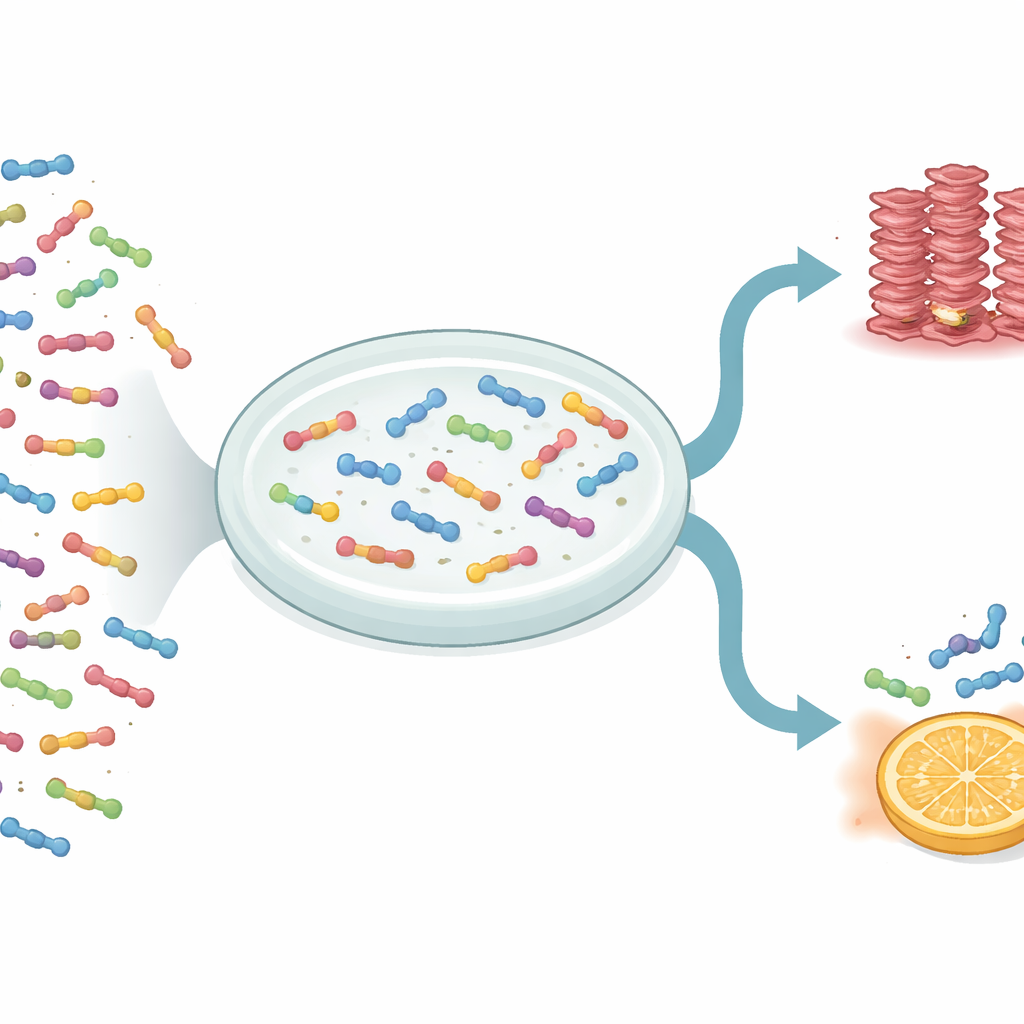
The researchers used a high-throughput approach called deep mutational scanning to examine 1,916 different versions of IAPP. These variants included swapping one building block (amino acid) for another, inserting extra ones, cutting some out, and trimming pieces from the ends. To measure how each version behaved, they fused IAPP to a yeast protein that forms amyloid-like assemblies inside yeast cells. If a particular IAPP variant was good at kick-starting clumping, yeast carrying it survived better under specific growth conditions. By sequencing the DNA of the yeast population before and after selection, the team quantified how strongly each change sped up or slowed down the initial step of fiber formation, called nucleation.
A vulnerable core and a hidden safety feature
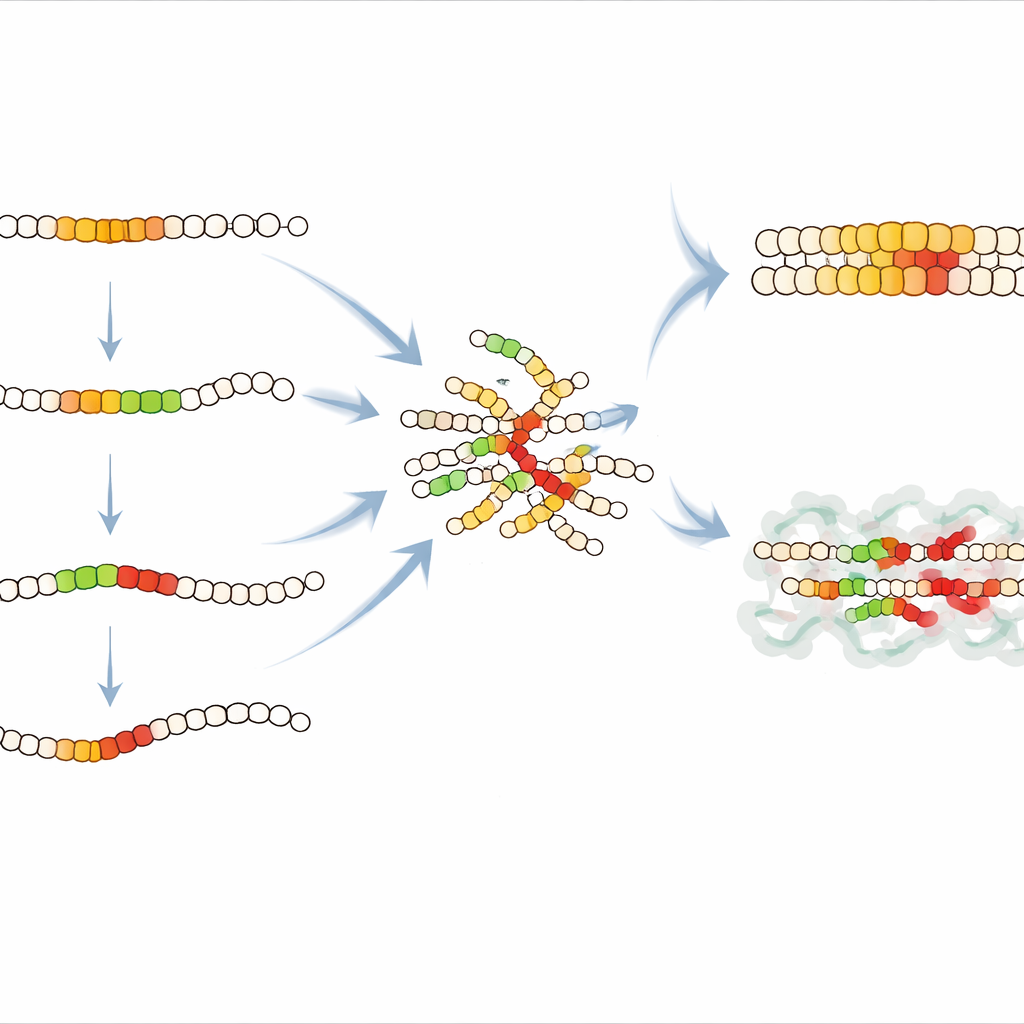
The map of mutational effects revealed a crucial stretch in the middle of IAPP, spanning positions 15 to 32, that is especially sensitive to change. Most alterations here weakened clumping, indicating that this region forms a structured core in the early fiber. Within an inner segment, positions 21 to 27, almost any change (except at one position) slowed nucleation dramatically, confirming that this short motif acts as the heart of the amyloid core. The study also uncovered an unexpected “gatekeeper” region earlier in the sequence, around positions 11 to 21. Inserting extra amino acids here often made clumping faster, implying that, in the natural sequence, this segment helps keep single IAPP molecules in a safer shape that resists aggregation. Disrupting it seems to unlock faster nucleation, hinting at a possible site for drugs or chaperone proteins to bind and stabilize IAPP.
Different routes to trouble in related brain and pancreas diseases
The team compared their IAPP dataset with a previous, equally detailed map for amyloid beta, the peptide that forms plaques in Alzheimer’s disease. Despite being unrelated organs and diseases, IAPP and amyloid beta share similar core structures when they form fibers and even show moderate similarity in sequence. The researchers found that mutations which interfere with fiber formation tend to affect both peptides in similar ways, suggesting a shared mode of disruption of the amyloid core. However, mutations that accelerate clumping behaved very differently between the two proteins. In other words, slowing these amyloids down follows common rules, but speeding them up appears to be highly specific to each peptide, making it difficult to use one dataset to predict harmful gain-of-function changes in another.
Links to human genetics and future therapies
The authors examined naturally occurring IAPP variants found in public genome databases, including the UK Biobank. Many rare human variants slowed nucleation and appeared less common among individuals with type 2 diabetes or high long-term blood sugar levels, hinting that such changes might slightly protect against the disease. Variants that increased nucleation were too rare to draw firm conclusions about risk, but they remain important candidates for future genetic and clinical studies. More broadly, the work provides a detailed atlas of how different mutations influence IAPP aggregation, offering a rational guide for designing new IAPP-based drugs that retain hormone function but resist forming damaging fibers. It also underscores a larger message: to understand and predict harmful protein clumping in human disease, we will likely need similar, quantitative maps for each amyloid-forming protein, rather than relying on one-size-fits-all rules.
Citation: Badia, M., Batlle, C. & Bolognesi, B. Massively parallel quantification of mutational impact on IAPP amyloid formation. Nat Commun 17, 4076 (2026). https://doi.org/10.1038/s41467-026-70611-z
Keywords: type 2 diabetes, amyloid, IAPP, protein mutations, aggregation