Clear Sky Science · en
Amazon deforestation weakens Atlantic Niño variability
Why this matters beyond the rainforest
The Amazon rainforest is often called the planet’s lungs, but this study shows it also acts as a kind of thermostat for distant oceans. As trees are cut down, the forest’s climate shifts—getting warmer and drier. The authors reveal that these local changes do not stay local: they reach thousands of kilometers away, weakening a key pattern of temperature swings in the tropical Atlantic Ocean known as the Atlantic Niño. Because this ocean pattern helps shape rainfall, storms, and even sea ice in far‑off regions, understanding how deforestation alters it is crucial for societies worldwide.
From dense forest to warmer, drier land
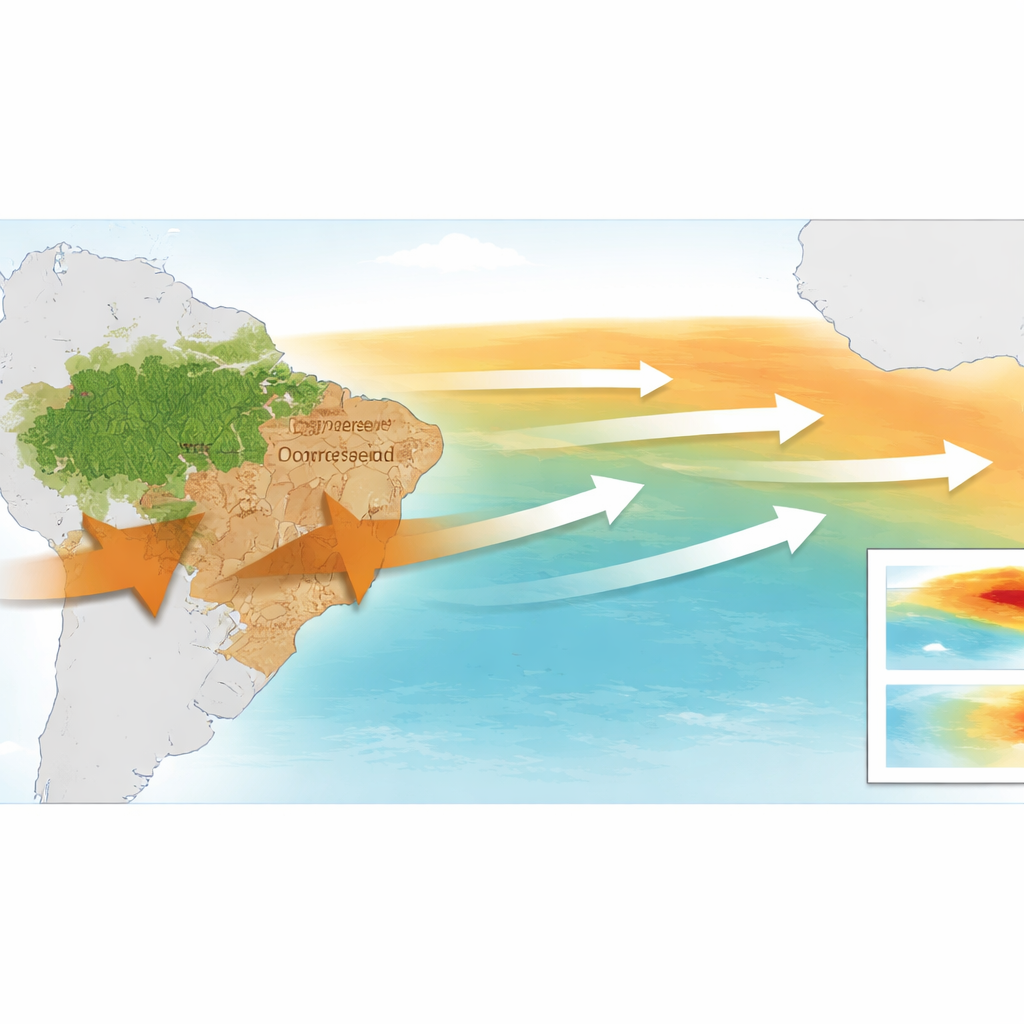
Since the 1970s, the Brazilian Amazon has lost about one‑fifth of its forest area. As trees disappear, the land reflects more sunlight, releases less moisture, and roughens the near‑surface air less. Together, these changes warm the air near the ground and reduce rainfall over the basin. Observations show that during June–August, Amazon air temperatures have risen while rainfall has steadily declined. The study confirms that these trends match long‑standing expectations: large‑scale clearing of tropical forest leaves the region hotter and drier than before, and these shifts are tightly linked in time.
An ocean rhythm grows quieter
Over the equatorial Atlantic, surface waters naturally warm and cool from year to year. One important pattern, the Atlantic Niño, features unusual warming in the central‑eastern equatorial Atlantic, often peaking in Northern Hemisphere summer. When strong, it can bring drought to the Sahel, extra rain to northeastern South America, and influence hurricane activity and climate as far away as Europe, India, and West Antarctica. Yet records over recent decades show that the ups and downs of this pattern have become noticeably weaker: both the swings in sea surface temperature and the associated changes in equatorial winds have shrunk since the 1970s.
How forest loss reshapes winds and water
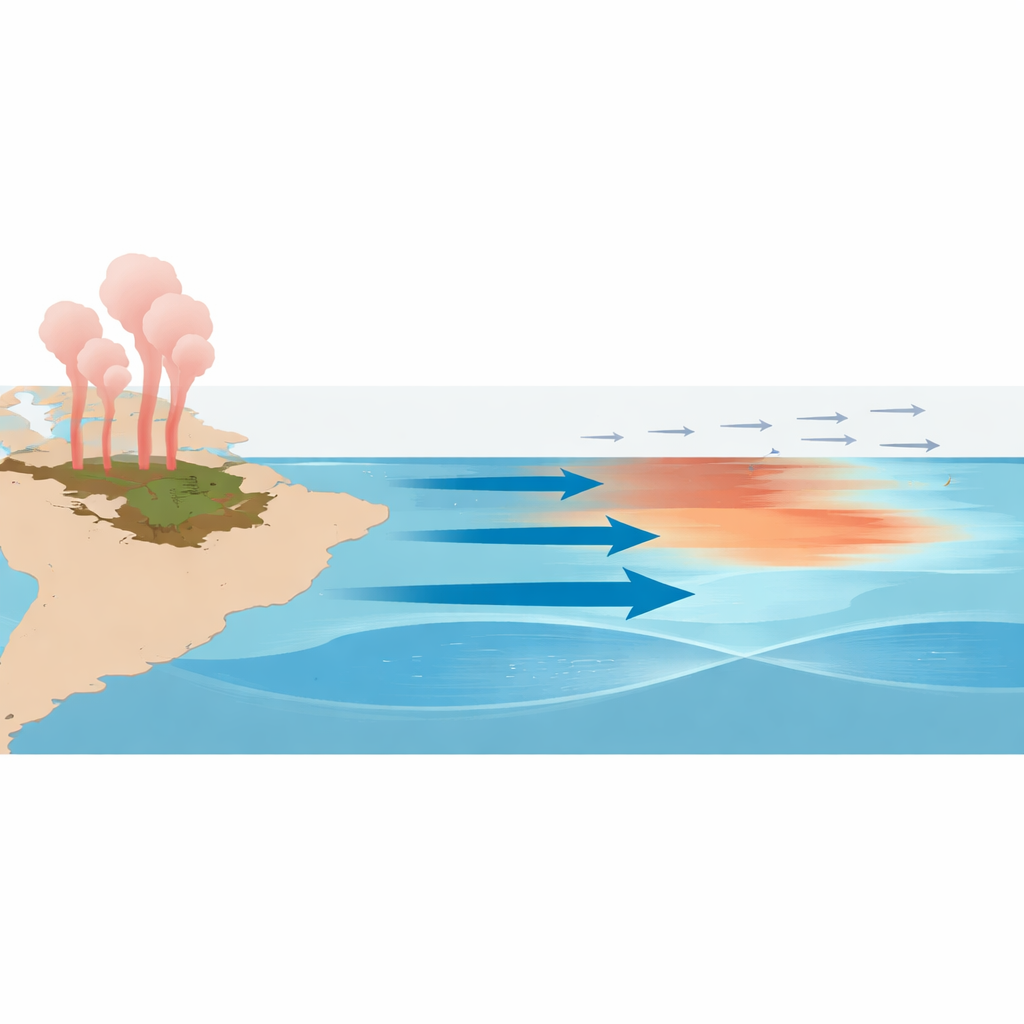
The authors connect these quieter ocean swings to the changing Amazon. Using detailed weather and ocean data, they show that reduced Amazon rainfall is strongly tied to stronger south‑to‑north winds near the surface over the western equatorial Atlantic. Drier, warmer conditions over South America strengthen trade winds south of the equator and weaken them to the north, creating a sharper temperature contrast between the cooler southern tropical Atlantic and the warmer north. This contrast encourages more cross‑equatorial flow from south to north, intensifying the southerly winds just west of the Atlantic’s warmest waters.
These stronger southerly winds interfere with a key reinforcing loop that normally powers the Atlantic Niño. Under usual conditions, differences in ocean temperature along the equator drive changes in east‑west winds, which in turn feed back on the ocean to amplify the temperature pattern—a process known as Bjerknes feedback. When southerly winds strengthen, they carry momentum northward and blunt the response of east‑west winds to temperature differences. The study shows that over recent decades this feedback has become less efficient, helping to explain why the Atlantic Niño’s variability has faded.
Testing the link with climate models
To move beyond correlation, the team ran controlled experiments with a state‑of‑the‑art Earth system model. They compared a world with intact Amazon forest to worlds where part or all of the Amazon was replaced by grassland. In both partial and total deforestation cases, the model produced a weaker Atlantic Niño, strengthened cross‑equatorial southerly winds, and a sharper north–south temperature contrast in the Atlantic—mirroring the observed changes. In the realistic partial‑deforestation setup, the drop in Atlantic Niño variability explained about one‑quarter of the observed weakening since the 1970s; complete clearing produced a larger effect but still could not account for the full decline, implying other human and natural influences also play roles.
What this means for people and the planet
In simple terms, the study shows that cutting down the Amazon does not just threaten biodiversity and local rainfall; it also dulls an important "beat" of the tropical Atlantic climate. By weakening the Atlantic Niño, Amazon deforestation can subtly reshape patterns of drought, floods, storms, and even polar sea ice that depend on this ocean rhythm. The work highlights that changes to tropical land surfaces can be as influential for global climate behavior as greenhouse gases or air pollution, underlining that protecting the Amazon is also about preserving the stability of weather and climate far beyond South America.
Citation: Wei, S., Wang, C., Cai, W. et al. Amazon deforestation weakens Atlantic Niño variability. Nat Commun 17, 3079 (2026). https://doi.org/10.1038/s41467-026-69771-9
Keywords: Amazon deforestation, Atlantic Niño, tropical Atlantic climate, land–atmosphere coupling, climate variability