Clear Sky Science · en
ATPγS substantially defeats the biasing mechanism for kinesin steps
How Cellular Cargo Haulers Keep Their Direction
Inside every cell, tiny protein "walkers" called kinesins haul cargo along microscopic tracks, helping to build, repair, and divide the cell. Like trucks on a highway, these walkers must keep moving mostly forward, even when pulling heavy loads. This study asks a deceptively simple question: what happens to kinesin’s ability to walk forward if we slightly change its fuel? The answer reveals an unexpected pause-and-go state that helps the motor stay on course.
A Molecular Walker and Its Usual Fuel
Kinesin-1 is a two-legged motor protein that walks along microtubules, rigid filaments that crisscross the cell. Each step is about 8 billionths of a meter, powered by the energy-rich molecule ATP. One head of the kinesin holds tightly to the track while the other swings forward, and the two alternate in a hand-over-hand fashion. Under opposing force—like a load pulling backward—the motor still prefers forward steps, thanks to an internal "biasing" mechanism that makes forward movement more likely than backward slips.
Swapping ATP for a Slower Look-Alike
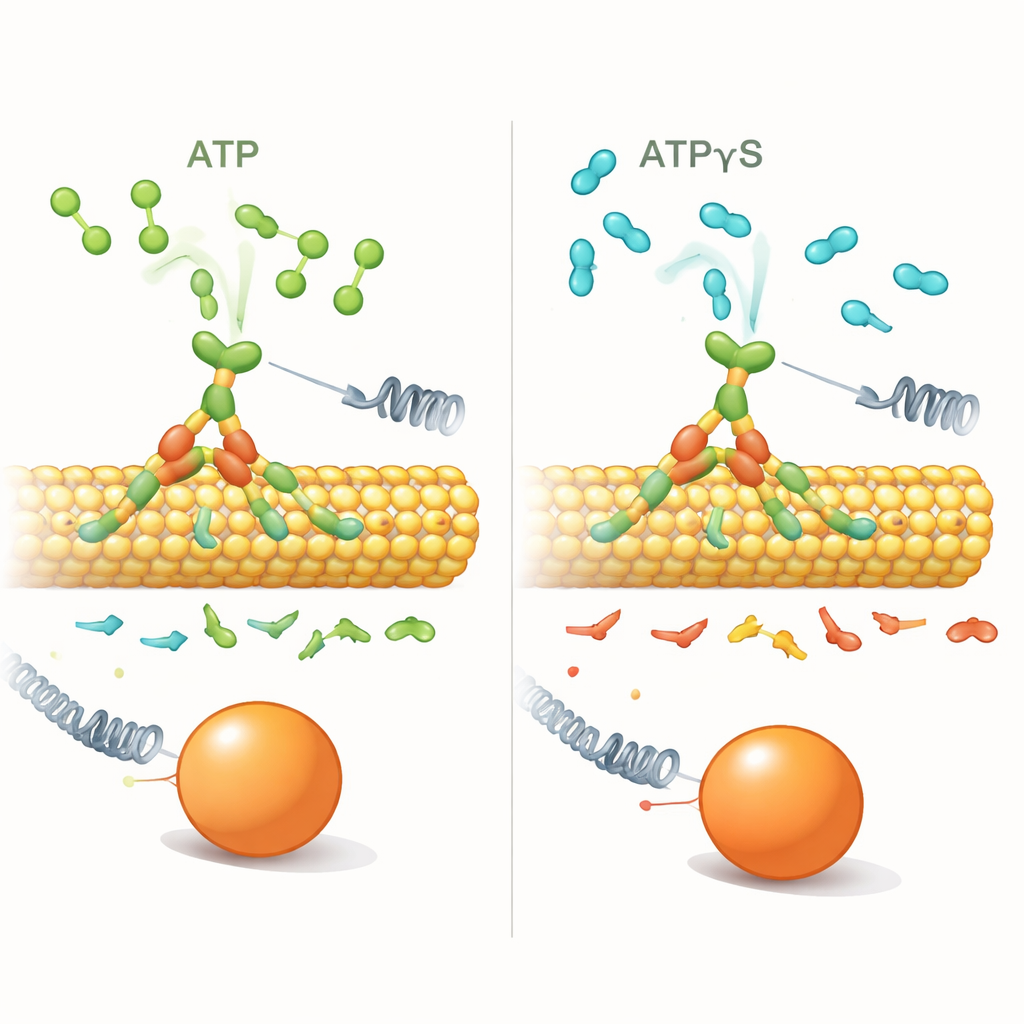
To probe how this bias works, the researchers replaced ATP with ATPγS, a nearly identical molecule that the motor breaks down much more slowly. Using single-molecule optical traps—laser tweezers that can hold onto a bead attached to a single kinesin—they measured how often kinesin took forward versus backward steps under different loads and fuel conditions. At low concentrations of ATPγS (1 micromolar), the motor behaved much like it does with ATP: it walked forward processively, with backward events becoming more common only as the load increased.
When Too Much Slow Fuel Breaks the Bias
The picture changed dramatically at high ATPγS concentration (1 millimolar). Kinesin still stepped along the microtubule and reached similar stall forces, but now short 8-nanometer backward steps became much more frequent even at low loads. The ratio of forward to backward steps, which normally drops sharply as the load increases, became almost flat: the load hardly mattered. At the same time, the waiting time before each step—the dwell—was long (about half a second or more) and showed only weak dependence on the applied force, unlike in ATP where dwell times grew steeply with load. In ATPγS, most backward moves were neat, single-step retreats rather than long "slips," suggesting a different underlying motion.
A Hidden Pause State Comes to Light
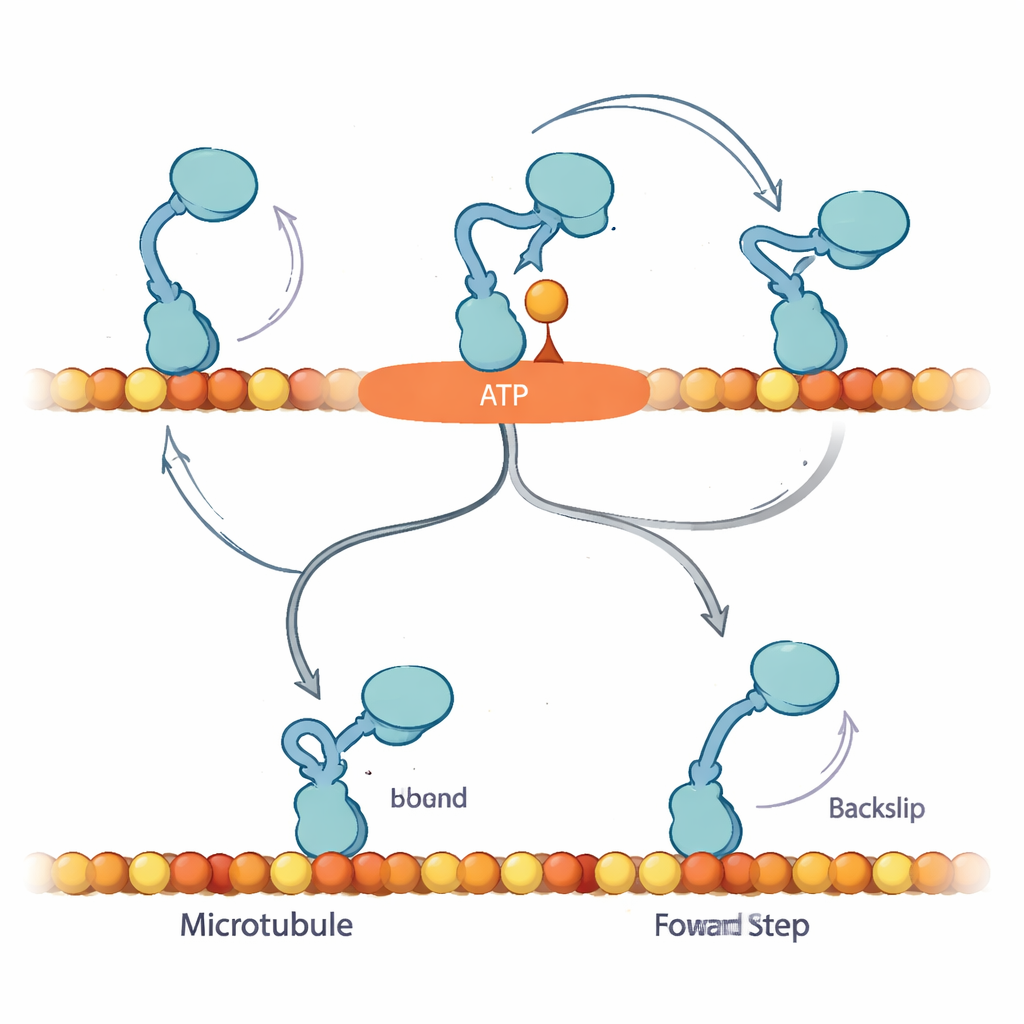
To explain these patterns, the authors propose that when a nucleotide first binds, kinesin enters a previously unrecognized "Await-Isomerisation" (AI) state. In this state, ATP (or ATPγS) is bound and the motor is primed to step, but a key structural segment, the neck linker, has not yet locked into place, and the active site is not ready to break down the fuel. From the AI state, the free head diffuses and can, in principle, bind either forward or backward on the track. In normal ATP, the AI state is fleeting: it quickly converts into a "closed" state where the neck linker docks, hydrolysis proceeds, and the tethered head is steered to the forward site, strongly favoring forward progress. With abundant ATPγS, this conversion is slowed and the AI state becomes overpopulated, opening a side pathway in which the motor more often takes genuine 8-nanometer backsteps.
Why a Controlled Pause Matters
The findings suggest that kinesin’s biasing mechanism relies on the ability to pause safely in the AI state without burning fuel, waiting for neck-linker docking to guide the free head to the next forward binding site. Under load with ATP, forward stepping and fuel breakdown are tightly coupled: if the motor fails to complete a forward step in time, it may slip backward, but this is a relatively rare outcome. In ATPγS, the prolonged AI state exposes a hidden backstep route, reducing forward bias yet still allowing net forward movement. For a lay observer, the key message is that this tiny motor does not simply burn fuel and march ahead; it uses a built-in waiting room—a controlled pause—to decide whether to advance, hold, or retreat. Subtly altering the fuel reveals this hidden logic, showing how cells fine-tune motion to keep their molecular traffic flowing in the right direction, even under strain.
Citation: Karnawat, V., Toleikis, A., Carter, N.J. et al. ATPγS substantially defeats the biasing mechanism for kinesin steps. Nat Commun 17, 2891 (2026). https://doi.org/10.1038/s41467-026-69573-z
Keywords: kinesin motor, molecular motors, ATP analogs, single-molecule biophysics, microtubule transport