Clear Sky Science · en
The role of the dorsal attention network in attention bias modification for social anxiety disorder
Why this matters for everyday social anxiety
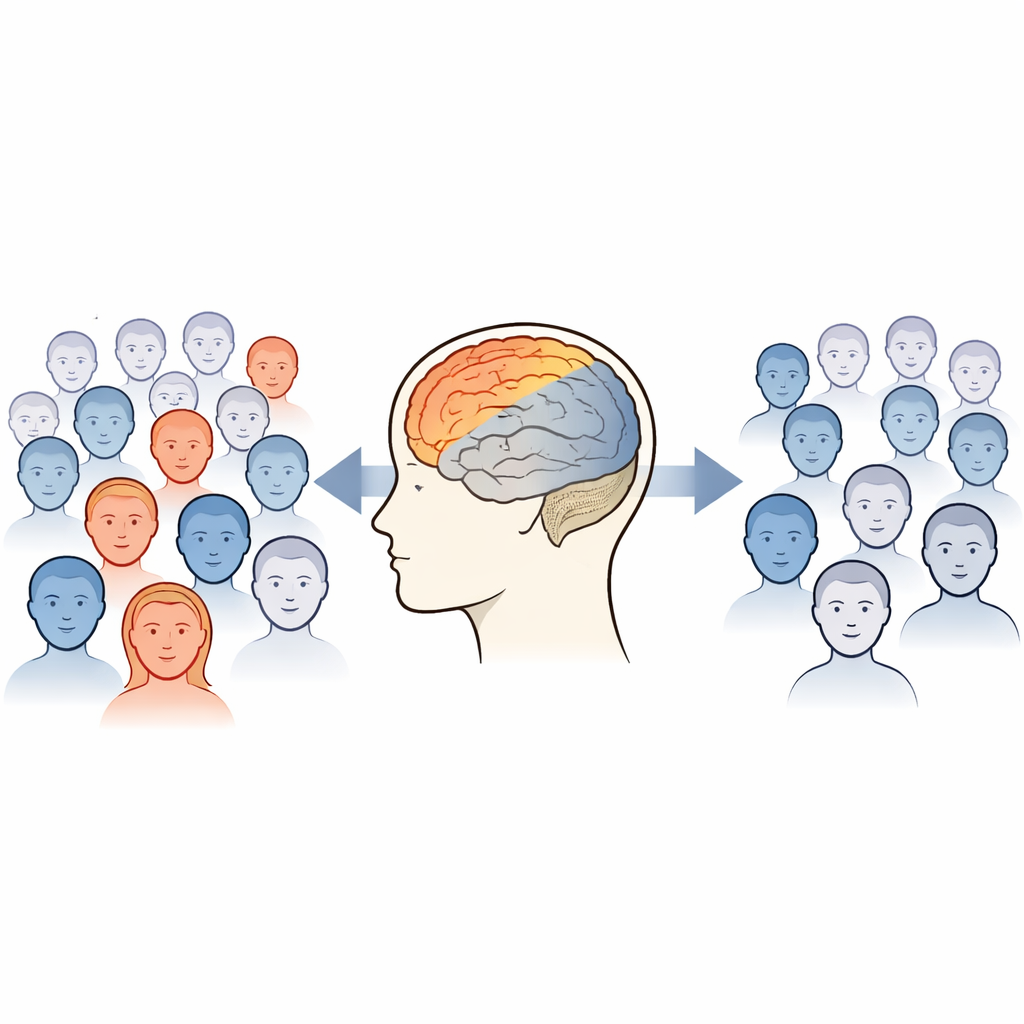
Many people with social anxiety feel their eyes are magnetically drawn to frowns, scowls, or signs of rejection in a crowd. This study explores a new kind of training that gently retrains where people look, and asks a deeper question: can we see changes in the brain’s attention system that both predict who will benefit and reflect successful treatment?
A new way to train attention with music
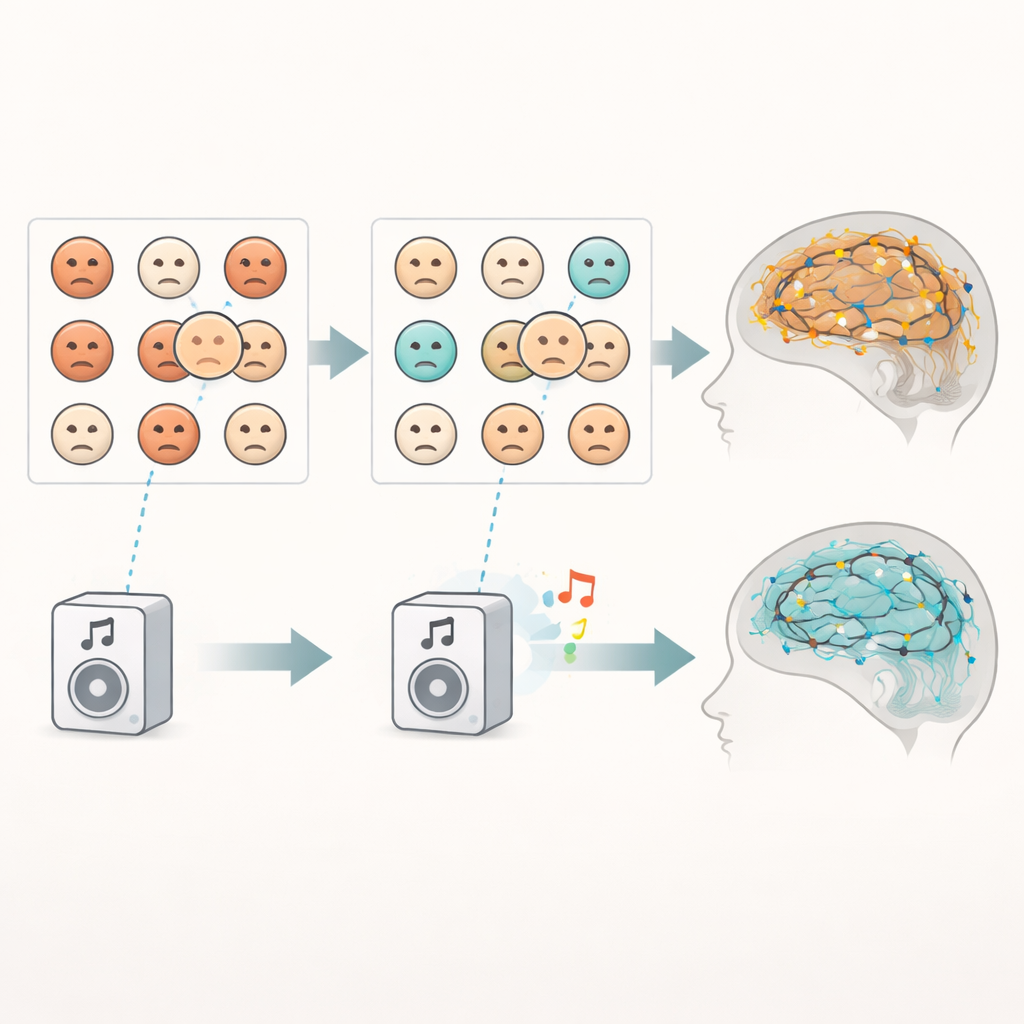
The researchers focused on Gaze-Contingent Music Reward Therapy, a computer-based program for people with social anxiety disorder. During training, participants viewed grids of faces showing neutral or disapproving expressions. While an eye-tracker monitored their gaze, a favorite music track played only when they looked at neutral faces and stopped whenever their gaze lingered on threatening faces. Over 12 weeks, this simple reward rule encouraged participants to spend less time staring at potential social threat and more time on neutral faces, nudging their attention habits in a healthier direction.
The brain’s attention control network
The team was especially interested in the brain’s “dorsal attention network,” a set of regions near the top and sides of the brain that help us deliberately aim and hold our focus. This network works like an internal spotlight operator, deciding what in the visual world deserves priority and what can fade into the background. The study asked whether the strength of connections within this network, measured while participants simply rested in an MRI scanner, could tell us in advance how much their anxiety would improve with the training, and whether those connections would change by the end of treatment.
Tracking change from the eyes to the brain
Forty-six adults with social anxiety were randomly assigned either to receive the attention training or to a waitlist with no treatment during the same period. All participants completed brain scans and anxiety questionnaires before and after the 12 weeks. As expected, only the training group showed clear reductions in both social anxiety symptoms and the amount of time they spent looking at threatening faces. When the scientists analyzed the brain data, they found that patterns of connection inside the dorsal attention network before treatment already carried information about how anxious people would be afterward. People whose network connections had certain balances among key hubs tended to show better outcomes.
How the attention network reorganizes with therapy
The researchers then looked at the brain after training. They found that connections within the dorsal attention network at the end of treatment also tracked how severe symptoms remained: people with more helpful connection patterns tended to be less anxious. Comparing the training group to the waitlist group revealed that many links inside this network were reorganized only in those who received the therapy. A region called the precuneus, involved in internally guided attention and how we map ourselves in space, played a central role in this reorganization. Overall, the training group showed a shift toward a less tightly over-connected attention network, which may reflect a more efficient and flexible way of directing attention.
Why this could change future treatment
To a layperson, the main message is that a brief, eye-tracking-and-music-based program not only helps people with social anxiety look less at threatening faces, but also reshapes a key attention system in the brain. Importantly, the strength and pattern of connections in this network can help predict who is likely to benefit most. This suggests that, in the future, brain scans might help clinicians match people to the treatments that fit their personal brain wiring, making care more precise and improving the odds of relief from social anxiety.
Citation: Coldham, Y., Yair, N., Azriel, O. et al. The role of the dorsal attention network in attention bias modification for social anxiety disorder. Transl Psychiatry 16, 178 (2026). https://doi.org/10.1038/s41398-026-03957-z
Keywords: social anxiety, attention training, eye tracking, brain networks, personalized psychiatry