Clear Sky Science · en
Preliminary technological insights into Shangshan period pottery from the Xiatang Site, Taizhou, Zhejiang Province
Ancient pots, new scientific clues
On a river terrace in southeastern China, people were firing clay pots nearly 9,000 years ago. At first glance these humble vessels—some plain, some boldly red—look like ordinary pottery sherds. But by treating them as tiny technological time capsules, researchers at the Xiatang site have reconstructed how early farmers and foragers chose their clays, prepared their paints, and tuned their kilns. Their findings reveal a community that borrowed ideas from a cultural heartland yet adapted them in inventive ways to local landscapes and resources.
Life on a growing Neolithic frontier
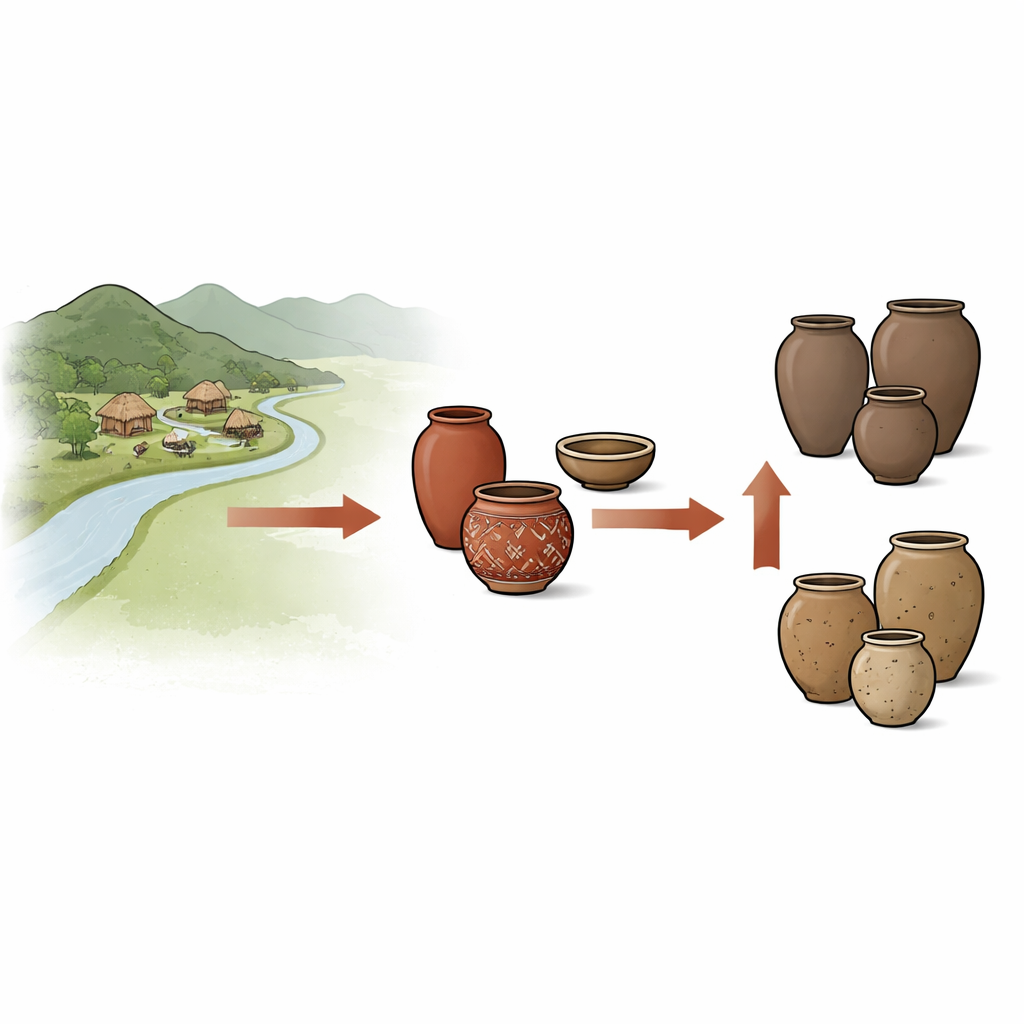
The Xiatang settlement lies in today’s Zhejiang Province, at the southern edge of the Shangshan Culture, the earliest known Neolithic culture in southern China. Around 9,300–8,300 years ago, people here still hunted and gathered but were also tending some of the world’s earliest rice. Their villages, ringed by moats and organized into living and ritual areas, already showed signs of social complexity. Pottery played a central role in daily life and ceremony: large jars for storage, basins for cooking, and striking red-painted pieces that appeared both in houses and in graves. A distinctive blend of vessel shapes marks Xiatang as a regional variant—evidence that it was not just copying the core Shangshan sites further north.
Decoding the red color on the pots
To understand how these vessels were decorated, the team studied red-painted sherds and a lump of red ore using a suite of microscopes and spectrometers. The analyses showed that the color comes mainly from hematite, an iron-rich mineral, mixed with quartz and clay. The ore and the paint share nearly the same mineral recipe, pointing to a common source: natural red ocher gathered near the site, including from local riverbeds. Subtle chemical shifts and changes in crystal structure indicate that the potters likely washed and refined this ocher to concentrate the iron, then ground it into a fine, water-mixed pigment ready for brushwork.
Painting before the fire
One key question was whether the red designs were added before or after the pots went into the fire. The answer matters because it speaks to both artistic practice and technical skill. Infrared measurements and mineral changes reveal that the pigment layer experienced the same high heat as the clay body—about 900–1000 °C. A thin, fine-grained layer under some painted areas is simply a smoothed slip rather than a glue rich in lime or other binders. No signs of organic binding media were found in the paint itself. Together, these clues show that Xiatang craftspeople painted their pots when they were dry but unfired, then fixed the designs permanently in the kiln. Their method involved at least five steps: collecting ocher, cleaning and grinding it, optionally applying a smoothing layer, painting stripes or full red coatings, and finally firing the vessel.
Shaping clay for different jobs
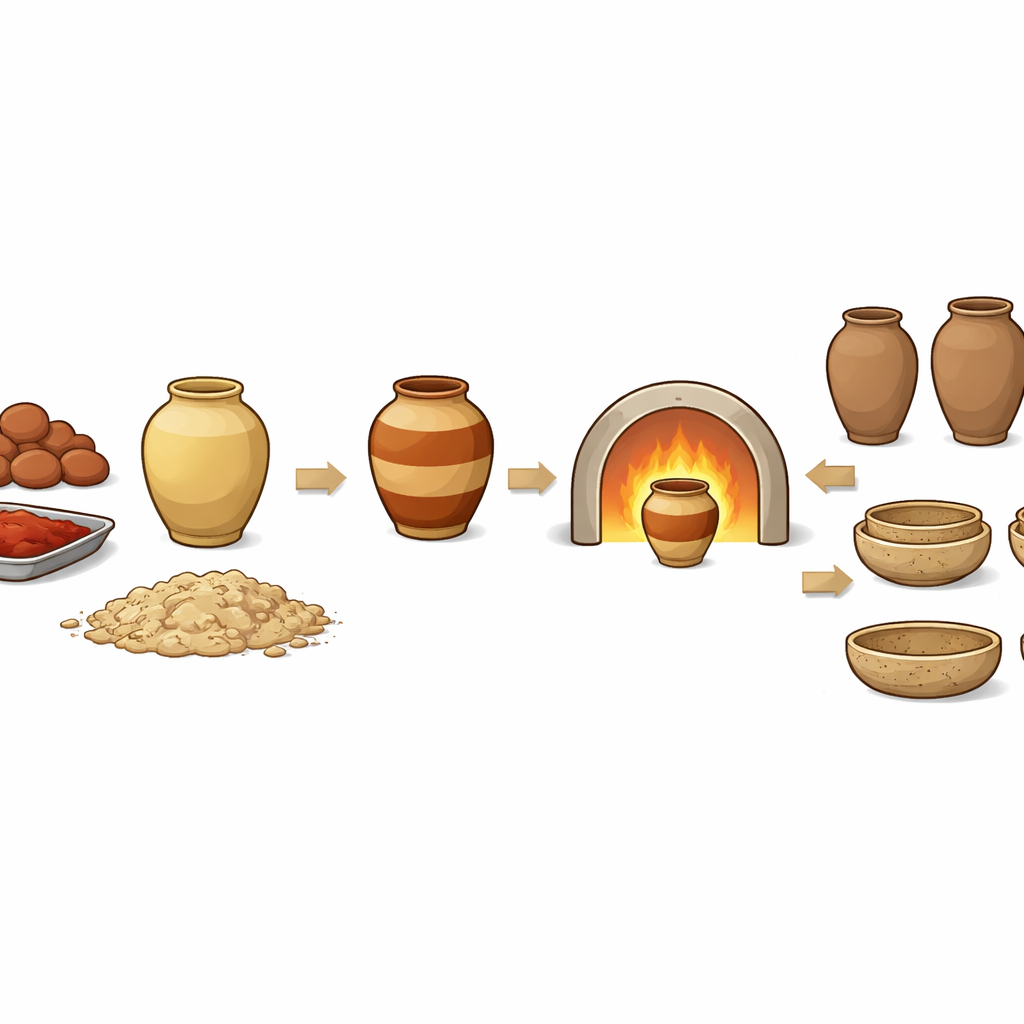
Beyond decoration, the researchers wanted to know how potters tuned their materials for different tasks. Chemical data from dozens of sherds point to a single broad source of clay around the site, consistent with nearby river and sediment deposits. Yet thin-section views under the microscope reveal three main “recipes,” differing in how much sand, rock fragments, and plant matter they contain, and in how well the fine particles are sorted. Tall storage jars were usually made from highly refined clay with few added grains or voids, producing denser walls and lower water uptake. Cooking basins, by contrast, often include more coarse mineral particles or traces of straw and rice husks. These inclusions and the holes they leave behind help spread heat and stop cracks from racing through the pot, trading tightness for toughness over the fire.
A borderland that reworked tradition
When Xiatang’s pottery is compared with that from five Shangshan core sites in the Jin–Qu Basin, both continuity and innovation appear. All share a preference for high-silica clays and the use of mineral or plant temper, and all aim for similar overall porosity. But Xiatang clays are richer in aluminum and therefore harder to melt, so potters responded by raising firing temperatures by about 100–200 °C while still keeping water absorption within the common 10–20 percent range. Combined with its unique vessel shapes, this higher-temperature practice shows that Xiatang was not merely imitating the core area. Instead, its craftspeople actively reshaped inherited techniques—adjusting recipes, paint preparation, and firing—to suit their own environment, leaving behind a detailed record of early technological creativity etched into every sherd.
Citation: Sun, Y., Zhang, M. & Zhong, Z. Preliminary technological insights into Shangshan period pottery from the Xiatang Site, Taizhou, Zhejiang Province. npj Herit. Sci. 14, 215 (2026). https://doi.org/10.1038/s40494-026-02463-1
Keywords: Neolithic pottery, Shangshan culture, red ocher pigment, ancient kiln technology, early rice farming