Clear Sky Science · en
Somatic mutations and clonal evolution in normal tissues and cancer development
Hidden Changes Inside Healthy Cells
Long before a tumor can be seen on a scan or felt as a lump, our cells are quietly collecting genetic changes as we age, react to our environment and heal from daily wear and tear. This review article explains how these invisible changes, called somatic mutations, build up in otherwise normal tissues, how certain mutations give some cells a competitive edge and how slow “clonal evolution” over decades can eventually set the stage for cancer. Understanding this hidden landscape is reshaping ideas about when cancer really begins and how we might detect or prevent it much earlier in life.
How Scientists Track Tiny Cell Families
Normal tissues are mosaics of many tiny cell families, or clones, and most are too small to study with older methods. The review describes new tools that let researchers read DNA from very few cells with remarkable precision. One approach is to carve out tiny pieces of tissue with laser-based microdissection and sequence all the DNA inside, giving a snapshot of how clones are arranged in space. Another is to grow miniature versions of organs, called organoids, from single cells and sequence those descendants, revealing each cell’s personal mutation history. A third strategy uses ultra-accurate sequencing that can find rare mutations in large cell mixtures without needing to grow them. Together, these techniques show that even “healthy” tissues are full of cells carrying cancer-like mutations. 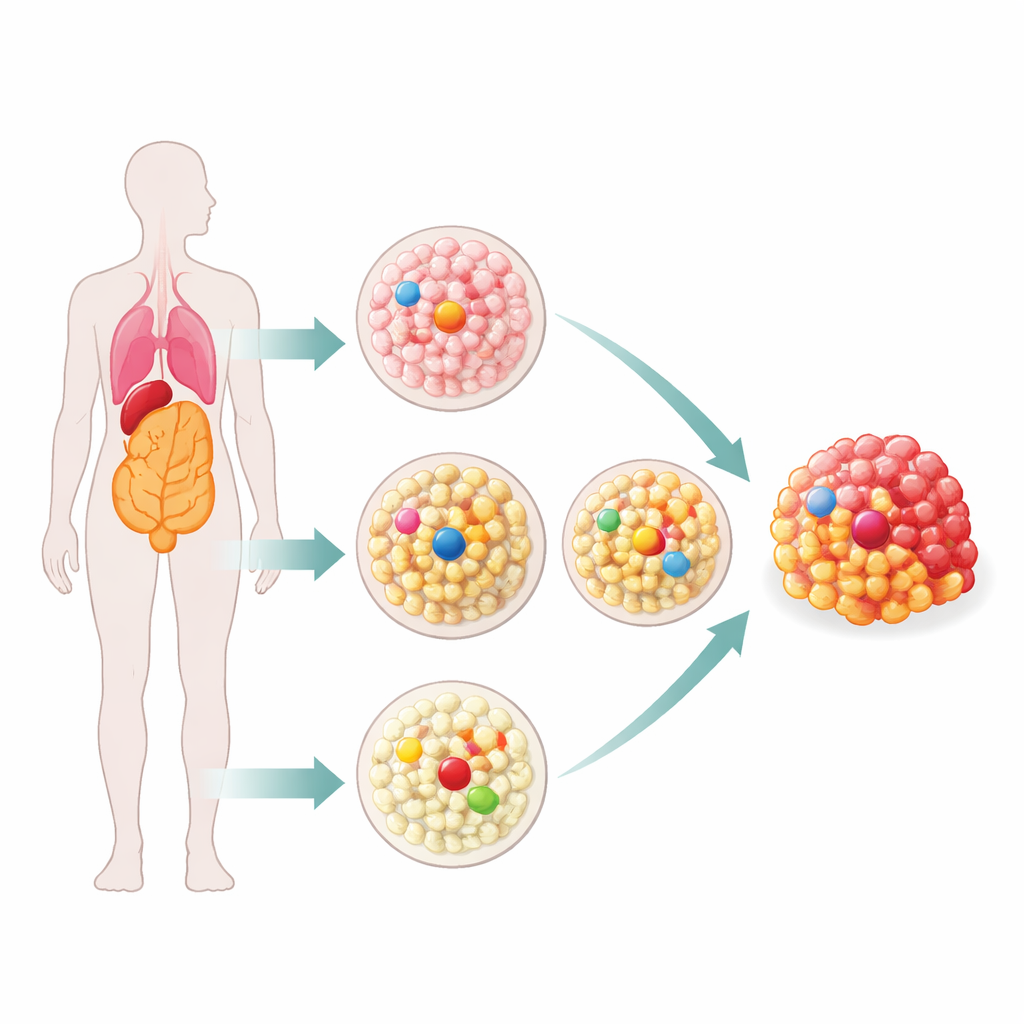
Why Mutations Keep Appearing
Mutations in normal cells arise from two broad sources: internal wear and tear and external exposures. From our very first cell divisions in the embryo, copying DNA is imperfect, and chemical reactions within cells slowly damage genetic material over time. These age-related processes leave characteristic “signatures” in the DNA that are seen across many organs, even in long-lived cells like neurons and muscle. On top of this, outside influences such as tobacco smoke, alcohol, ultraviolet light, inflammation, certain infections and medical treatments like chemotherapy add their own distinct patterns of damage. People born with inherited weaknesses in DNA repair or other protective systems can accumulate far more mutations in normal tissues, which helps explain why some families have much higher cancer risks.
When Mutated Cells Gain an Advantage
Most mutations are harmless passengers, but some change key genes that control growth, survival or repair. Cells carrying these “driver” mutations can gain a small but important edge over their neighbors, allowing their clone to expand. In the blood, for example, stem cells with specific driver mutations become more common with age, a condition called clonal hematopoiesis that raises the risk of blood cancers and some heart and liver diseases. In many surface tissues—such as skin, esophagus, airways, bladder, stomach and uterus—patches of cells carrying cancer-associated drivers like NOTCH1, TP53 or PIK3CA spread across otherwise normal-looking tissue. Often these mutations appear surprisingly early in life, even in childhood, and can remodel large areas of tissue long before any precancerous lesion can be seen under the microscope.
Not All Clones Move Toward Cancer
Clonal evolution plays out differently from organ to organ, and an expanded clone does not automatically mean cancer will follow. In structures such as the colon, prostate and liver, stem cells live in small, physically separated units, limiting how far any one clone can spread. Some clones arise not to promote tumors but to help cells survive stress. For instance, in chronic inflammatory or metabolic diseases, cells may acquire mutations that blunt harmful signaling or reduce toxic damage, a form of “adaptive rescue.” Other mutations, like certain changes in the Notch pathway in the esophagus, may even slow the growth of emerging tumors, hinting that some mutant clones could protect against cancer. Only a small fraction of the many clones carrying driver mutations seem to acquire the additional alterations needed to become dangerous.
The Long Road From Normal Cell to Cancer
By piecing together mutation patterns from normal tissue, precancerous growths and tumors in the same person, researchers can now reconstruct rough timelines of cancer development. In blood disorders and breast cancer, initial driver mutations often arise decades before diagnosis, with slow clonal growth followed by later hits that finally trigger overt disease. Yet key questions remain: which combinations of mutations and environmental factors push a clone over the edge, why some high-risk clones never progress and how changes in cell “software” (epigenetic marks) interact with DNA mutations. As tools improve, mapping these hidden clonal histories may enable blood or tissue tests that spot risky clones early, guide prevention strategies such as smoking cessation or infection control and ultimately shift cancer medicine toward intervening years before a tumor forms. 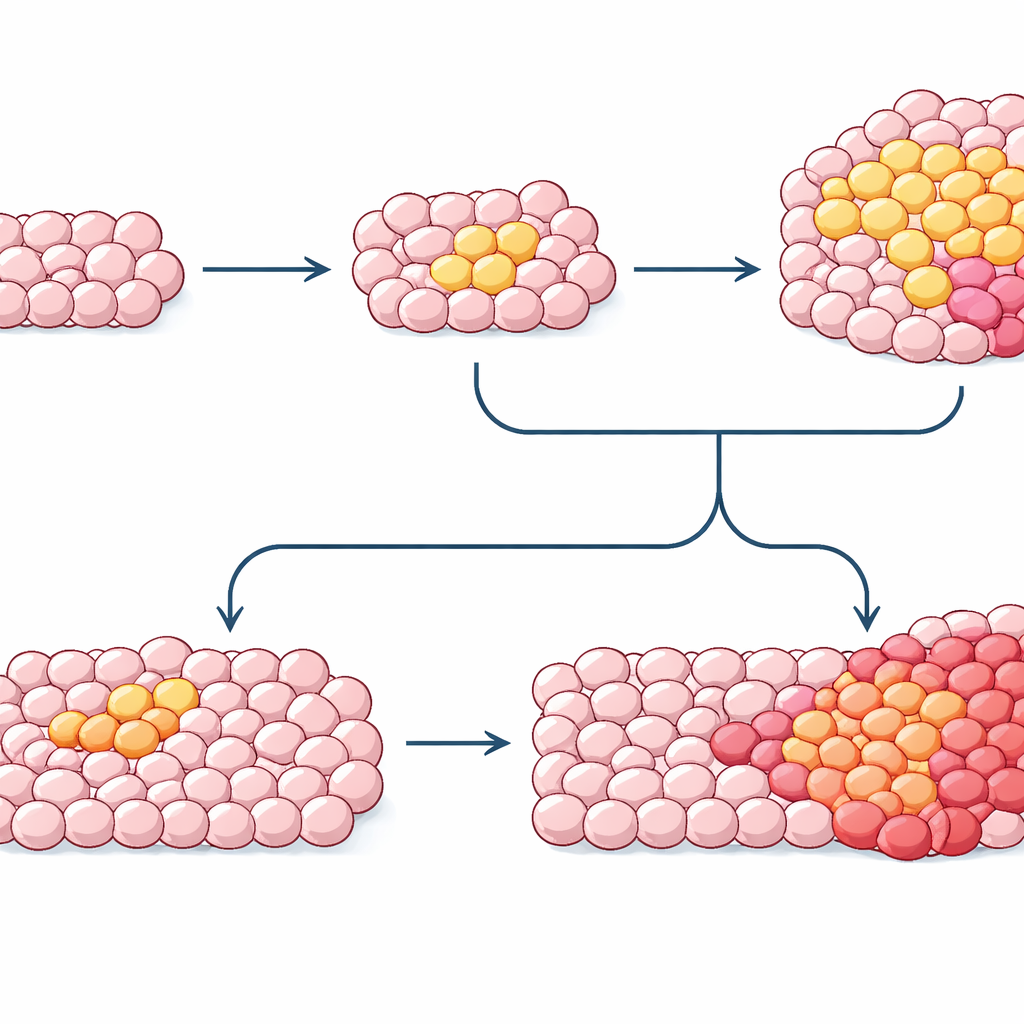
What This Means for Everyday Health
This article shows that cancer is not a sudden event but the end point of a long, mostly silent evolutionary process happening inside normal tissues. Our cells are constantly changing, shaped by age, genes and environment, and many carry mutations long before any illness appears. By learning which kinds of clonal growth are dangerous, which are harmless or even protective and how lifestyle or inherited factors tilt the balance, scientists hope to design smarter screening, tailor risk estimates and develop ways to steer cellular evolution away from cancer.
Citation: Yoshida, K. Somatic mutations and clonal evolution in normal tissues and cancer development. Exp Mol Med 58, 961–969 (2026). https://doi.org/10.1038/s12276-025-01592-0
Keywords: somatic mutations, clonal evolution, normal tissues, cancer risk, early carcinogenesis