Clear Sky Science · en
Children’s participation in Bush School: insights into parental understanding and support for nature play
Why muddy play matters for families
Many parents want their children to spend more time outdoors, yet busy schedules, safety worries, and screen time often keep kids inside. This study follows a group of six and seven year olds in Sydney, Australia, who took part in a weekly “Bush School” program: two hours of unstructured play in nearby bushland during the school day. Instead of only asking how parents shape children’s play, the researchers flipped the question to explore how children’s joyful, messy experiences in nature can in turn reshape what parents think about play, learning, and risk.
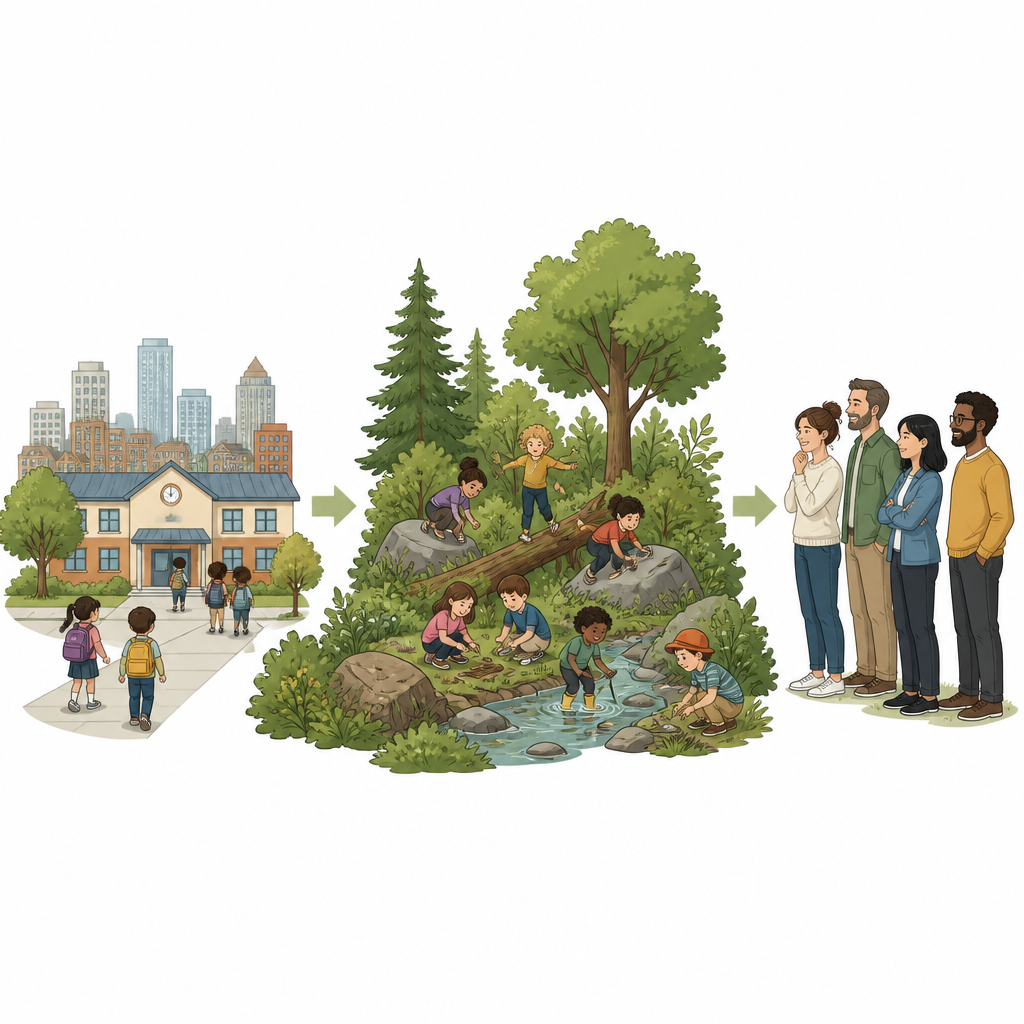
School in the bush, not just in the classroom
Bush School moved one morning a week out of the classroom and into a semi wild setting with rocks, trees, and open space. Under the guidance of outdoor educators and classroom teachers, children climbed, built cubbies, played in mud kitchens, went on short bushwalks, crafted with natural materials, and gathered in circles to talk and reflect. The sessions were deliberately light on formal lessons and heavy on child led exploration and imagination. Parents did not attend, but a series of surveys before and after the ten week program captured their views about nature, play, school, and safety, alongside their observations of changes in their children.
What parents noticed in their children
Before Bush School, most parents already believed that play and time in nature were good for children. After the program, many felt these beliefs had been confirmed and deepened by what they saw at home. Nearly all reported that Bush School days became their child’s favourite school days. Parents described their children as more creative in their games, more willing to explore outside, more talkative about their school experiences, and often calmer or more content during family bushwalks. Some noticed new friendships forming and an overall lift in enthusiasm for school, especially for children who found it hard to sit still during regular lessons.
Seeing benefits and rethinking risk
Spending regular time in the bush helped parents see nature play as different from a standard playground visit. They highlighted the freedom and variety of natural spaces: loose branches to move, changing weather, uneven ground, and abundant sensory experiences. Parents linked these features to gains in confidence, problem solving, physical skills, and resilience. While many still saw nature play as somewhat riskier because of falls, insects, or rough surfaces, almost all felt the benefits outweighed the bumps and scrapes. Several said their own comfort with “risky play” grew as they watched their children learn to judge what felt safe, stretch their limits, and recover from minor mishaps.
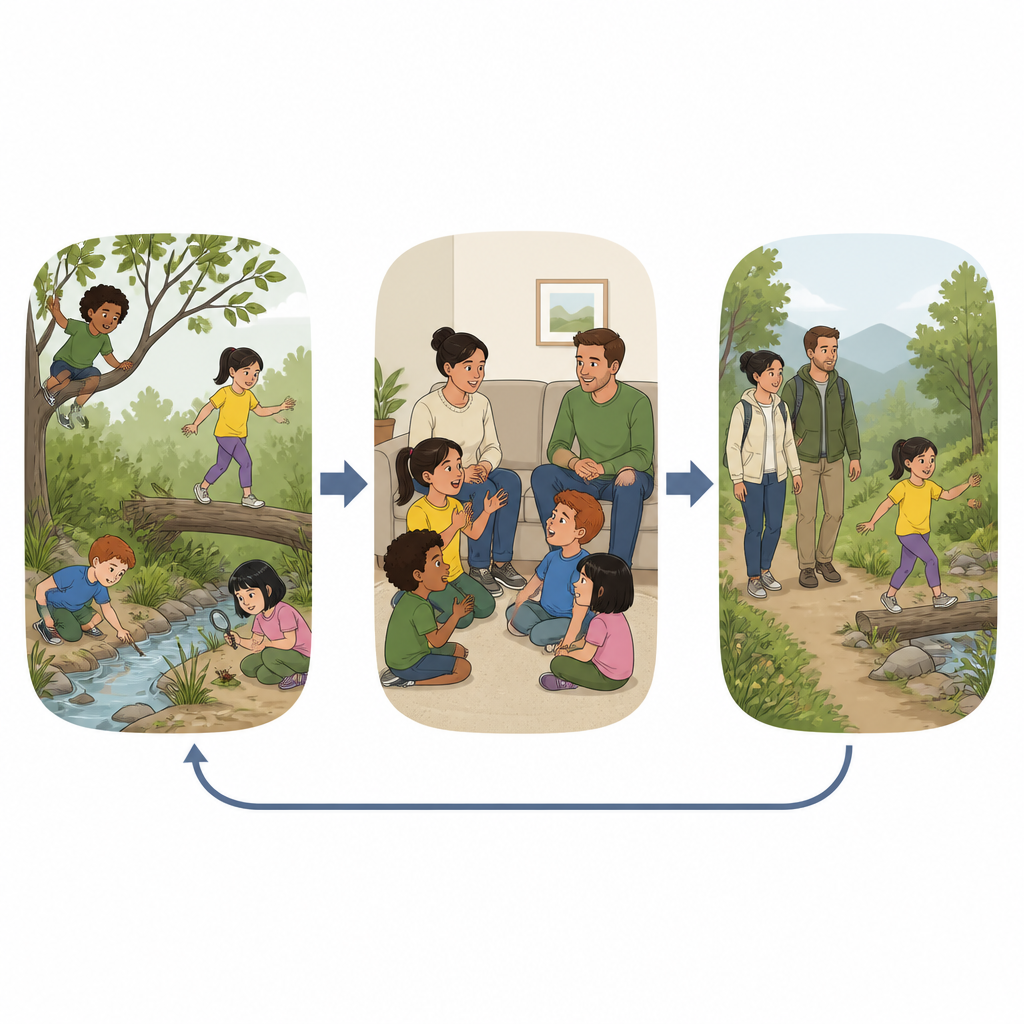
From children’s stories to family habits
Children did not leave their bush adventures at the school gate. They brought stories, questions, and new interests home, often becoming the family’s guide to the natural world. Parents reported that bushwalks and outdoor trips became more frequent, and that children were more eager to notice birds, plants, soils, and small creatures. Some families even visited the Bush School site on weekends so children could proudly show their parents around. In these moments, the usual roles shifted: children became sources of knowledge and enthusiasm, and parents followed their lead, which subtly changed how families talked about and used nearby natural places.
Rethinking what school can be
As parents watched the ripple effects of Bush School, many began to see nature play not as a “nice extra” but as a valuable part of primary schooling. They felt it supported school subjects like science and art, helped children reset between classroom tasks, and should be offered more widely, even made a regular feature for all students. The study was small and based in a relatively well resourced community, so its findings cannot be taken as universal. Still, it suggests that when schools make room for rich outdoor play, children can change not only themselves, but also how their parents understand learning, risk, and the importance of time spent in nature.
Citation: Harper, A., Gray, T. Children’s participation in Bush School: insights into parental understanding and support for nature play. Humanit Soc Sci Commun 13, 662 (2026). https://doi.org/10.1057/s41599-026-07010-8
Keywords: nature play, outdoor learning, parent attitudes, risky play, primary school