Clear Sky Science · en
A multi-scale perspective on the accessibility of public electric vehicle charging stations and community equity disparities
Why charging access matters for everyday life
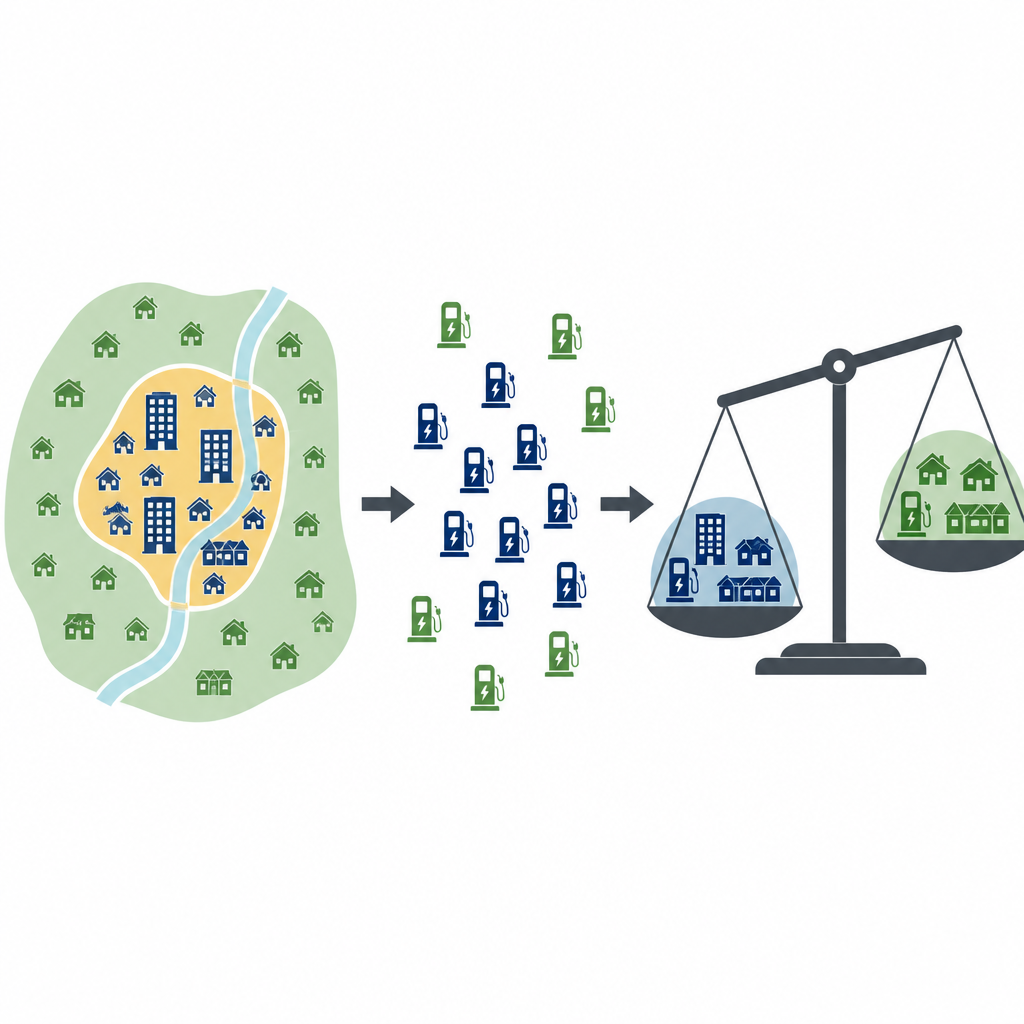
As electric cars become more common, a basic question arises: can people easily recharge them near where they live? This study looks at that question in the Chinese city of Chengdu, asking not only how many public charging stations exist, but also who can actually reach them. By treating charging as a public service, the authors show that decisions about where to put chargers can either reduce or deepen gaps between different neighborhoods.
Looking at the city from multiple viewpoints
The researchers focus on Chengdu’s central urban area, which they divide into older inner districts and newer outer districts. Using detailed data from digital maps and real estate listings, they map more than 800 public charging stations and nearly 10,000 residential communities. They then examine three simple features of each community: how expensive the housing is, how many households live there, and when the buildings were constructed. This information allows them to explore who benefits most from the existing charging network.
Measuring how easy it is to reach a charger
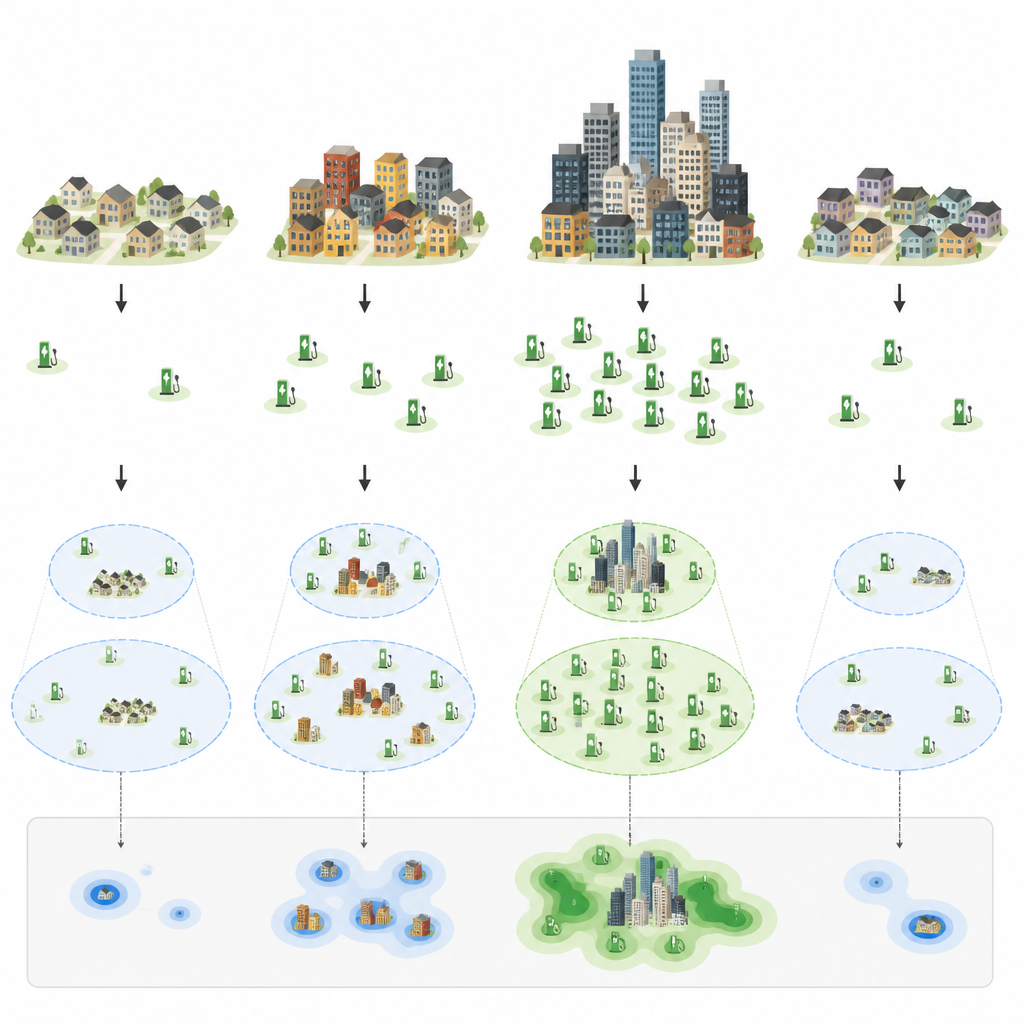
Instead of just counting chargers, the team asks how many real charging “opportunities” an average household has within a certain distance. They look at two everyday scales: 1 kilometer, which corresponds to a comfortable walking distance for routine charging near home, and 3 kilometers, which reflects a short car trip within the city. Their method accounts for the number and type of chargers at each station and how many nearby communities compete to use them. They then use spatial statistics to see where high and low access tends to cluster and how those patterns relate to community traits.
Uneven access between city center and outer districts
The maps reveal clear central clustering of both communities and charging stations, with denser development and more facilities in the inner districts. Yet even with this concentration, most residents across the study area have relatively low access to public chargers, with only scattered pockets of high accessibility. The outer districts show stronger clusters of both well served and poorly served neighborhoods, while the inner districts look more even. When the authors compare access with housing prices, population size, and building age, they find that outer districts, especially large and fast growing communities, often lag behind in convenient charging options.
Who gains and who is left behind
A striking result is that higher housing prices do not automatically bring better public charging access. In fact, at the citywide level, communities with higher prices or larger populations often have fewer average charging opportunities, especially when looking at the broader 3 kilometer range. Newer developments tend to have better access at short range, likely because building rules have recently required charging facilities, while older areas can be harder and more expensive to retrofit. In some places, neighborhoods with lower housing costs end up closer to more public chargers, partly because land is cheaper for building stations there and some higher priced communities rely more on private parking chargers.
What this means for future city planning
By combining citywide, district level, and neighborhood level views, the study shows that simple targets like the total number of chargers are not enough. Planners need to ask where chargers are placed in relation to the people who will use them. The authors suggest tailoring policies: fine tuning and filling gaps in the older inner districts, while giving priority to fast growing, high demand but under served areas in the outer districts. They also propose using local access maps to flag zones that are doubly disadvantaged, where both community conditions and charging access are poor, so that public investment can be directed there first. In plain terms, the work argues that fair access to convenient charging should be part of how cities judge their shift to electric vehicles, helping ensure that the move to cleaner transport benefits residents across all types of neighborhoods.
Citation: Wang, C., Gu, Y. & Shen, J. A multi-scale perspective on the accessibility of public electric vehicle charging stations and community equity disparities. Humanit Soc Sci Commun 13, 650 (2026). https://doi.org/10.1057/s41599-026-06910-z
Keywords: electric vehicle charging, spatial equity, urban planning, infrastructure accessibility, Chengdu