Clear Sky Science · en
Government roles in legalizing China’s digital business environment: evidence from Beijing, Shanghai, and Chongqing
Why the Rules Behind Online Business Matter
When you shop, bank, or start a company online, you mostly see screens and apps. Behind those screens, however, governments decide who can do business, how data are handled, and how quickly a new firm can open its doors. This article looks at how three major Chinese cities—Beijing, Shanghai, and Chongqing—are trying to build fair, efficient rules for digital business, and what that means for entrepreneurs, workers, and consumers in China and other developing countries.
How Digital Rules Shape Everyday Commerce
The study starts from a simple idea: a good “digital business environment” is as important to an economy as roads and ports. It includes how easy it is to register a company online, how safely data are handled, and whether disputes can be resolved in a predictable way. China, now a digital powerhouse, has been pushing to upgrade these rules so that markets can work more smoothly while the government still plays a guiding role. International scorecards like the World Bank’s B-READY program measure such conditions, but they do not fully capture how China’s own institutions operate. This research fills that gap by examining how local governments actually design and apply digital-era rules on the ground.
Four Faces of Government in the Online Economy
To make sense of a complex policy world, the author breaks government action into four main roles. First, local authorities act as rule makers, writing policies on data use, online registration, and market access. Second, they serve as coordinators, trying to get tax offices, market regulators, and technology departments to share information instead of forcing firms to repeat the same paperwork. Third, they are service providers, building “one-stop” online portals and digital infrastructure that businesses can use directly. Finally, they operate as evaluators, collecting feedback and statistics—such as how many days it takes to start a business—to see whether reforms are working and where they fall short.
Three Cities, Three Pathways
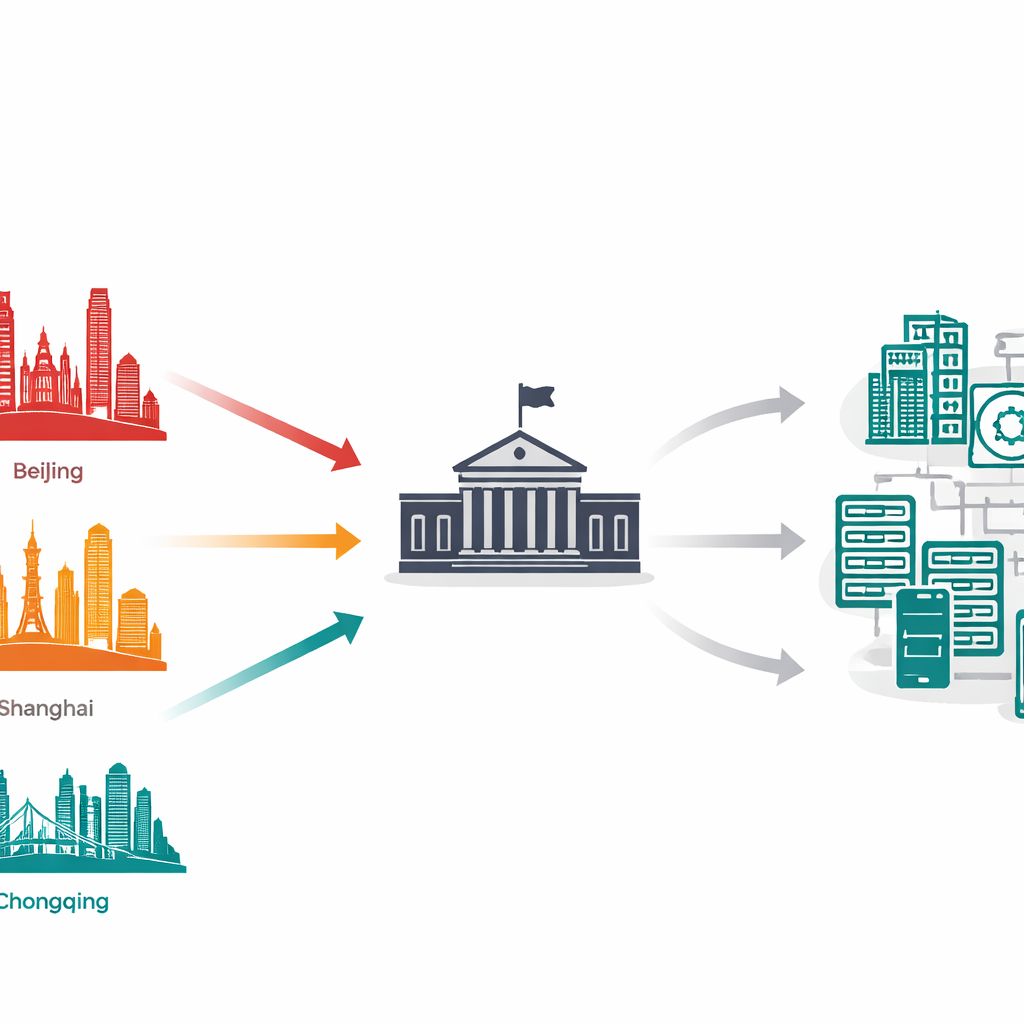
Through in-depth interviews with key officials in Beijing, Shanghai, and Chongqing, the study shows that these shared roles play out differently from place to place. Beijing leans on its position as the political and tech center to move quickly on formal rules, such as local data regulations, and has sharply cut the time needed to start a business through integrated online services. Shanghai uses its status as a global financial hub to experiment with tools like “regulatory sandboxes,” where new digital finance products can be tested under close but flexible oversight, and an “enterprise cloud” that bundles government and support services for firms. Chongqing, a large inland municipality, has focused first on basic digital infrastructure, streamlined registration, and broad policy packages to catch up with the coastal frontrunners while dealing with tougher challenges in funding, connectivity, and talent.

What the Interviews Reveal About Progress and Gaps
The officials interviewed describe both achievements and sticking points. Across the three cities, approval steps have been simplified and average start-up times have dropped to a few days, sometimes even one day. Yet deeper issues remain. In Beijing, fragmented approval chains and uneven legal protections in areas like bankruptcy still frustrate businesses. In Shanghai, front-line service quality and truly seamless cross-border digital trade are hard to guarantee. Chongqing struggles with uneven infrastructure, fewer high-skilled workers, and later adoption of advanced digital tools. The study also notes that most of the evidence comes from the government side; systematic feedback from firms themselves and detailed quantitative tests of reform impact are still limited.
Why This Matters for Businesses and Other Countries
For entrepreneurs choosing where to set up shop, the findings translate into concrete trade-offs. Beijing and Shanghai offer more mature legal safeguards and sophisticated services, which suit firms that depend heavily on predictable rules and complex data operations. Chongqing and similar cities can offer lower costs and more room for experimentation, but with thinner support systems. For policymakers in developing countries, the Chinese cases highlight that building a healthy digital business climate is not just about buying technology. It requires clear laws, coordinated agencies, user-friendly online services, and honest evaluation of what works. The overall conclusion is that China has made real strides toward faster, more transparent digital commerce, but still needs to improve legal clarity, cross-border rule alignment, and support for less-developed regions so that the benefits of the digital economy can be shared more widely.
Citation: Li, Y. Government roles in legalizing China’s digital business environment: evidence from Beijing, Shanghai, and Chongqing. Humanit Soc Sci Commun 13, 552 (2026). https://doi.org/10.1057/s41599-026-06811-1
Keywords: digital business environment, China governance, Beijing Shanghai Chongqing, digital economy policy, business regulation