Clear Sky Science · en
Cost-effectiveness of statins, berberine, and combination for primary cardiovascular disease prevention in Scotland
Why this matters for everyday health
Heart disease and stroke remain leading killers, but many people now take daily pills for years to lower their risk. This study asks a simple but important question: which options give the best health benefits for the money spent? Focusing on adults in Scotland, the researchers compared standard cholesterol-lowering drugs called statins with a plant-derived supplement, berberine, and with treatments that combine the two.
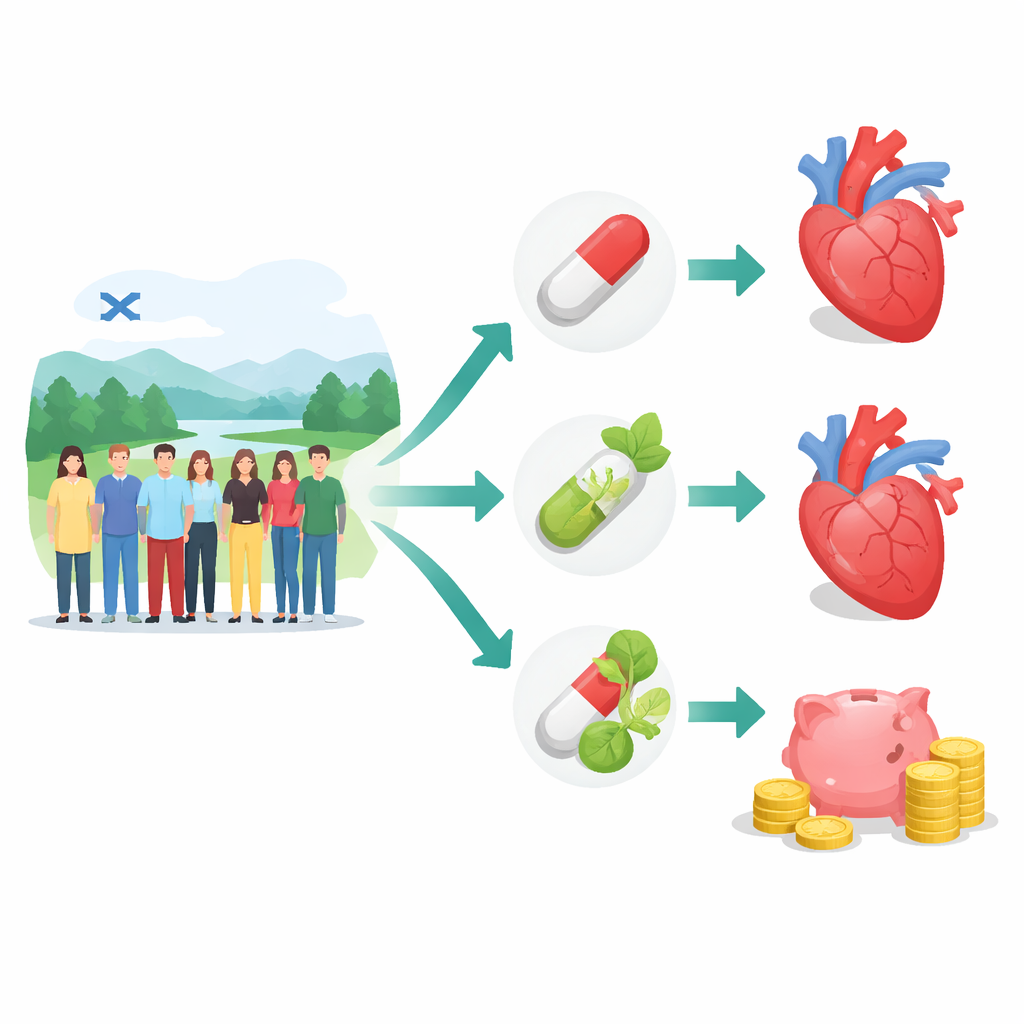
Different paths to protect the heart
The team looked at people aged 40 and over who had not yet had a heart attack or stroke but were at raised risk based on a widely used score that considers age, blood pressure, cholesterol, smoking, and social deprivation. They examined two risk cutoffs: people with at least a 20% chance of having a major heart or stroke event in 10 years, and a broader group with at least a 10% chance. For each group, they compared five choices: no preventive treatment, statins alone, berberine alone, and two combination options mixing a statin with different doses of berberine.
Following people’s health and costs over a lifetime
Instead of running a new clinical trial, the researchers used an established computer model built from long-term Scottish health surveys and hospital records. This model can “follow” thousands of virtual individuals over their remaining lives. It tracks who goes on to develop heart disease, stroke, or diabetes, how long people live, their quality of life, and how much care they use. By feeding in how strongly statins and berberine lower harmful blood fats, and how they influence diabetes risk, the model can estimate how many future heart problems are avoided and at what total cost to the Scottish health service.
Which options give the most health for the money?
All active treatments clearly beat doing nothing when judged against a standard benchmark used in the UK: spending up to £20,000 for each extra year of life in good health. In both risk groups, statins alone prevented the most events for the lowest cost, making them the best-value choice overall in today’s Scottish prices. Berberine by itself did improve cholesterol and reduced diabetes risk, but in the Scottish setting it cost more and delivered fewer gains than statins, so it was judged less cost-effective. The two combination approaches prevented even more heart and stroke events than statins alone, at higher overall costs that still fell within acceptable value-for-money ranges.
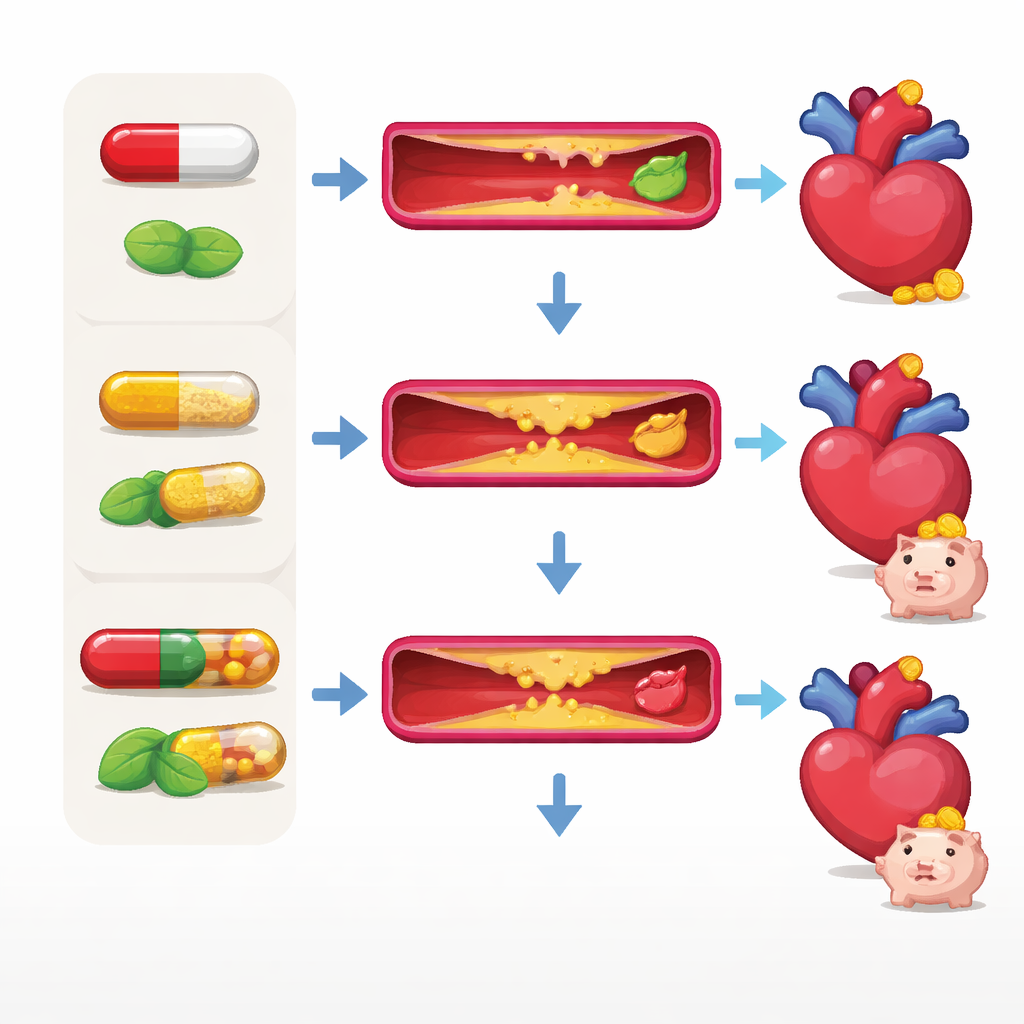
Price tags can flip the story
A key twist in the analysis was what happens if berberine is much cheaper. In Scotland, berberine is sold as an uncovered supplement, often imported, and is pricier than generic statins. In China, by contrast, it is widely used, produced locally, and much cheaper. When the model was re-run using Chinese drug prices, every strategy involving berberine—either alone or in combination—became more cost-effective than statins alone. This highlights how the same treatment can look like poor value in one country and excellent value in another, simply because the price changes.
Strengths, gaps, and what comes next
This work stands out for looking not only at pills but at long-term outcomes, including side effects like diabetes and the full lifetime costs of hospital care. It also tested uncertainty in many assumptions, repeatedly re-simulating the future under slightly different conditions. In nearly all of these runs, each active strategy still offered good value compared with no treatment. However, there are caveats: data on berberine and especially on combined therapy mostly come from relatively small trials, many done in China rather than Scotland, and there are not yet large studies directly tracking whether berberine users have fewer heart attacks and strokes.
What this means for patients and policy
For people in Scotland at higher risk of cardiovascular disease, the study supports current practice that statins remain the best-value first choice for preventing a first heart attack or stroke. Berberine emerges as a promising option for those who cannot tolerate statins or prefer a plant-based approach, but in Scotland its current price makes it a less efficient use of health service funds than statins. Where berberine is cheaper, or if its price falls—for example through local production or insurance coverage—it could become not just an alternative, but in some cases a better-value option, especially when combined with statins. In short, the research suggests that several routes can lead to fewer heart problems; which one is “best” depends not only on biology, but also on how much society is willing to pay and how medicines are priced.
Citation: Xia, Y., Leung, K. & Zhao, J.V. Cost-effectiveness of statins, berberine, and combination for primary cardiovascular disease prevention in Scotland. npj Cardiovasc Health 3, 22 (2026). https://doi.org/10.1038/s44325-026-00121-w
Keywords: cardiovascular disease prevention, statins, berberine, cost-effectiveness, cholesterol