Clear Sky Science · en
Collapse of the Atlantic meridional overturning circulation would lead to substantial oceanic carbon release and additional global warming
Why This Ocean Story Matters
Many climate warnings focus on rising temperatures and melting ice, but deep beneath the surface, a giant ocean conveyor belt quietly helps stabilize our climate. This study explores what could happen if that conveyor in the Atlantic Ocean were to break down. The authors find that such a collapse would not only reshape regional temperatures by many degrees, but also unleash stored carbon from the ocean, adding extra long‑term warming on top of human‑driven climate change.

A Planet-Sized Ocean Conveyor
The Atlantic Meridional Overturning Circulation, or AMOC, is a vast system of currents that carries warm surface water northward and returns cold, dense water southward at depth. It helps keep northwestern Europe mild and influences weather patterns worldwide. Scientists worry that growing freshwater input from rainfall, rivers, and melting ice could weaken this circulation. Past climate records suggest that sharp AMOC shifts have coincided with abrupt climate swings, but the consequences for today’s warmer, high‑carbon world are still uncertain.
Testing a Climate Tipping Point
To probe this risk, the researchers used a fast but comprehensive Earth system model called CLIMBER‑X. They first let the simulated climate settle into long‑term balance at different carbon dioxide levels—from pre‑industrial conditions up to more than double that value. Then they added large pulses of freshwater to the North Atlantic to force the AMOC to shut down, and watched how temperatures and the carbon cycle evolved over thousands of years. By running three versions of the model—one with full land and ocean biology, one with only the ocean’s carbon, and one with fixed atmospheric carbon—they could disentangle physical cooling from carbon‑driven warming.
A Colder North, a Hotter South
When the circulation collapsed, the planet did not simply cool. Heat transport to the northern North Atlantic dropped sharply, producing strong cooling there and around the Arctic—about 7 degrees Celsius in the far north in the long‑term simulations. Expanding sea ice reflected more sunlight, reinforcing the chill. At the same time, the Southern Hemisphere warmed, especially around Antarctica, where temperatures eventually rose by roughly 6 degrees. Combined with ongoing greenhouse warming in a medium‑high carbon world, some parts of the Southern Ocean ended up more than 10 degrees warmer than in pre‑industrial times, even as the North Atlantic stayed markedly cooler.
Hidden Carbon Rises to the Surface
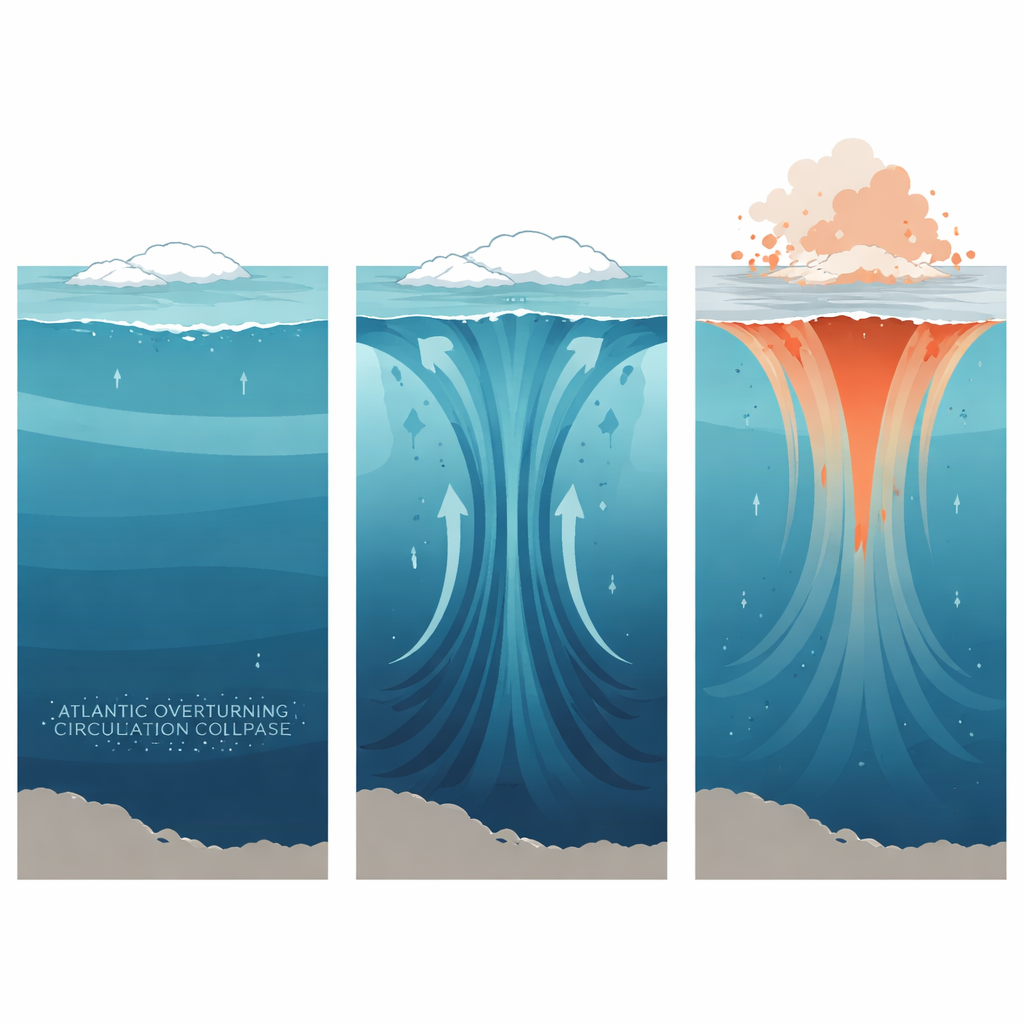
The most surprising outcome concerned carbon. Physically, the shutdown tended to cool the globe slightly. But the circulation change also reorganized how the ocean stores carbon. As the Atlantic conveyor stalled, deep mixing was triggered around Antarctica. This "uncorked" carbon‑rich deep waters, allowing large amounts of dissolved carbon to escape into the atmosphere. Depending on the background carbon dioxide level, atmospheric concentrations rose by about 47 to 83 parts per million in the fully interactive model—equivalent to adding 100 to 175 billion tons of carbon to the air. Land ecosystems absorbed some of this extra carbon, but not enough to cancel it, so the planet’s average temperature ultimately ended up about 0.2 degrees Celsius warmer than before the collapse.
What It Means for Our Future
In everyday terms, this work shows that an Atlantic circulation collapse would be a double‑edged shock: it would cool some northern regions sharply while driving powerful warming and carbon release in the south, nudging global temperatures even higher. Although such long‑term, fully realized changes might not unfold exactly as in the model, the study highlights a key risk. The deep ocean, often seen as a quiet repository for our emissions, could become a source of additional greenhouse gas if a major circulation tipping point is crossed, amplifying climate change rather than buffering it.
Citation: Nian, D., Willeit, M., Wunderling, N. et al. Collapse of the Atlantic meridional overturning circulation would lead to substantial oceanic carbon release and additional global warming. Commun Earth Environ 7, 295 (2026). https://doi.org/10.1038/s43247-026-03427-w
Keywords: Atlantic overturning circulation, ocean carbon release, climate tipping points, Southern Ocean warming, global warming