Clear Sky Science · en
Global warming increases ammonia emissions and reduces the efficacy of mitigation actions
Why warmer farms matter for our air
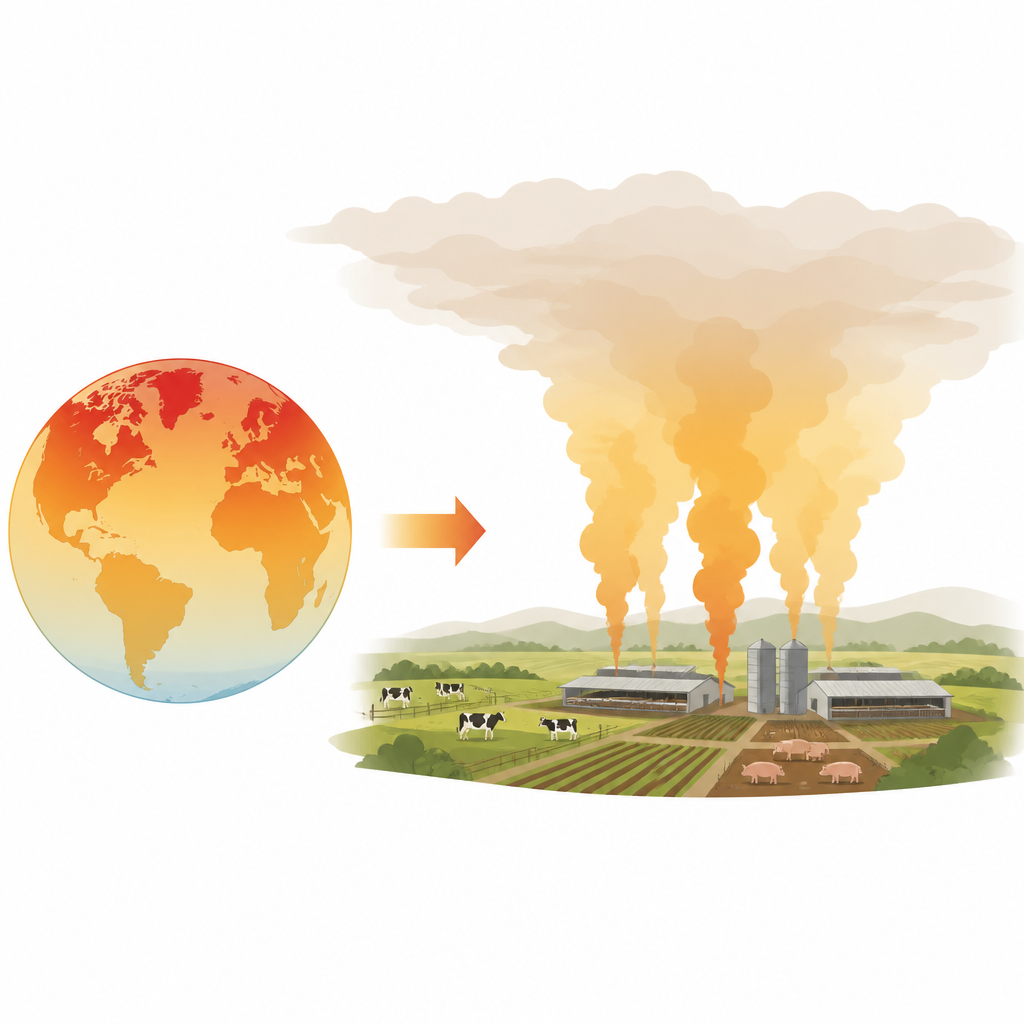
Most people rarely think about ammonia, yet this invisible gas from farms can cloud the air we breathe, damage wild plants, and quietly waste billions of dollars’ worth of fertilizer. This study asks a simple but pressing question: as the planet warms, will ammonia pollution from global agriculture get worse, and will today’s cleanup plans still work as expected?
How farms leak a hidden gas
Agriculture is by far the main source of ammonia in the air, driven by livestock manure and synthetic fertilizers. When cows, pigs and other animals excrete nitrogen, and when fertilizer is spread on fields, part of that nitrogen escapes as ammonia gas. Once airborne, it helps form tiny particles that harm human health and reduce visibility, and later falls back to the ground where it can stress sensitive plants and erode biodiversity. At the same time, every bit of ammonia that escapes is lost fertilizer, reducing how efficiently farms use precious nitrogen resources.
Why heat turns up ammonia loss
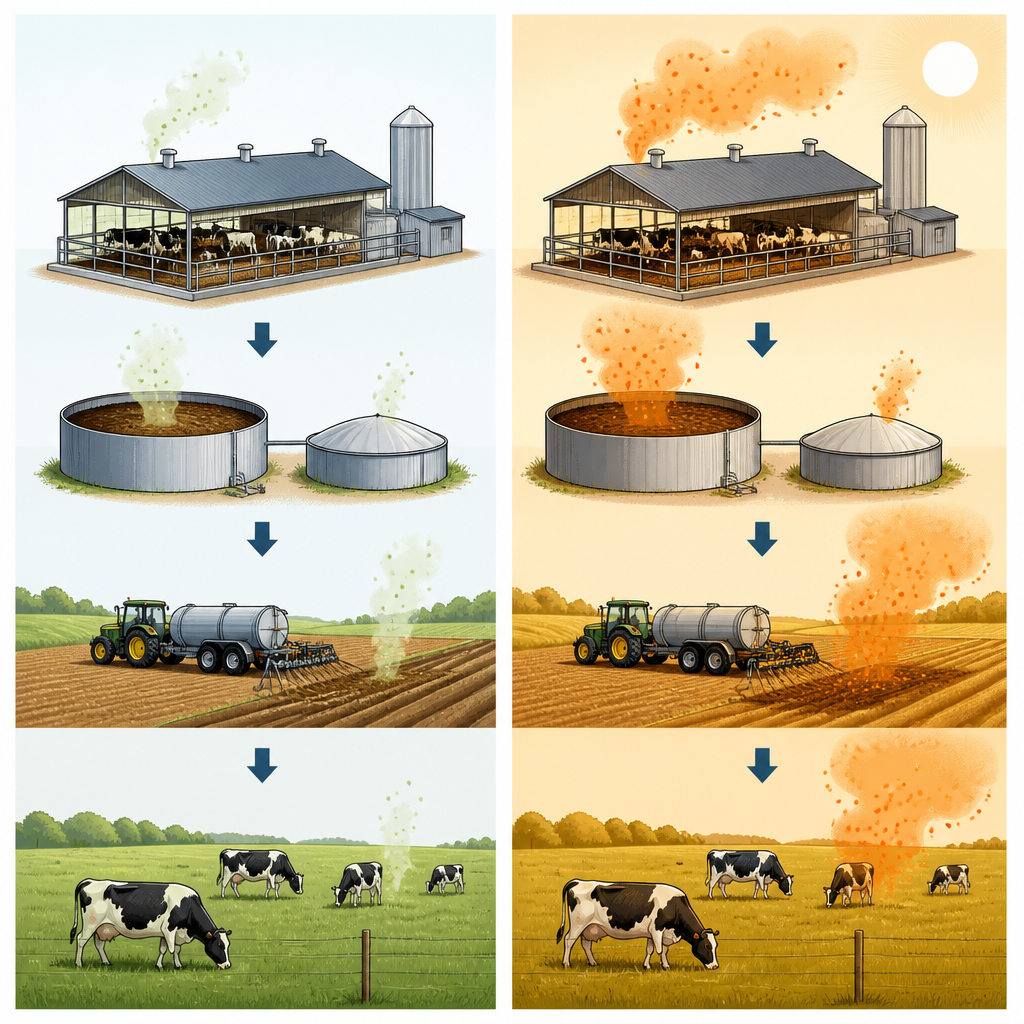
Ammonia is especially responsive to temperature. Simple chemistry suggests that, all else equal, emissions can roughly double with every few degrees of warming. But real farms are more complicated, with many interacting steps from animal housing to manure storage and field spreading. To capture this complexity, the authors use a detailed computer model called AMCLIM that tracks nitrogen flows through both crop and livestock systems worldwide. The model accounts for local climate, soil, animal housing, manure handling and fertilizer practices, and then simulates how much nitrogen escapes as ammonia under different temperatures.
What the model says about a warmer world
The simulations estimate that agriculture released about 45 million tons of nitrogen as ammonia in 2010, with roughly two thirds coming from livestock and one third from synthetic fertilizer. Emissions are highest in South and East Asia, Europe, North and South America, with hotspots in the North China Plain, northern India, Pakistan, parts of the eastern United States and the Netherlands. On average, the study finds that each 1 °C of global warming boosts agricultural ammonia emissions by about 3 to 4 percent, though the response varies by region and by stage in the farm system. Cold regions show strong sensitivity because warming unlocks more evaporation, while in already hot areas much of the easy-to-lose nitrogen has already been stripped away.
Climate stress on cleanup efforts
The team then tests a package of six straightforward measures often recommended to curb ammonia: slightly lower fertilizer doses, better placement of fertilizer and manure into soil, improved animal feeding to reduce waste, smaller emitting surfaces in animal houses, and covered storage for manure. Under today’s climate this bundle could cut global agricultural ammonia emissions by about 31 percent. But when future warming is added using standard climate scenarios, that same package delivers less benefit. By the late 21st century, projected warming alone raises emissions by 5 to 22 percent, depending on how strongly greenhouse gases are controlled. As a result, the global reduction achievable by the six measures shrinks to between 16 and 28 percent, with effectiveness in some regions, such as South America, falling close to zero.
What this means for food and the environment
For non-specialists, the key message is that tackling ammonia pollution cannot be separated from tackling climate change. Warmer conditions make it easier for nitrogen to slip from farms into the air, partly cancelling out the gains from familiar management fixes. The study concludes that to protect air quality, ecosystems and fertilizer value, societies will need both stronger efforts to cut greenhouse gas emissions and more ambitious ammonia controls across the whole chain of animal housing, manure handling and fertilizer use. In other words, cleaner farming in the future will depend on cooler temperatures as well as smarter practices.
Citation: Jiang, J., Stevenson, D.S., Uwizeye, A. et al. Global warming increases ammonia emissions and reduces the efficacy of mitigation actions. Commun Earth Environ 7, 398 (2026). https://doi.org/10.1038/s43247-026-03404-3
Keywords: ammonia emissions, agriculture, climate warming, air quality, nitrogen pollution