Clear Sky Science · en
In-situ deep ocean monitoring reveals rapid kelp degradation limits marine biomass-based carbon sequestration potential and alters benthic ecosystems
Why Sinking Seaweed Caught Scientists’ Attention
As the world searches for ways to slow climate change, one seemingly simple idea has gained attention: grow vast amounts of seaweed, sink it to the deep ocean, and lock away its carbon for centuries. This study puts that idea to the test in the real ocean. By carefully watching kelp dumped on the deep seafloor for a year, the researchers ask two basic questions: how long does the kelp’s carbon really stay put, and what happens to the deep-sea life that suddenly finds itself buried in a feast?
Testing the Seaweed Shortcut to Carbon Storage
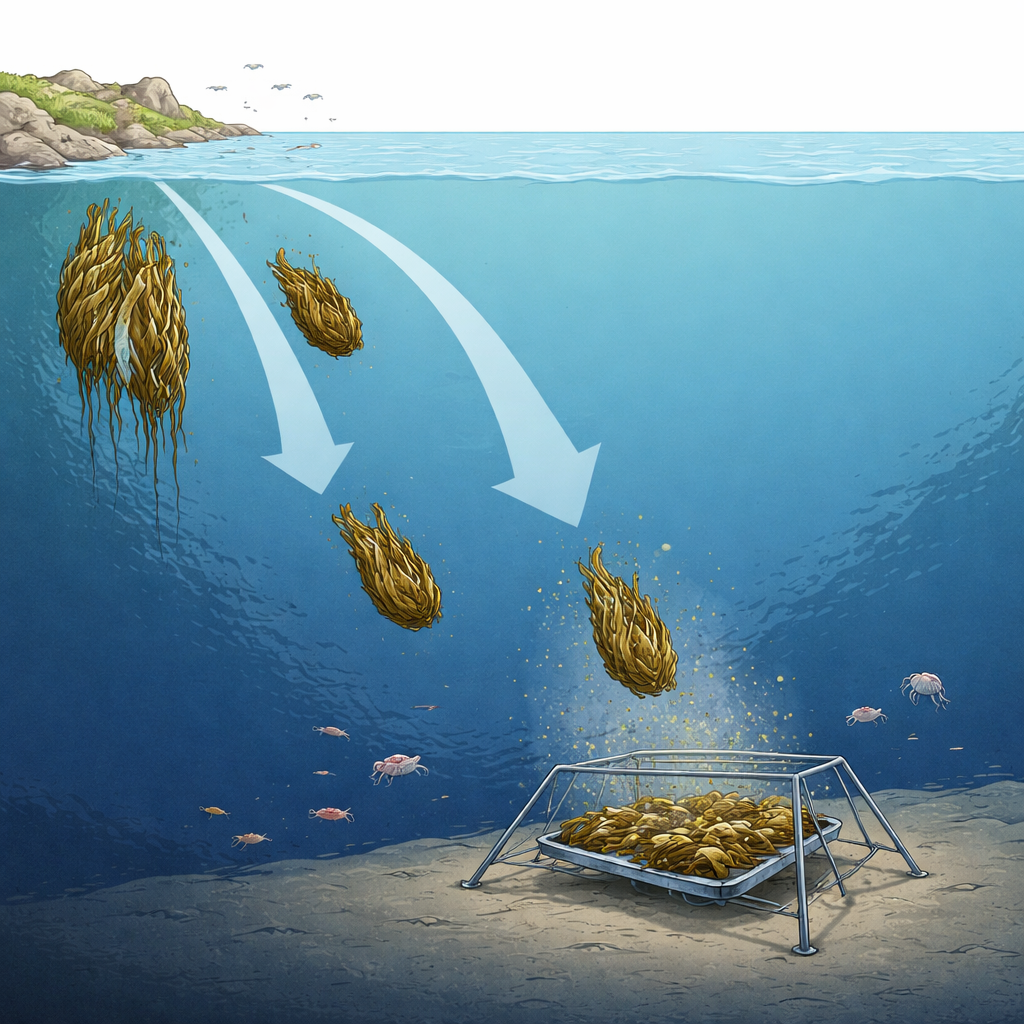
The oceans already soak up about a third of the carbon dioxide humans emit each year, and some researchers hope to boost that natural service by farming large seaweeds like kelp. The logic is straightforward: kelp grows quickly near the surface, pulling CO2 from the air via photosynthesis. If we then sink that kelp into the deep ocean, the carbon it contains might remain out of contact with the atmosphere for hundreds to thousands of years. But this promise relies on a key assumption—that the kelp largely stays intact on the seafloor instead of rapidly breaking down and returning as CO2. Until now, most evidence came from shallow, oxygen‑rich waters or from lab experiments, not from the dark, low‑oxygen depths where large-scale sinking would likely occur.
A Year-Long Experiment on the Deep Seafloor
To close this gap, the team deployed a custom metal frame—a benthic lander—at 1,255 meters depth off Vancouver Island, in a naturally low‑oxygen region known as an oxygen minimum zone. Inside the frame, trays held bundles of sugar kelp alongside bare “control” surfaces. A seafloor camera, powered and connected by an undersea cable, captured high‑resolution video for an entire year while nearby instruments recorded temperature, salinity, oxygen, and currents. By tracing how the visible area of kelp changed in each image, the scientists could reconstruct how quickly the biomass disappeared, and by identifying more than 5,000 individual animals on the videos, they could track how the local community responded to this sudden pulse of food.
Fast Decay and a Bustling Deep-Sea Feast
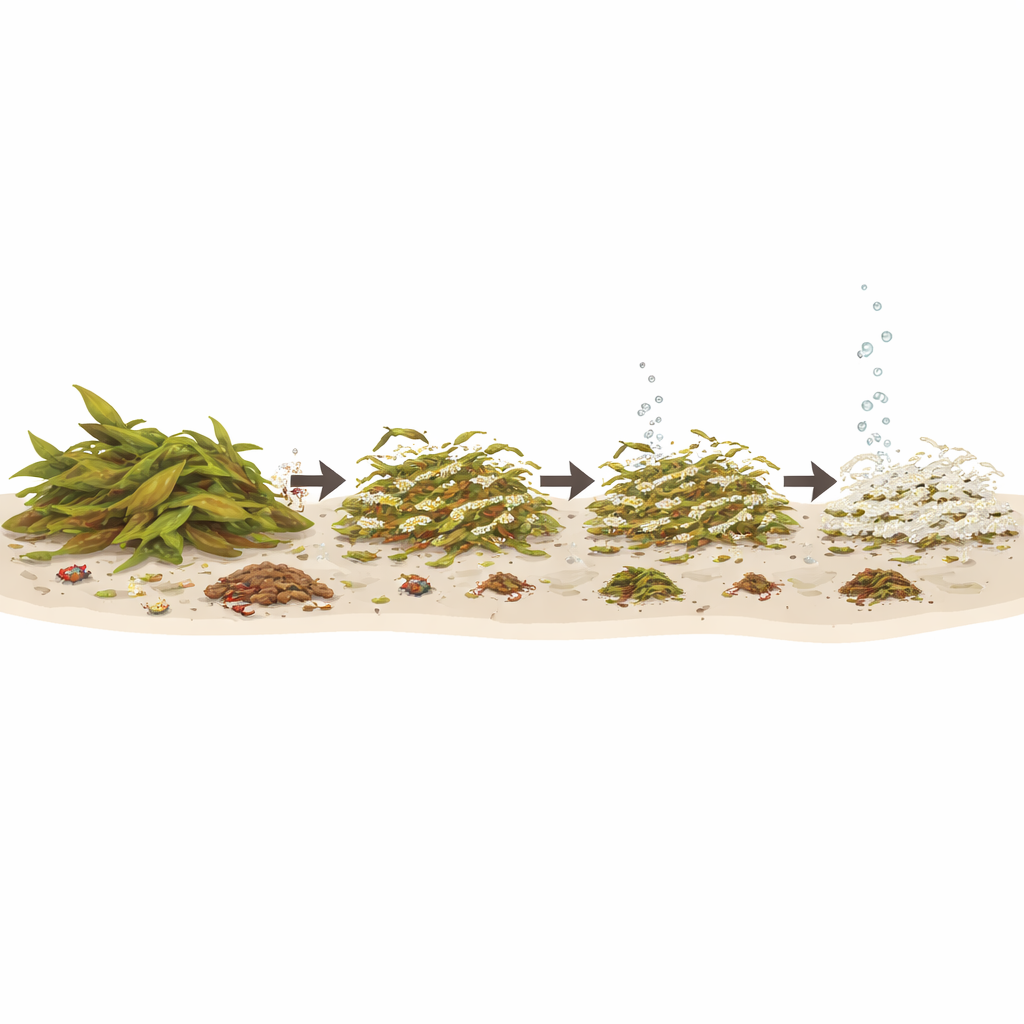
The images showed that the kelp did not linger. More than 90 percent of the visible kelp vanished in about 100 days, and essentially all of it disappeared within a year. The fastest loss coincided with a burst of microbial growth and a wave of scavengers and grazers—tiny amphipods, worms, and larger crabs—swarming the kelp piles. Even in the trays suspended above the seafloor, where contact with sediment microbes was reduced, the kelp broke down at similar rates, underscoring the efficiency of the local community at consuming this new food source under low‑oxygen conditions. The researchers infer that most of the kelp carbon was quickly transformed into dissolved and particulate forms and respired back into CO2, with only a small fraction potentially entering longer‑lived pools in sediments or deep waters.
Deep-Sea Neighborhoods Reshaped
The experiment also revealed that sinking kelp is not just a carbon problem—it is an ecosystem problem. Kelp trays attracted far more animals than nearby controls, especially small scavenging crustaceans. Over time, the mix of species on the kelp‑covered surfaces diverged from that on the bare ones, and some differences persisted even after the kelp had visually disappeared. Filmy white patches, interpreted as mats of sulfur‑using bacteria, formed on and around decomposing kelp, hinting at tiny pockets where oxygen was stripped away and more extreme chemical conditions developed. Although the overall deep‑water oxygen levels at the site remained stable, the study suggests that concentrated kelp deposits can create local hotspots of intense activity, altered chemistry, and shifting food webs.
What This Means for Using Kelp to Fight Climate Change
To a non‑specialist, the punchline is clear: in this deep Pacific test bed, kelp sank for carbon storage did not stick around for long. The biomass itself vanished in a few months, meaning that the long‑term fate of its carbon depends less on how fast it rots and more on how ocean currents move any resulting CO2 through the deep sea and eventually back to the surface. At the same time, even modest kelp inputs reshaped the local community and likely created small zones of low oxygen and unusual chemistry. The authors conclude that large‑scale seaweed sinking is unlikely to provide simple, risk‑free carbon storage in similar open‑ocean settings. Any serious attempt to use this approach will need careful, site‑specific monitoring and modeling—not only to count carbon, but also to guard against unintended damage to deep‑sea ecosystems.
Citation: Bauer, K.W., Correa, P.V.F., Lupin, A. et al. In-situ deep ocean monitoring reveals rapid kelp degradation limits marine biomass-based carbon sequestration potential and alters benthic ecosystems. Commun Earth Environ 7, 367 (2026). https://doi.org/10.1038/s43247-026-03342-0
Keywords: kelp carbon sequestration, deep-sea ecosystems, marine carbon dioxide removal, oxygen minimum zone, biomass degradation